Silverhill Attorney Jared Lyles Appointed to Fill Town Council Vacancy
The Silverhill Town Council unanimously appointed attorney Jared Lyles to the Place 3 seat vacated by new mayor Tim Wilson.
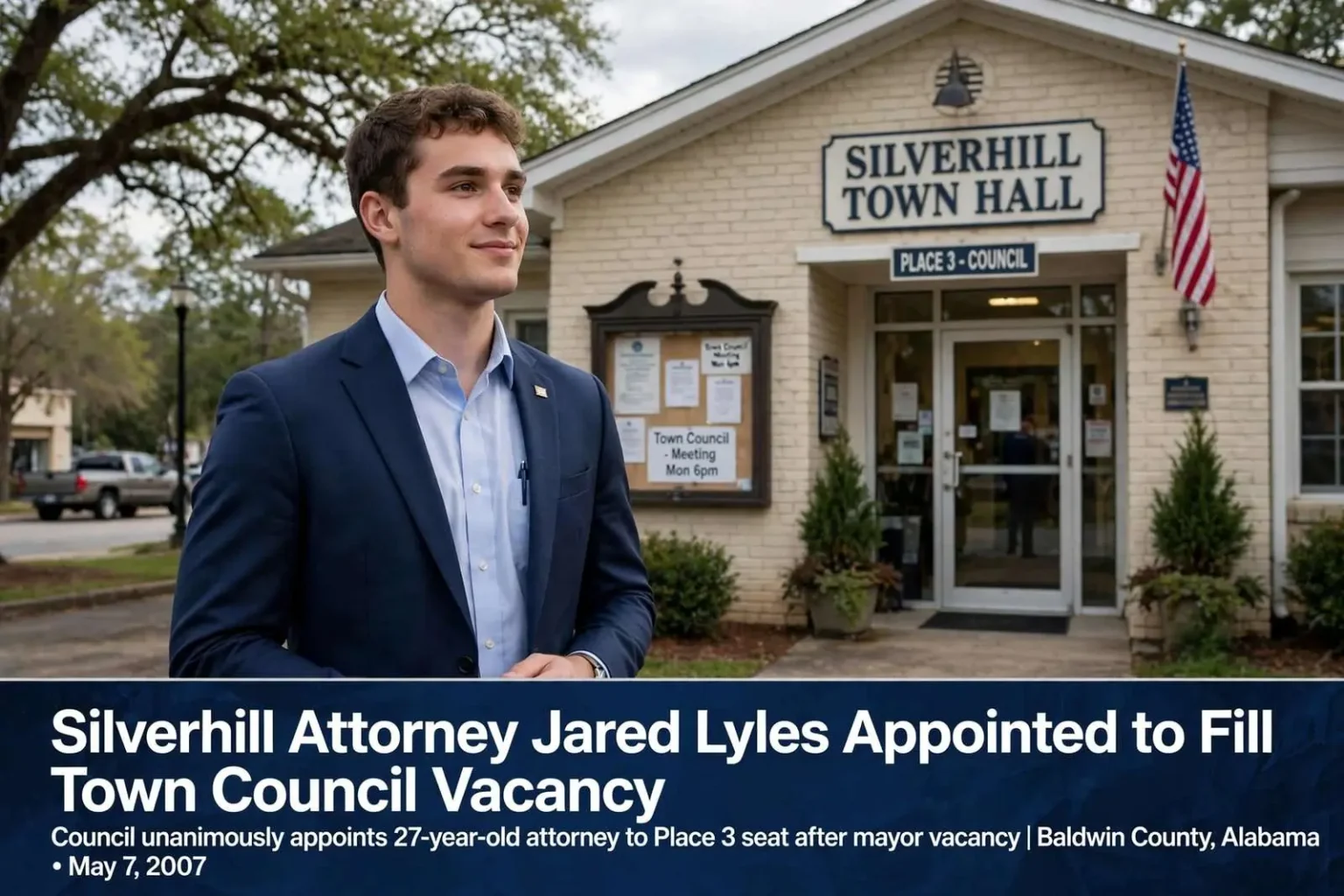
The Silverhill Town Council filled its last open seat, unanimously appointing local attorney Jared Lyles to the Place 3 position vacated when Tim Wilson stepped up to become mayor. Lyles, a 27-year-old Fairhope native who moved to Silverhill three years earlier, said he welcomed the chance to give back to a community that had been good to him and his law practice.
The appointment restores the council to a full complement after months of upheaval at town hall, and it hands a significant public role to one of the town’s newer residents. In a small Baldwin County municipality, a council seat touches nearly every function of daily government — streets, water service, police protection and the permit desk that residents and contractors deal with face to face.
A town in transition
The appointment capped a stretch of turnover at Silverhill’s town hall. Mayor Allen F. Green resigned in June 2006 citing health concerns. Frankie Kucera, the town’s mayor from 1976 to 1984, came out of retirement to fill the post that July but stepped down again the following March. Wilson — first elected to the council in 1992 and a former utilities department employee who also chairs the town’s Planning and Zoning Board — was appointed mayor at the May 7 meeting, opening the council seat Lyles now fills.
The sequence of departures left the town of a few hundred residents without an elected mayor twice in under a year, and the council’s ability to keep routine business moving through the churn reflects how small-town Alabama government actually operates. In municipalities of Silverhill’s size, the mayor and council members know one another personally, most of them hold other jobs, and the paid staff — a town clerk and a small utilities crew — carry the institutional memory that survives political turnover.
Council member Michael Allegri Jr. made the motion to appoint Lyles; the vote was unanimous, with member John Ullrich absent. The vote filled Place 3 and left the council one step from complete: choosing a mayor pro-tem to preside in the mayor’s absence. In towns without a full-time mayor, the pro-tem position is more than ceremonial — the designee chairs meetings when the mayor cannot attend and often functions as the council’s de facto vice mayor on day-to-day matters.
The new councilman
Lyles brings an unusual profile to a small-town council: a young attorney, native of Fairhope across the bay, who chose Silverhill as his home and built his practice there. His legal training is directly relevant to municipal work, where councils routinely wrestle with zoning language, ordinance amendments, contracts and the procedural requirements of Alabama’s open meetings and public records laws.
Small towns often struggle to recruit younger residents into public service, since the positions pay little or nothing and the workload — monthly meetings, phone calls from constituents, review of maintenance and budget questions — competes with careers and family obligations. A 27-year-old willing to take a council seat represents the kind of generational turnover that keeps small municipal governments alive as long-serving officials eventually step aside.
His appointment also reflects the town’s character as a bedroom community in central Baldwin County, where residents increasingly commute to jobs in larger towns along the Eastern Shore or in Mobile while keeping their civic lives rooted at home. Moving to town three years earlier and joining the council places Lyles in a position to learn the town’s systems early and grow into a longer role in its government if he chooses.
Routine business moves forward
The rest of Monday’s session was uneventful. The council amended its purchase order policy, tabled two measures and rejected another, and directed town clerk Bonnie McNeil to draft updated electric and plumbing permit fee schedules modeled on neighboring Summerdale’s rates for consideration June 4. Debris removal specifications were also reviewed, with final language expected at the next meeting.
Each of those items represents the ordinary machinery of a small Alabama town. A purchase order policy governs how employees commit town money — who may buy what, at what dollar threshold and with what documentation — and tightening such a policy is a common response to state audits, which examine small municipalities’ internal controls as closely as they do larger cities’. Brought-to-table measures typically need more information or an absent party; rejected measures simply end the matter, at least for the moment.
The permit fee schedules touch residents and contractors most directly. Electric and plumbing permits are how the town documents that work in homes and businesses meets code, and the fees attached to them fund the inspections and record-keeping behind that assurance. Benchmarking rates against Summerdale — a neighboring central Baldwin County town of similar size just to the south — is standard practice among small municipalities, which try to keep fees comparable to avoid making their town the expensive outlier for builders deciding where to work.
Debris removal specifications may sound like housekeeping, but in Baldwin County they carry real weight. The county has a long history of storm damage, from hurricanes that sweep in off the Gulf to the tornadoes that track across south Alabama, and after a major storm a small town’s ability to clear fallen trees and wreckage quickly depends on contracts and specifications written well in advance. Clear specifications also matter for FEMA reimbursement, which requires documentation that debris removal was performed according to established terms.
Spending on the chamber instead of an ad
Members declined to buy advertising in a newspaper publication, preferring to devote those dollars to the Central Baldwin Chamber of Commerce’s annual publication. The decision illustrates how a small town’s marketing budget works: a one-time advertisement competes against membership in a regional chamber whose directory, events and networking put the town’s name in front of the businesses and residents of the surrounding area all year.
The Central Baldwin Chamber serves the cluster of communities in the center of Baldwin County — Silverhill, Summerdale, Robertsdale, Loxley and their neighbors — an area that has grown steadily as the Eastern Shore’s expansion pushes inland. Chamber publications and events give member towns a shared platform, and for a town of Silverhill’s size, the chamber’s annual publication likely reaches more potential businesses and residents than any single newspaper insertion would.
For the town itself, the choice also signals continuity with its neighbors. Small municipalities in Baldwin County cooperate on everything from economic development to emergency planning, and supporting the regional chamber is one of the standard ways a town keeps its seat at the table.
Silverhill’s place in Baldwin County
Silverhill is one of the small towns that give central Baldwin County its character — a compact community with deep roots, founded more than a century ago by Swedish settlers who gave the town its distinctive name and heritage. Today it sits along the corridor between the interstate and the beaches, close enough to the Eastern Shore’s growth to feel its effects while retaining the scale of a place where a town council meeting still functions as the community’s civic center.
Towns like Silverhill face particular challenges in a fast-growing county. Baldwin County has been one of Alabama’s fastest-growing for years, and new residential development in the central part of the county puts pressure on small towns’ infrastructure — water systems, streets and police coverage designed for a smaller population. A council seat like Place 3, filled by a resident with an attorney’s eye for ordinances and contracts, is one of the tools a small town has for managing that growth deliberately rather than reactively.
The mayor’s chair Wilson now occupies adds to that continuity. His years on the council since 1992, his time in the utilities department and his chairmanship of the Planning and Zoning Board give him a working knowledge of the town’s physical systems and its land-use rules — the two areas where a growing small town most needs experienced leadership.
What comes next for the council
With Place 3 filled and a mayor pro-tem still to be chosen, the council can return its attention to the calendar: the June 4 consideration of the permit fee schedules, final language on debris removal specifications and the ordinary cycle of utility operations, street maintenance and budget oversight that fills most small-town agendas.
The state’s municipal framework shapes that work. Alabama’s smaller towns operate under the mayor-council form of government, with the council holding legislative power and the mayor presiding over meetings and handling day-to-day administration, subject to the council’s control of spending. In towns without a full-time mayor, that division requires cooperation — and a full council is the prerequisite for it.
For Silverhill’s residents, the practical takeaway from Monday’s meeting is stability. The council is whole again, the town’s clerk is preparing the permit work the building community asked for, and the town’s storm-readiness paperwork is being tightened. It is the kind of meeting that rarely makes headlines, and exactly the kind that keeps a small town running.