
South Alabama Film Festival Extended Its Entry Deadline Ahead of November’s Downtown Mobile Event
The 2010 South Alabama Film Festival extended its shorts, music video and student film deadlines ahead of its Nov. 5-7 run in downtown Mobile.
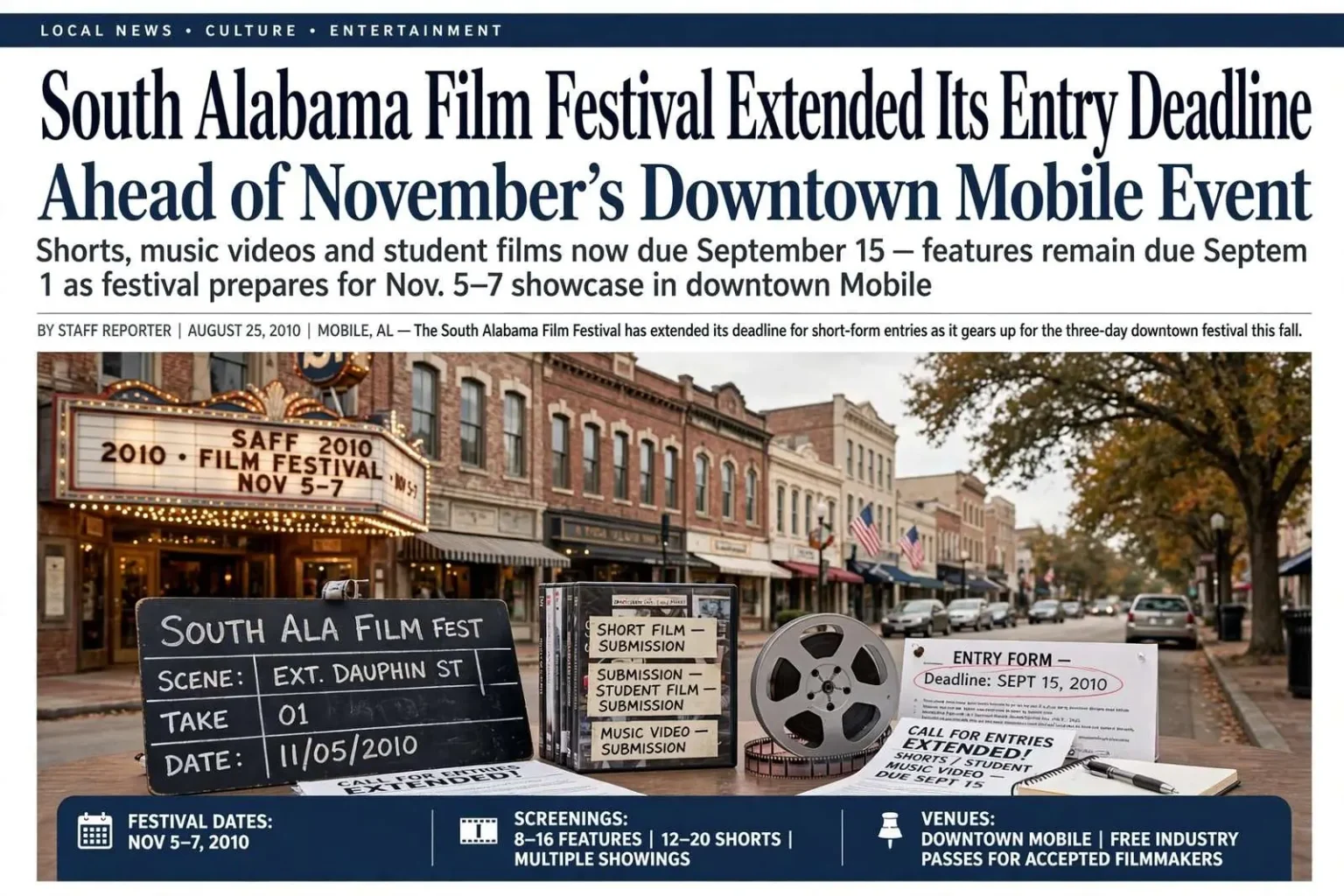
With the festival set for downtown Mobile on November 5-7, 2010, the South Alabama Film Festival gave filmmakers extra time: the deadline for shorts, music videos and student films moved to September 15, while the feature-film deadline stayed at September 1. The extension was aimed at the short-form entries that often arrive last — student projects, commissioned music videos and director’s cuts still in the color room — and it kept the window open for Gulf Coast filmmakers weighing whether their work would be ready by fall.
The festival, which programmed its screenings across venues in downtown Mobile, was positioning itself as a regional showcase in the tradition of the South’s growing circuit of city film festivals. The 2010 edition would unfold over three days in early November — Friday through Sunday, November 5-7 — a weekend slot that put the event in Mobile’s pleasant stretch of autumn, after summer heat and before the holiday calendar filled. For downtown, the festival brought an audience of filmmakers, crews and film-loving visitors into the city’s restaurants and hotels in what would otherwise be a quiet stretch between BayFest and the holidays.
What the Festival Wanted
Organizers were looking to program eight to sixteen feature-length films and twelve to twenty shorts, each screened multiple times across the three-day weekend. The repeat-screening model was a deliberate choice: instead of a film playing once to whoever could attend a single slot, each selection would show more than once across the three days, letting audiences build a schedule around work and school. It also multiplied the exposure for visiting filmmakers, whose work would be seen by more than one audience.
Both fiction and nonfiction were welcome, with special consideration for films made in or around Mobile, elsewhere in Alabama, or in the American South. The regional preference put the festival in line with the mission that has driven most Southern festivals since the film incentive era began — to give local stories and local crews a screen, and to build an audience for work made outside the industry’s coastal centers. Alabama’s film scene in 2010 was small but busy: the state had recently built out its incentive programs, Mobile’s historic districts had hosted period productions, and a generation of young filmmakers from the University of South Alabama and schools elsewhere in the state was producing shorts on newly affordable digital equipment.
Entries had to have been completed after December 1, 2007, and could not have been publicly screened in Mobile or Baldwin counties before the festival dates. The freshness rules served two purposes: they kept the lineup new, and they protected the festival’s own value proposition — a Mobile premiere — for the filmmakers who entered. The completion window of nearly three years gave the program access to a wide range of recent work while excluding catalog titles that had already circulated.
The fee schedule ran $30 for features, $20 for shorts, and $10 for student films and music videos, with a $5 discount for Alabama filmmakers showing current identification. The discount was a signal about the festival’s priorities: home-state filmmakers, who were most likely to attend in person and to build the event’s local following, paid less to enter. Student films and music videos carried the lowest fee of all, keeping the entry door open to teenagers, college students and bands making their first videos on borrowed cameras.
For working filmmakers, the economics of a festival entry are a calculation. A $30 feature fee is modest by industry standards — major festivals charge multiples of that — and the multiple screenings a small festival can offer are often worth more to an independent producer than the fee, since every additional screening builds word of mouth. The South Alabama Film Festival’s schedule of three-day, multi-showcase programming was built around that idea: a film that plays twice as often finds twice the audience.
The Fine Print
Selections were to be announced around September 20, giving accepted filmmakers a six-week runway to the November 5-7 event. The announcement date mattered practically — filmmakers who lived outside the region needed time to arrange travel, and local participants needed to clear their weekends. It also gave the festival’s organizers time to build the program schedule, arrange venues and start the publicity push that would determine whether the screenings drew audiences or empty seats.
Accepted films required two additional DVD copies for jury screenings and the archive, plus a press kit and an exhibition copy. The requirements were standard for the era’s festivals: a jury needed its own viewing copies to score the competition, the archive copy preserved the festival’s history, and the press kit — synopsis, stills, credits, filmmaker bios — fed the local coverage that made or broke a young festival’s visibility. In 2010, the DVD was still the universal exchange format; digital delivery would transform all of this within a few years, but for this festival’s third decade of planning, labeled DVDs in labeled mailers were the currency of the trade.
Filmmakers were encouraged to attend and take part in post-screening Q&A sessions, and every accepted film received free industry passes. The Q&A tradition is what turns a screening into a festival — audiences in Mobile would get to ask the director what the budget really was, or how a particular shot was achieved, and visiting filmmakers would leave with contacts and a sense of the region’s film community. Free passes for accepted filmmakers meant an entrant whose short was selected could spend the whole weekend watching the rest of the program and meeting the other entrants, which is where festivals earn their place in a region’s creative economy.
Submissions went by mail to the festival’s Post Office box in Mobile, with a labeled DVD, one-page description and application fee. The paperwork was simple by design. A one-page description kept organizers’ reading load manageable during selection, and the labeled-DVD requirement eliminated the mislabeled-disc problem that plagues festival offices every season. Organizers noted many entries had already arrived — but they wanted to see more, and the extended deadline was aimed squarely at the filmmakers who needed the reminder that September was closer than it looked.
The festival’s November dates placed it in a downtown that had grown into a reliable host for events of this kind. Mobile’s calendar by 2010 already included BayFest’s October music festival, Mardi Gras’s winter dominance and a calendar of art walks along Dauphin Street, and a film festival added a daytime, all-ages anchor to that lineup. A festival that screens features and shorts across three days fills restaurants and hotels at a slower, steadier pace than a one-night concert — and it plants seeds, since the filmmakers who attend come back with crews and projects if the experience is good.
The student and music video categories deserve particular note, because they are where regional festivals build their futures. A $10 entry fee is within reach of a high school media class or a college junior with a finished short, and the filmmakers who enter student categories go on to make the features that anchor festival lineups a decade later. By holding the shorts deadline open to September 15 — two weeks after features closed — organizers acknowledged the rhythm of student work, which tends to be finished at the start of a fall semester rather than in August. Music video directors, likewise, often finish projects on client schedules that do not respect festival calendars, and the extension gave them room to submit recent work.
The competition’s regional carve-outs also told the story of what the festival was for. Films made in or around Mobile, elsewhere in Alabama, or in the American South received special consideration, a preference that positions a festival as a builder of a regional cinema rather than a neutral clearinghouse. Southern independent film in 2010 was in a strong stretch — the region’s stories, accents and landscapes were drawing national attention, and festivals in smaller Southern cities were where much of that work first found screens. A Mobile festival that gave preference to Southern films was betting that local audiences would rather see work with roots in their own ZIP codes than a slate of out-of-town imports — and that Alabama filmmakers, given the platform, would fill the program.
The screening location itself carried weight. Downtown Mobile’s theaters and event venues put visiting filmmakers within walking distance of restaurants and hotels, and the November weekend gave the city a cultural draw in a season when convention traffic dips. Festivals of this scale — a dozen to thirty-odd films, one weekend, a handful of venues — run on volunteer labor and sponsor support, and their survival depends on the local film community showing up: not just to watch, but to submit. Every extra entry in September’s mail bin was a vote for the festival’s future, and the organizers’ closing note — many entries already arrived, but they wanted to see more — was both an encouragement and a status report from a young event building its program one labeled DVD at a time.