
Southern Voices at the Mobile Museum of Art spotlights Southern filmmakers
The Mobile Museum of Art presented Southern Voices, a filmmaker showcase curated by April Dobbins, on Aug. 10, 2017, with short films and a Q&A.
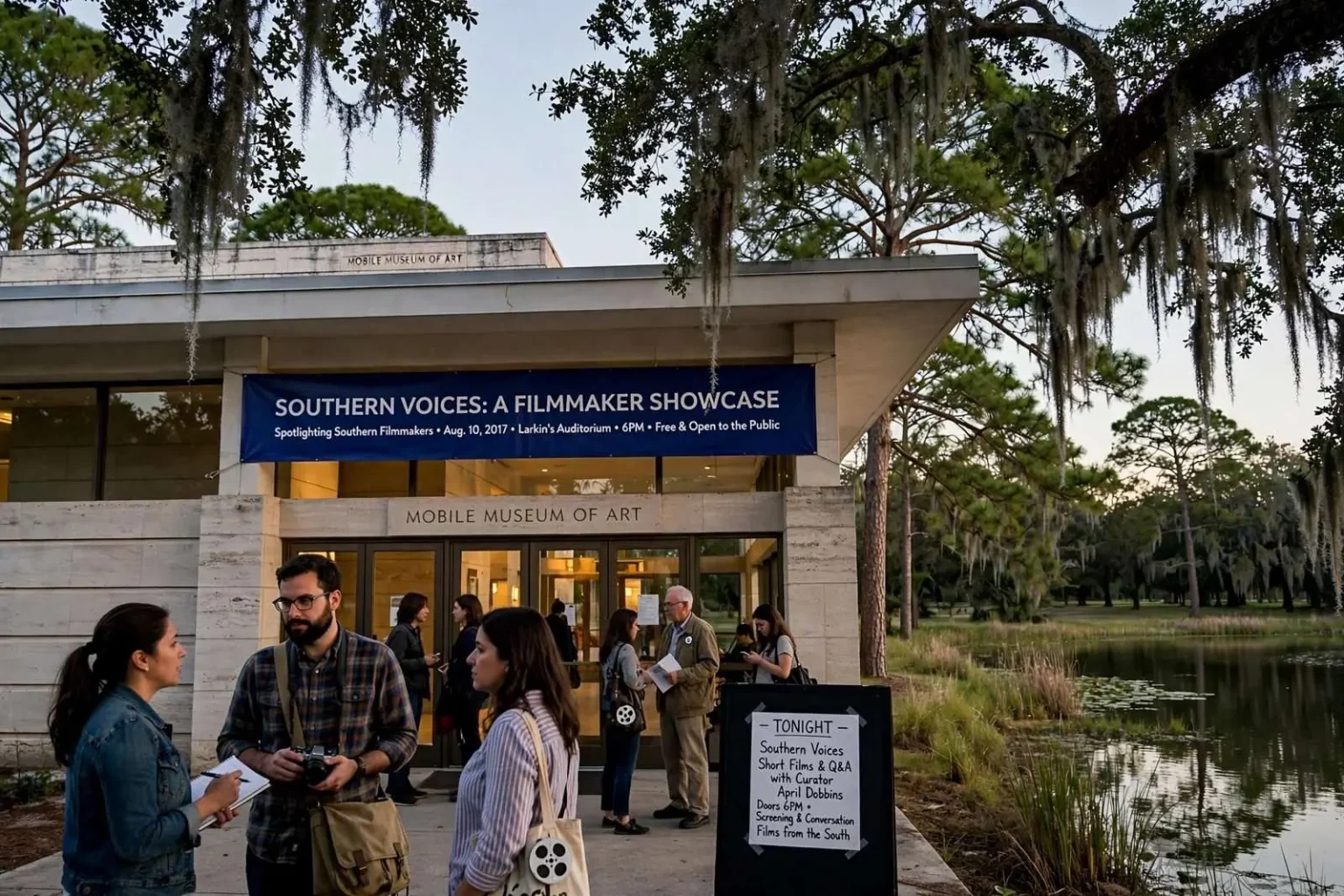
On Aug. 10, 2017, the Mobile Museum of Art presented Southern Voices: A Filmmaker Showcase, a program built to spark conversation about the filmmaking process in the South. The screening began at 6 p.m. in Larkin’s Auditorium, giving area audiences an evening devoted to the people and stories shaping the region’s independent film scene.
The museum, set among the pines and lakes of Langan Park, has long served as the Gulf Coast’s principal home for the visual arts, with a collection that spans centuries and galleries that host rotating exhibitions drawn from around the world. By 2017 it had also become a gathering place for programs that reached beyond its permanent collection, from artist talks to performances and film events. Southern Voices fit that expanding mission, bringing a medium usually associated with theaters and festivals into a gallery setting where the audience could engage directly with the makers.
The timing reflected a broader moment for Southern film. Across the region, independent filmmakers were finding new audiences for stories rooted in Southern places, and film festivals in Alabama and neighboring states had grown into genuine stepping stones for emerging talent. At the same time, streaming platforms and cheaper production equipment had lowered the barriers that once kept Southern storytellers from getting their work seen. A showcase like this one gave Mobile viewers a chance to see that movement up close, on a big screen, before it scattered across the festival circuit.
A slate built for conversation
The program’s stated goal was conversation. Rather than presenting films as finished products to be watched in silence, the museum framed the evening as an exchange about how filmmaking actually happens in the South, from developing a story to financing it, shooting it on location and carrying it to festivals. That emphasis on process made the event as much a workshop for aspiring filmmakers as a screening for film lovers.
Short films were the vehicle. The format has long served as the proving ground for emerging directors, offering a way to develop a voice and a resume without the cost of a feature. The showcase assembled a slate of short works by Southern filmmakers, several of which had already debuted at international festivals such as Cannes and Sundance and carried distinctly Southern themes, a combination that signaled both the ambition of the makers and the growing reach of regional storytelling.
For local audiences, the slate offered something rarely available in Mobile: a curated program of Southern-made shorts that had already competed on the world stage. Festival selections of that caliber typically reached viewers only through travel or subscription services, and seeing them in a communal setting, with the curator on hand, gave the evening a character no home viewing could match.
The Southern themes running through the selected works were central to the program’s identity. Stories grounded in the region tend to draw on its landscapes, family traditions, religious life, music and complicated history, and the showcase made that material its through line. For a Mobile audience, the settings and sensibilities on screen were recognizable in a way that Hollywood product rarely is, and that recognition was part of what the museum hoped would fuel discussion after the lights came up.
The international festival pedigree of several films also said something about the state of Southern cinema. Cannes, held each spring in France, and Sundance, the Utah festival founded by Robert Redford that anchors the American independent film calendar, are among the most selective showcases in the world, and acceptance there marks a filmmaker as someone to watch. That work by Southern directors had reached those stages underscored the argument, implicit in the whole evening, that the region was producing film art of national and international consequence.
Curated by April Dobbins
The evening was curated by filmmaker April Dobbins, whose own work appeared in the museum’s Contemporary Alabama Photography exhibition, giving the showcase a direct link to the galleries just beyond the auditorium. Dobbins brought to the task a resume that stretched across photography, writing and film, and a particular interest in the stories of the rural South, the same territory much of the screened work explored.
Dobbins is a photographer, writer, and filmmaker based in Miami and a 2017 Sundance Institute Knight Fellow, one of the artists supported through the fellowship program the institute runs with the John S. and James L. Knight Foundation to nurture independent creators in the Miami area. Her work has been published widely, and her double life as a visual artist and filmmaker made her a natural bridge between the museum’s photographic exhibitions and its first major film showcase.
Her standing in the broader art world was underscored by another distinction: she was among 15 artists invited by photographer Alec Soth to his inaugural Camp for Socially Awkward Storytellers, a retreat the acclaimed American photographer organized for a small, hand-picked group of image makers. Soth, known for his meditative large-format portraits of American places, invited only a handful of artists to that first gathering, and Dobbins’ inclusion placed her in company well beyond the regional scene.
At the time of the showcase, Dobbins was producing a documentary feature, Alabamaland, chronicling her family’s life and history in the rural South. The project grew out of the same soil as the showcase itself, an effort to document lives and places that mainstream film culture had often overlooked. Her presence gave Mobile audiences not just a screening but a window into how such a documentary comes together, from family archives and fieldwork to festival ambitions.
For Mobile, the showcase also connected to a wider story about the arts along the upper Gulf Coast. The city’s cultural institutions had spent years building calendars that mixed traveling exhibitions with homegrown programming, and film had emerged as one of the most reliable ways to draw younger audiences into museum spaces. Events that paired screenings with discussion gave those visitors a reason to return, and they positioned the museum as a participant in the region’s creative economy rather than a quiet repository of older work.
The showcase’s setting inside Larkin’s Auditorium reinforced that institutional character. The auditorium has served the museum for years as its venue for lectures, performances and film programs, a room where the community could sit together and talk afterward in a way that commercial multiplexes rarely encourage. On an August evening in 2017, it offered the region’s film community a focal point: a place to watch Southern stories told by Southern voices, and to ask the makers directly how those stories got made.
The screening concluded with a question-and-answer session, giving Mobile audiences a close look at the region’s emerging film voices. The conversation format honored the program’s founding purpose, to spark discussion of the filmmaking process itself, and it let viewers probe the choices behind the work: how a director finds a subject, what it takes to shoot in small Southern towns, how a short film travels from a hometown screening room to a festival theater in Utah or the south of France.
What the evening left behind
Question-and-answer sessions of this kind have become a staple of regional film programming precisely because independent film remains an opaque craft to most viewers. Budgets, festival strategy, distribution and the daily realities of documentary production are rarely visible on screen, and a curator with Dobbins’ experience could speak to all of them from firsthand knowledge. For aspiring filmmakers in the audience, the session offered practical insight; for general viewers, it deepened the films themselves.
The showcase also underscored the role of institutions in sustaining a regional film culture. Individual filmmakers can carry stories to festivals, but it takes museums, arts councils and local presenters to build the audiences those stories need at home. By putting Southern shorts on its own screen and placing a working filmmaker in front of the audience, the Mobile Museum of Art was investing in the ecosystem that keeps regional storytelling alive, one program at a time.
A decade earlier, a program of Southern short films in Mobile would have been a rare curiosity. By August 2017 it was part of a recognizably larger pattern, one that included film offices across Alabama, growing festival calendars and Southern work competing at Cannes and Sundance. Southern Voices captured that shift in miniature: a region telling its own stories, and a museum giving those stories, and the people who make them, a room of their own.
The reach of the program also extended to the Gulf Coast’s own creative community. Mobile and the surrounding region have long produced storytellers, but for much of the twentieth century the infrastructure to train and screen them sat elsewhere, in Atlanta, New Orleans and beyond. Programs like Southern Voices signaled that the gap was closing, offering local writers, photographers and filmmakers a model of what a career in film could look like and a curator who had walked the path from regional roots to national recognition.