SouthSounds 2015: A Weekend of Gulf Coast Music in Review
SouthSounds Music and Art Festival returned to downtown Mobile in April 2015 with a wide spread of independent musicians across local venues.
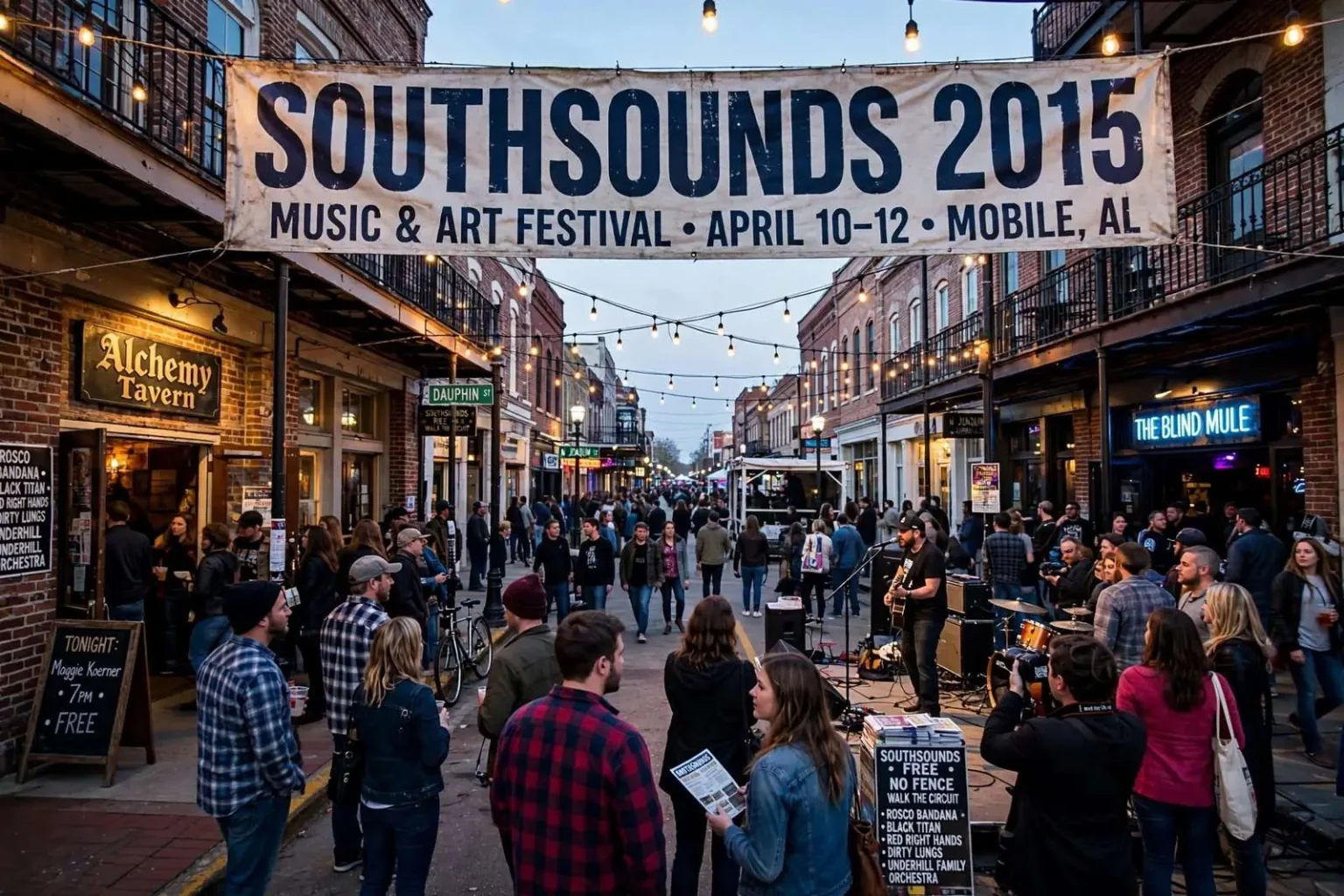
MOBILE, Ala. — SouthSounds Music and Art Festival returned to downtown Mobile in April 2015 with a wide spread of independent musicians, and those who missed it got a taste through photos and video from the weekend. The three-day event leaned on local venues and a fenceless format that keeps the music close to the street, turning blocks of downtown into a walkable circuit of stages rather than a single gated festival ground.
Across three days, the festival showcased dozens of acts from across the Gulf Coast and beyond, from solo singer-songwriters to full rock bands, in rooms that ranged from club-sized to bar-corner small. The lineup mixed hometown Mobile acts with performers from New Orleans, Birmingham, and elsewhere in the region, keeping the emphasis that has always defined the event: discovery, with audiences catching bands on the way up in the kind of intimate rooms where a set can win a room over completely.
For the Gulf Coast music community, the festival has become a rite of spring — a weekend when regional acts schedule their own tours around it, when fans road-trip into downtown from New Orleans, Pensacola, and the Baldwin County beach towns, and when the city’s venues get to show what they can do at full capacity. That reputation is built on years of lineups like this one, heavy on unsigned and small-label talent, light on corporate staging, and entirely dependent on the health of the local club scene.
Day 1: A Storm Forced Move and a Packed Room
The first day set the tone. New Orleans singer Maggie Koerner, fighting off the flu and a weather relocation that pushed her set indoors, still managed to win over a packed Alchemy Tavern room — and even took guitar duties on a few songs along the way. What could have been a compromised appearance turned into one of the weekend’s standout performances, the kind of resilient set festival crowds remember long after bigger, smoother stages are forgotten.
At Moe’s BBQ, Rosco Bandana played with Mobile’s Sean Murphy of El Cantador on drums, folding one of the festival’s hometown drummers into a visiting band’s lineup for the night. On the Blind Mule stage, Birmingham’s GT made its SouthSounds debut, while BEITTHEMEANS and Black Titan closed out the night with heavier, louder sets as the evening wore on.
Rapper Boyfriend, backed by the Madd Wikkid, drew a loud, mostly female crowd for a performance that brought a different energy to the day’s bill. The variety — rock bands, a singer with flu-stricken grit, a New Orleans rapper with a live band — was the point. SouthSounds has always spread its bets across genres and stages, and Day 1 delivered that range in full.
The Rooms That Host It
The festival’s success depends on the character of its venues, and Mobile’s roster supplies plenty of it. Alchemy Tavern has long been one of the city’s most dependable rooms for touring and local acts, with a main floor and an upstairs space that let it run two distinct stages on a night like this. Callaghan’s Irish Social Club in the Oakleigh neighborhood has earned a regional reputation far beyond its size, the kind of small room where a closing band can feel like it is playing a house show. The Blind Mule and Moe’s BBQ round out the circuit, each adding its own atmosphere to the weekend’s rotation of stages.
Those rooms are also where the Mobile scene lives the other fifty weekends of the year. The bands that headlined SouthSounds stages — the Red Right Hands, Dirty Lungs, Of Legends and Liars, Black Titan — are fixtures of the same circuit, and the festival’s venue-first model means the money and attention it generates flows back into the establishments that keep live music alive downtown week after week.
Day 2 and Day 3: Hometown Acts Take the Lead
The middle of the festival belonged to Mobile. Day 2 spotlighted homegrown acts such as the Red Right Hands, Dirty Lungs at the Blind Mule, and Of Legends and Liars, giving the local scene the stage time that festivals outside the city rarely offer its bands. For musicians who spend the rest of the year playing one-off gigs around town, SouthSounds functions as a shared showcase — a weekend when the whole scene is on display at once, with audiences moving between rooms to sample it.
Day 2 also gave audiences the pleasure of watching young Mobile bands sharpen their craft in real time. Sets by the Red Right Hands and Dirty Lungs carried the energy of acts playing the biggest weekend of their home scene’s calendar, and the Blind Mule stage gave each of them a proper headline slot in front of crowds that mixed curious festival-goers with the bands’ own local followings. Of Legends and Liars rounded out the hometown bill, keeping the day’s lineup anchored in the city’s own roster from start to finish.
Black Titan gave fans a bonus that weekend, surprising them with a late-night set upstairs at Alchemy after having already closed the Blind Mule stage the night before. Doubled-up appearances are a SouthSounds tradition of sorts, a product of the festival’s dense venue footprint: when the stages sit within a few blocks of each other, a band that finishes one slot can still make another across downtown before the night ends.
Day 3 closed the weekend in fitting fashion. Underhill Family Orchestra finished its set as the final act on the Alchemy Tavern stage, debuting new tracks for the festival crowd, before Steelism finished the festival entirely at Callaghan’s — the last notes of 2015’s edition played in one of Mobile’s most beloved small rooms, capping three days of music the way the event likes best: up close and loud.
The Fenceless Format
What separates SouthSounds from the region’s big-ticket festivals is the absence of a fence. There is no single admission gate, no sprawling fairground, no main stage at a half-mile’s walk from the food trucks. Instead, the festival hands downtown Mobile’s existing venues the bill and lets the city’s own geography do the work — fans walk from Alchemy to the Blind Mule to Callaghan’s, bands load in and out between sets, and the music stays close to the street the whole weekend.
The format has practical benefits beyond atmosphere. Venues already equipped with stages, sound systems, and bars handle production duties that a greenfield festival would have to build from scratch. Downtown businesses see the crowds directly — bands bring their audiences through the same doors that serve regulars the rest of the year. And fans on a budget can piece together a festival experience from the street-level action alone, with performances spilling into patios and public spaces along the circuit.
VIP Perks and Street Life
VIP patrons got more than proximity this year. The package included free beer from Fairhope Brewing Company and Back Forty Beer Company — two Gulf Coast breweries with strong local followings — along with a trolley running between venues and a T-shirt to mark the weekend. The trolley in particular addressed the one wrinkle of a multi-venue festival: distance. With sets stacked back to back across downtown, a ride between stages kept VIP attendees from missing openers.
Around the organized stages, the festival overlapped with the rhythms of downtown itself. Artwalk, performances in Cathedral Square, and street events along Joachim Street folded the festival into the public spaces Mobile already uses for gatherings, blurring the line between ticketed event and street life. On festival nights, the blocks around Dauphin Street filled with people moving between venues, catching sets through open doors, and turning the weekend into something closer to a downtown-wide block party than a conventional festival.
The festival’s springtime slot also gives the Gulf Coast a bookend to its fall and summer festival season. Where the beach festivals draw national headliners and crowds measured in the tens of thousands, SouthSounds works the other end of the spectrum: fewer people, more bands, and stages close enough together that a fan can see six acts in a night. It is a model that has grown along with the city’s own bands, and 2015’s edition was a snapshot of both at their best — a scene with enough depth to fill a dozen slots with hometown names and a downtown with enough rooms to hold them.
A Scene on the Rise
Between the hometown showcases and the visiting acts, SouthSounds 2015 showed how much the Mobile scene has grown. Bands like El Cantador, Black Titan, the Red Right Hands, and Underhill Family Orchestra gave the festival its local backbone, while out-of-town performers used Mobile as a stop on the regional circuit that runs between New Orleans and the beaches of the Florida panhandle. The event’s ability to fill rooms across three nights with that mix is a measure of how far the city’s music community has come — and of how well downtown’s small venues can carry a festival when given the chance.
For those who missed it, photos and video from the weekend captured what the crowds saw: a city full of music, from packed club rooms to street corners, and a festival that keeps finding new ways to make downtown Mobile the Gulf Coast’s stage for independent music each spring.