SouthSounds 2016: A Guide to the Festival’s Expanding List of Downtown Venues
SouthSounds 2016 spread across a growing map of downtown Mobile businesses, and for first-time visitors the sheer number of stages could be daunting.
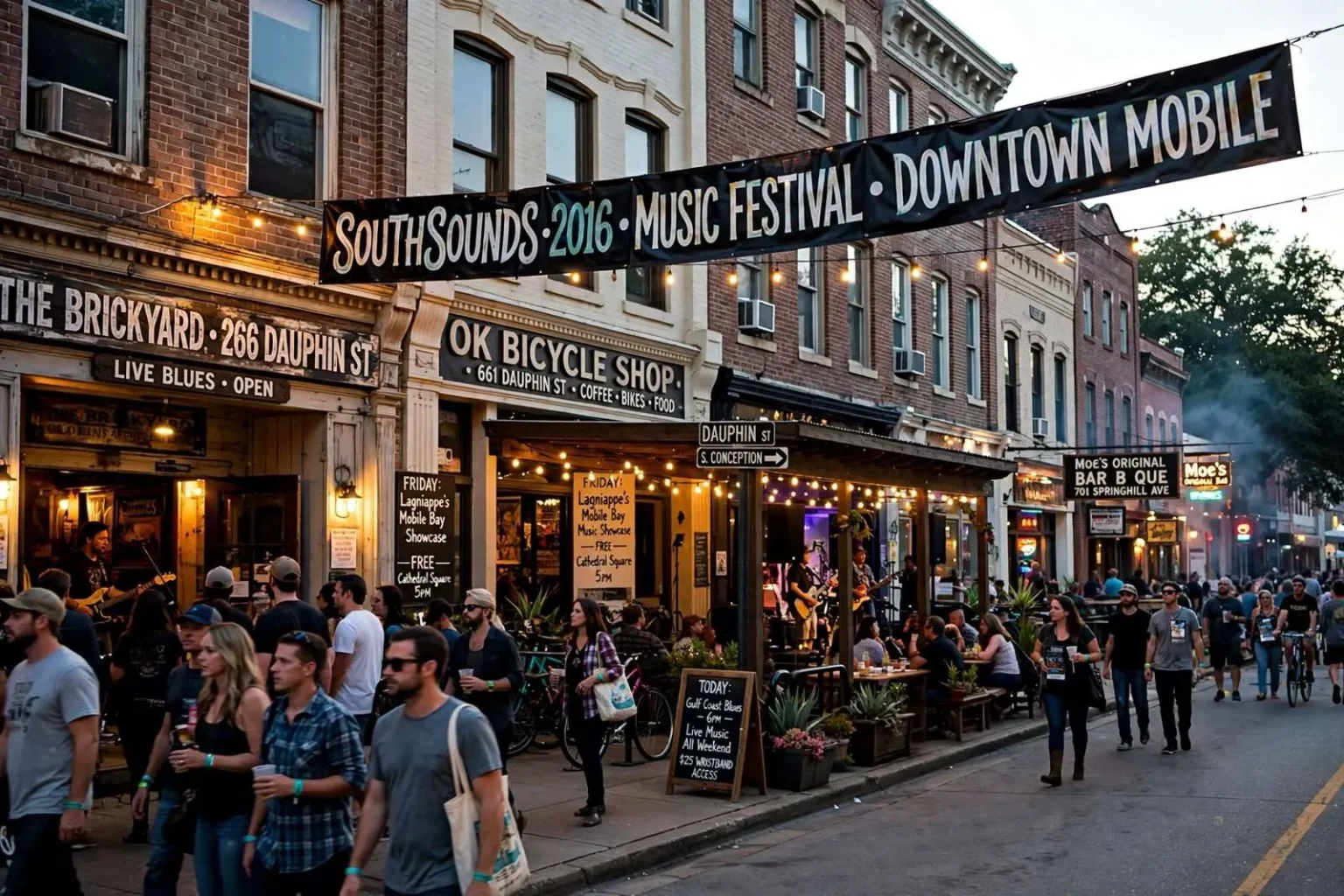
SouthSounds 2016 spread across a growing map of downtown Mobile businesses, and for first-time visitors the sheer number of stages could be daunting. The festival, built around the idea that emerging artists should be heard in the kind of small rooms where careers actually start, turned Dauphin Street and its surrounding blocks into a walkable circuit of music running from afternoon into the early morning hours. With wristbands good for every venue, attendees wandered from stage to stage, catching a few songs in one room before crossing downtown for the next act on their list.
Beyond the Blind Mule and Alchemy Tavern — the established anchors that had hosted festival showcases in previous years — several other independent rooms opened their doors for the weekend. The expansion was deliberate: festival organizers have long framed SouthSounds as a showcase of the city itself as much as of its bands, routing fans through downtown businesses that depend on the foot traffic a festival weekend brings. For the venues, three days of rotating lineups meant full rooms at hours when a normal week might be slow; for the acts, it meant playing to a constant turnover of listeners who had paid specifically to discover something new.
New and returning rooms
The Brickyard, at 266 Dauphin St., was a new festival stop midway between the main hubs, with local bluesman James “Gulf Coast Blues Boy” Richardson on the bill. The Brickyard’s position on the block made it a natural way-station for fans moving between the larger cluster of stages, and its booking leaned into the local talent that gives SouthSounds much of its character. Richardson, a fixture of the Gulf Coast blues scene, brought a style shaped by the region’s deep tradition — the same Delta-and-bayou lineage that runs through Mobile’s bars and juke joints on any given weekend.
OK Bicycle Shop, a few blocks away at 661 Dauphin St., paired bike shop and restaurant with an outdoor pergola, giving the festival one of its most distinctive settings. The venue’s front-of-house rhythm as a daytime cafe and bicycle shop transforms into a stage-backed patio by night, and during the festival the pergola area hosted sets under the open air, a welcome change of pace from the dark club rooms along the street. Its block sits at the western end of the Dauphin Street strip, which made it a favorite sunset stop before the late-night rounds began.
The Merry Widow, at 51 S. Conception St., featured Mobile’s Infant Richard and the Delta Stones among its three-day lineup. The venue, a longtime underground-leaning bar a block off Dauphin, has built its identity on loud guitars, local favorites, and late-night hours, and it used the festival weekend to showcase both hometown bands and touring acts. Infant Richard and the Delta Stones, a Mobile band with a devoted local following, drew the kind of crowd that turns a festival set into a homecoming.
Moe’s Original Bar B Que, at 701 Springhill Ave., offered early-evening sets and a back-stage area, extending the festival’s footprint north of the main drag. The barbecue joint’s stage filled the dinner-hour gap in the festival schedule, giving fans a place to eat and hear music before the club shows started, and its setup — with space for artists to gather before and after sets — made it a hub for the musicians themselves. A few blocks can make a difference at a walking festival, and Moe’s placement pulled traffic up Springhill Avenue and spread the weekend’s economic benefit a little further downtown.
O’Daly’s, one of three bars at 564 Dauphin St., hosted headliners including The Weeks of Jackson, Mississippi. The address packs multiple venues into a single doorway, and during SouthSounds it functioned as a one-stop block party, with attendees moving between rooms as lineups rotated. Booking The Weeks — a Mississippi band with a growing regional reputation — in the O’Daly’s space gave the festival a marquee draw in an intimate setting, the kind of up-close show a band that size would be playing theaters within a few years.
Free shows in Cathedral Square
For those who could not afford the $25 weekend pass, Lagniappe’s Mobile Bay Music Showcase on Friday and New Southern Music Showcase on Sunday brought local and regional acts to Cathedral Square for free. The outdoor stage in the park — ringed by oak trees and the historic churches that give the square its name — offered the festival’s most accessible experience, open to anyone who wanted to wander in. Families, passersby, and fans saving their money for the club shows all mixed on the lawn, and the free programming ensured that the weekend’s music was never limited to wristband holders.
The two showcases served complementary purposes. Lagniappe’s Mobile Bay Music Showcase put the spotlight squarely on hometown acts, the working bands that hold down local stages all year and rarely get a festival stage of their own. The New Southern Music Showcase, on Sunday, looked outward, bringing in regional artists from across the Southeast and tying the festival to the broader circuit of Southern indie, roots, and Americana music. Together they bracketed the weekend, opening it with the city’s own voices and closing it with the region’s.
A festival built on independent businesses
The festival, organizers and musicians agreed, is one of the clearest examples of how independent businesses sustain Mobile’s music community. SouthSounds has no stadium stage and no headliner economy; its model depends entirely on the owners of bars, restaurants, and clubs along Dauphin Street and the surrounding blocks opening their doors, splitting the weekend’s audience among a dozen rooms. Each venue books its own lineup, so the festival’s character emerges from the collaboration between organizers and business owners rather than from a single curated bill.
That structure has practical benefits. Because the stages are existing venues, the city’s music infrastructure gets used, not bypassed; the bands that play festival weekends are often the same acts that could be booked back into the same rooms any other month. Because the venues are walkable, the audience moves through downtown, spending at one business and then another — bar tabs, kitchen orders, and door charges all flow to the same operators who take a chance on live music the other fifty weekends of the year. And because the footprint grows with each year’s participating rooms, the festival’s success feeds directly back into the businesses that host it, making the case to each owner that opening the doors for a showcase weekend is worth the effort.
For musicians, the weekend functions as an audition in front of the most attentive audience a Gulf Coast act can find. Festival crowds come to discover, and artists who win over rooms at SouthSounds often find themselves booked back for headline shows, picked up by other venues along the Gulf Coast, or added to bills with larger touring acts. The Brickyard, OK Bicycle Shop, the Merry Widow, Moe’s, and O’Daly’s all doubled as scouting posts that weekend, with bookers and promoters from around the region moving through the crowds.
Navigating the weekend
For first-timers, the practical challenge was arithmetic: dozens of acts, a dozen rooms, three days, and no way to see everything. Veterans of past festivals advised picking a neighborhood anchor and reading the schedule in advance, then leaving room for improvisation — some of the weekend’s best moments came from walking into a room for one band and staying for the next. The compact geography helped; from the Brickyard at 266 Dauphin to OK Bicycle Shop at 661, no stage was more than a few minutes’ walk from another, and in the heat of a Gulf Coast summer the short hops between air-conditioned rooms mattered as much as the schedule itself.
The $25 weekend pass bought access to every club stage, while the Cathedral Square shows remained free, and individual venues also charged at the door for those attending single nights. That tiered structure kept the festival open to every budget, from the committed fan who paced themselves across all three days to the casual listener who caught a free Sunday afternoon show in the park on the way to dinner downtown.
By the time the last sets rang out Sunday night, SouthSounds 2016 had done what it set out to do: filled the rooms of independent downtown businesses with listeners, put local and regional acts on the same stages, and shown once again that Mobile’s music scene runs on the commitment of its small venues. The map of stages — Dauphin Street, Conception Street, Springhill Avenue, Cathedral Square — read like a tour of the city’s independent spirit, and for the musicians who played it, the festival remains the surest stage the Gulf Coast offers to the next generation of Southern music.