SouthSounds 2016 Spotlight: Shaheed & DJ Supreme Bring Hip-Hop to Hayley’s Bar
At 1 a.m. on Saturday of the 2016 SouthSounds Music Festival, Birmingham's Shaheed and DJ Supreme were set to deliver a free performance at Hayley's Bar.
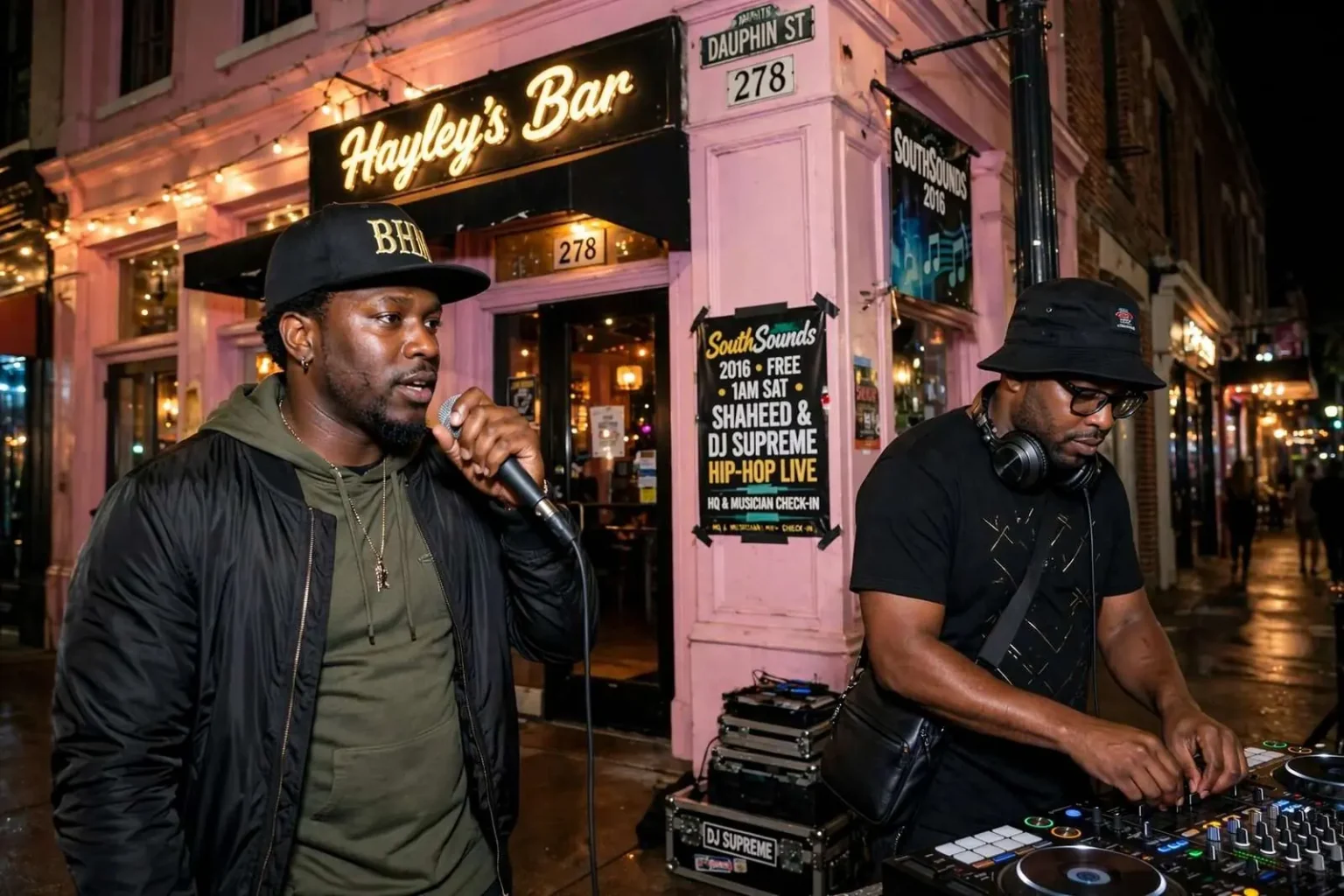
When the 2016 SouthSounds Music Festival rolled through downtown Mobile, one of its most anticipated late-night moments belonged to a pair of Birmingham artists who had already made the city feel like a second home. Shaheed and DJ Supreme, a hip-hop duo with deep roots in Alabama’s largest city, were set to deliver a free performance at 1 a.m. on Saturday of festival weekend at Hayley’s Bar, the unmistakable pink building at 278 Dauphin Street. For anyone who had followed the duo’s rise across the region, the booking made sense: for years Hayley’s has served as the festival’s headquarters and musician check-in spot, the place where artists, crew members and devoted fans converge when the bigger stages go quiet.
The slot carried meaning beyond the late hour. SouthSounds has built its reputation as a festival of discovery, spreading dozens of acts across the clubs and stages of downtown Mobile rather than concentrating everything on a single main stage. That format rewards artists who can win over a room one song at a time, and it gives audiences a chance to stumble into a performance they had no intention of seeing. A set that begins after midnight in a compact bar is exactly the kind of showcase where that kind of discovery happens.
Hip-hop’s place on the SouthSounds lineup also said something about the festival’s range. Gulf Coast festivals have often leaned toward rock, indie and Americana lineups, leaving fans of rap and its related traditions to seek out club nights on their own. Giving a Birmingham duo a prominent late-night slot on Dauphin Street signaled that the festival regarded hip-hop as central to the region’s musical conversation, not a niche add-on.
A returning favorite
Some may remember the duo from the 2015 festival, when they performed at Alchemy Tavern, another stop on the downtown circuit. Having recorded with members of Jurassic 5, the group built a loyal regional following, and last year’s crowd ended the set chanting, “Ain’t no party like a Mobile party.” The chant became something of a calling card, proof that the connection between the artists and their Mobile audience was more than a one-off festival booking. In a touring landscape where acts pass through town for a single night and vanish, that kind of repeat chemistry stands out.
The Jurassic 5 connection mattered, too, because it placed the duo in a lineage of artists known for craft. The Los Angeles collective earned national attention for its layered vocal interplay and DJ-driven production, and artists who share studio time with members of that tradition tend to be measured against a high standard. For a regional act, the collaboration functioned as both a credential and a school, and it helped explain why word of the duo’s shows traveled well beyond Birmingham city limits.
What the duo promised
In a pre-festival conversation, Shaheed described SouthSounds as a chance for bands and artists to be discovered by new listeners, framing the weekend as an audition in front of the most attentive audience an emerging act could ask for. He promised a set built on “positive energy, beats and rhymes, health, wealth and knowledge of self, and all the elements of hip hop.” The phrasing placed the performance inside a longer tradition. Since its beginnings in the Bronx in the 1970s, hip-hop culture has counted MCing, DJing, breakdancing and graffiti among its core elements, with knowledge of self often described as the fifth — a reminder that the music grew out of community, history and self-determination rather than commerce alone.
That outlook shaped expectations for the Hayley’s set. Rather than a highlight reel aimed at casual listeners, the promise suggested a performance meant for people who follow the culture closely: turntable work given room to breathe, verses built around substance, and an emcee comfortable addressing the crowd between songs. For a festival crowd migrating from stage to stage, the duo’s reputation for showmanship was the hook that pulled them through the door at an hour when most of the city had called it a night.
Why Hayley’s matters
He credited Hayley’s intimate, welcoming atmosphere — and Mobile’s anything-goes party spirit — as reasons the bar feels like a landmark. That description matched what longtime festivalgoers already knew. The pink-painted building on Dauphin Street has long functioned as more than a venue: it is where the practical business of a multi-day festival intersects with its social life. Artists check in there, announcements ripple through the crowd there, and friendships form in line at the bar between sets. During SouthSounds weekend, the space operates as a de facto town square for the musicians themselves, many of whom spend the rest of the year scattered across the Southeast.
Dauphin Street itself gives the festival its geography. The downtown corridor, lined with bars, restaurants and historic storefronts, allows a visitor to walk from venue to venue without moving a car, an arrangement that encourages sampling a few songs here and a few songs there. Late at night the street becomes a single continuous crowd, and the bars with the strongest reputations fill first. A free 1 a.m. show at one of the street’s best-known addresses drew exactly the kind of after-hours audience that keeps festival energy alive into the early morning.
For Birmingham artists, Mobile has long been a meaningful stop on the regional circuit. The two cities anchor opposite ends of Interstate 65’s Alabama stretch, separated by roughly 250 miles, and acts that can draw in both markets have demonstrated a reach that bookenders notice. A successful Mobile show — especially a festival appearance that ends with a crowd chanting along — travels back north through word of mouth, social media clips and the memories of the musicians and fans who share the same circuit. Performances like the one at Hayley’s therefore served double duty: entertainment for the night, and an investment in the duo’s regional standing.
The broader festival picture
SouthSounds modeled itself on the idea that a city’s clubs can collectively do the work of a stadium show. Rather than selling one headliner, the festival sold a weekend of wandering, with wristbands granting access to a succession of rooms where the next act is always a guess. That model depends heavily on venues like Hayley’s, whose owners and staffs absorb the logistical burden of hosting acts back to back while keeping the atmosphere loose enough for collaboration. It also depends on artists willing to play unconventional slots — early afternoons, midnight hours, standing-room corners — in exchange for the chance to convert strangers into fans.
The 2016 edition arrived at a moment when Mobile’s downtown had been steadily rebuilding its identity as an entertainment district. Investments in the street, a growing residential population in the city core, and a calendar of festivals gave Dauphin Street a momentum that locals described with real pride. A hip-hop duo from Birmingham closing out a Saturday night at one of the street’s signature bars fit that momentum, and it offered a preview of the kinds of acts the festival could attract as its reputation grew across the Gulf Coast.
What a late-night set means for an artist
The economics and mechanics of a festival slot like this one are worth understanding. A free show removes the barrier of a cover charge at exactly the hour when casual festivalgoers are deciding whether to keep going or head back to their hotels. The artist, meanwhile, plays to a room that mixes devoted followers with complete newcomers, which makes each song a test of the material’s ability to hold attention. Duos built around an emcee and a DJ tend to thrive in those conditions because their format is conversational — the crowd is spoken to, brought in, responded to — rather than simply observed from a stage.
There is also the matter of the hour. A 1 a.m. crowd in a bar is self-selected: the people present chose to be there, and they bring an energy that a 6 p.m. festival slot rarely matches. Hip-hop, a genre born at block parties and in rec rooms where the party itself was the point, historically does its best work in exactly those rooms. The chanting that closed the duo’s 2015 set was evidence of that dynamic at work — an audience that arrived curious and left participating.
A weekend that confirmed a role
The late-night Hayley’s performance capped a weekend that, for many downtown regulars, confirmed the venue’s role as the spiritual home of the festival. Headquarters, check-in point, late-night stage and social hub: few buildings of any size take on so many jobs during SouthSounds weekend, and the fact that a modest bar on Dauphin Street manages all of them is a large part of the festival’s character. When the duo took the stage in the early hours of Sunday morning, they were not merely playing a slot on a schedule. They were occupying the most symbolically loaded room the festival had to offer.
For Shaheed and DJ Supreme, the set was another chapter in a growing relationship with Mobile — a city that had chanted for them a year earlier and was being invited to do so again. For the festival, it was a demonstration of the discovery-first model working as designed: two accomplished regional artists, a devoted room, and a performance that turned the festival’s headquarters into the loudest address on Dauphin Street. For the audience, it was simply the party continuing at full volume long after most weekends would have ended. All three of those things happening at once is what a good festival night looks like, and Hayley’s provided the room for it.
As the crowd spilled back onto Dauphin Street in the early morning, the weekend’s larger lesson remained visible in miniature. Festivals succeed when the spaces between the headliners are filled with moments worth stumbling into, and few moments in 2016 fit that description better than a free, late-night, elements-of-hip-hop set from two Birmingham artists who had already made Mobile chant their hook once before. The pink building at 278 Dauphin Street was where that moment lived, just as it had for years — and just as, for many downtown regulars, it always would.