Space 301 Launches Movie Mondays With ART:21 ‘Stories’ Screening
Space 301 screened ART:21's 'Stories' free with wine on Oct. 24, 2011, profiling Kara Walker, Kiki Smith and more as Movie Mondays grew downtown.
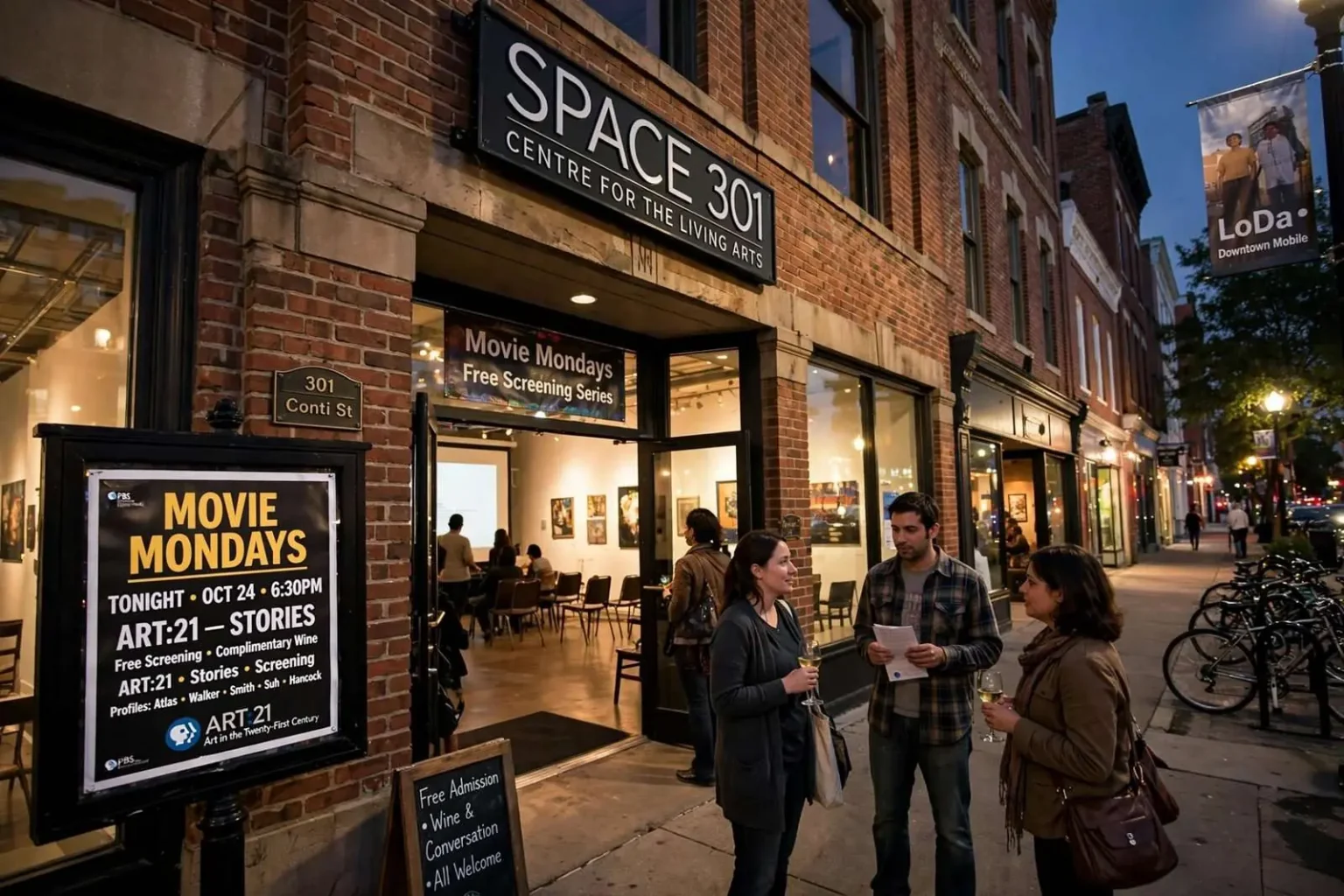
Space 301 continued its Movie Mondays series on Monday, October 24, 2011, at 6:30 p.m. with a free screening of “Stories,” an episode of the Peabody-winning contemporary art documentary series ART:21 — Art in the Twenty-First Century. Admission was free, with complimentary wine for attendees.
The episode explores how artists tell stories through their work, profiling Charles Atlas, Kara Walker, Kiki Smith, Do-Ho Suh and Trenton Doyle Hancock. Filmed on location everywhere from New York and Philadelphia to São Paulo and Seoul, “Stories” follows the five artists as they draw autobiographical, satirical and fantastical material from architecture, literature, mythology and history.
The five careers on display could hardly be more varied. Atlas built his reputation at the intersection of video, dance and media art, shaping how performance reached the camera. Walker’s silhouetted installations confront viewers with the brutal history of race and slavery rendered in elegant black cut paper. Smith’s sculptures and drawings move through the body, folklore and the fragility of the physical world. Suh’s architectural fabric works trace the weight of homes, migration and memory. Hancock’s dense, comic-panel-derived mythologies build entire universes around his half-man, half-plant character Torpedo Boy. What joins them — and what “Stories” sets out to show — is that each uses narrative as a working method, not merely a subject.
For an audience in Mobile, the screening offered a window into the contemporary art world that few venues in the region could provide. Documentaries of this kind let viewers hear artists explain their own work in their own words — a format that demystifies art that can look forbidding on a gallery wall, and that gives newcomers a way in before they ever stand in front of the pieces themselves.
A Downtown Venue Finding Its Footing
The screening was part of a busy fall at Space 301, the Centre for the Living Arts facility on Conti Street that had been ramping up programming beyond visual exhibitions to include films, concerts and community events.
Space 301 took its name from its address in a landmark downtown building, and from the beginning its mission stretched the definition of a gallery. The Centre for the Living Arts positioned the space as a multidisciplinary home for the arts in downtown Mobile — a place where exhibitions shared a calendar with performances, film series, workshops and public gatherings. The Conti Street location put it steps from the LoDa entertainment district, at the center of the city’s push to rebuild downtown nightlife around culture.
The ART:21 series, produced for PBS, is widely used as an introduction to contemporary art, making it a natural fit for the venue’s mission of bringing new media work to downtown Mobile audiences.
That fit ran in both directions. A documentary series designed for public television audiences gives casual viewers the context that contemporary art often demands, and a venue trying to grow an audience for such work gets a program that educates while it entertains. The free admission and the complimentary wine lowered the barriers further — the evening was built as much as a social gathering as a screening, the kind of event that turns a first-time visitor into a regular.
Movie Mondays and the LoDa Calendar
Movie Mondays joined the gallery’s regular exhibition calendar as a recurring free evening event, giving Mobilians a midweek arts option during LoDa ArtWalk’s off weeks.
That scheduling logic is worth unpacking. LoDa ArtWalk, the monthly evening when galleries and businesses in the Lower Dauphin district open their doors for a coordinated arts walk, draws the biggest crowds of the month to the neighborhood — but it comes once a month, leaving weeks in between when the district’s venues compete with the ordinary pull of dinner and drinks. A recurring Monday film night gives the gallery a presence across those gap weeks, builds a habit among regulars, and puts something free and cultural on the calendar at a time of week when downtown is otherwise quiet.
For the Centre for the Living Arts, the series also served the broader goal of making Space 301 a daily fixture of downtown life rather than a destination reserved for exhibition openings. Venues that program only on peak nights struggle to build sustained audiences; venues that offer something worthwhile every week train residents to think of the space as theirs. A free screening with wine on a Monday is a modest invitation, but repeated over months it reshapes who walks through the door.
Why ART:21 Matters
The ART:21 series has become a standard classroom and museum resource precisely because it treats artists as articulate interpreters of their own work. Each season pairs its profiled artists loosely by theme — here, the question of how stories are built — and lets the artists speak in their studios, on location and through their work rather than through critics’ commentary. The Peabody Award the series earned reflected that approach, recognizing television that took contemporary art seriously enough to let it explain itself.
For Mobile audiences in 2011, the screening arrived at a moment when contemporary art remained scarce in the city’s galleries. The local museum landscape offered strong collections of traditional and regional work, and the city’s commercial galleries leaned toward established and decorative artists. Space 301’s programming — experimental exhibitions, video, installation and now film — carved out space for the new and the challenging, with the Centre for the Living Arts acting as the venue’s institutional backing.
The October 24 screening of “Stories” fit that role exactly: five major contemporary artists, introduced on screen, in a downtown gallery, for free, on a weeknight. For the audience that filled the space that Monday, it was an evening of stories about storytelling — and another step in Space 301’s effort to make downtown Mobile a place where contemporary art had a home.
The “Stories” episode itself rewards a closer look at what its five subjects represent. Charles Atlas came to prominence as a video artist and filmmaker whose decades of collaboration with choreographers — most famously Merce Cunningham — helped define how dance could live on screen, and his own media works play with the television formats they borrow. Kara Walker, one of the most prominent artists of her generation, uses the 18th-century silhouette tradition to stage confrontations with the legacy of slavery and the caricatures that survive it, and her large-scale installations have appeared in museums around the world.
Kiki Smith’s work spans sculpture, printmaking and drawing, often centered on the body and on fairy tale and myth; her subjects range from internal organs to witches, saints and animals, rendered with a delicacy that makes the difficult material approachable. Do-Ho Suh, born in Seoul, builds exquisitely sewn fabric replicas of the homes he has lived in, exploring identity, home and displacement — themes shaped by his journey from Korea to the United States and by his questioning of how individuals fit within larger structures. Trenton Doyle Hancock, a Texan whose paintings, drawings and installations overflow with text and imagery, invented an elaborate mythology in which the Torpedo Boy character battles the plant-like Vegans, and his work carries the visual density of the comic books that shaped him.
Showing all five in a single episode gives Mobile viewers a compact survey of the directions contemporary art was taking in the early 21st century: video, installation, narrative painting, sculpture and the interrogation of history — each explained by the artist who made it.
For Space 301, the choice of episode also modeled the kind of engagement the venue hoped to foster. An audience that spends an evening hearing Kara Walker discuss why she works in silhouettes, or Do-Ho Suh walk through the fabric replica of a childhood home, leaves with tools for looking — tools they carry into the gallery’s own exhibitions and into ArtWalk nights throughout the district.
Movie Mondays continued on the gallery’s calendar as the fall went on, part of a programming stretch that had the Centre for the Living Arts facility busier than at any point since its opening — films on Mondays, exhibitions across the main galleries, and the community events that the venue’s founders imagined when they set out to make the Conti Street space a living room for the downtown arts.
Free programming of this kind carries the venue’s mission as much as any exhibition. Screening rights for a PBS documentary series are modest compared with the cost of mounting shows, and the audience a film night builds — students, young professionals, neighbors who might not otherwise set foot in a gallery — feeds every other part of the institution. The complimentary wine and the Monday-evening slot signaled that the event was designed as a habit rather than an occasion: come once, then come back.
The fall of 2011 found downtown Mobile in the middle of the cultural build-out that gave the LoDa district its identity. Restaurants and music venues had multiplied along Dauphin Street, ArtWalk had become a fixture of the city’s monthly calendar, and the city’s investment in the Saenger Theatre and the surrounding blocks pointed the same direction. Space 301’s expansion into films and concerts put the gallery squarely inside that momentum, and Movie Mondays gave it a weekly stake in the district’s rhythm.
Whether audiences came for the artists, the wine or simply the company, the format worked: a Monday night in a downtown gallery, five of contemporary art’s most compelling figures on screen, and a neighborhood outside the door that was learning to treat the arts district as its own. For Space 301, that was the point of the whole exercise — bringing new media work, and new audiences, into the same room.