
Spaced Out Summer Takes Over the Gulf Coast Exploreum With Black Holes, NASA Imagery and Virtual Journeys
Black holes, NASA imagery and virtual journeys through the universe: the Gulf Coast Exploreum's Spaced Out Summer runs through Aug. 28 in downtown Mobile.
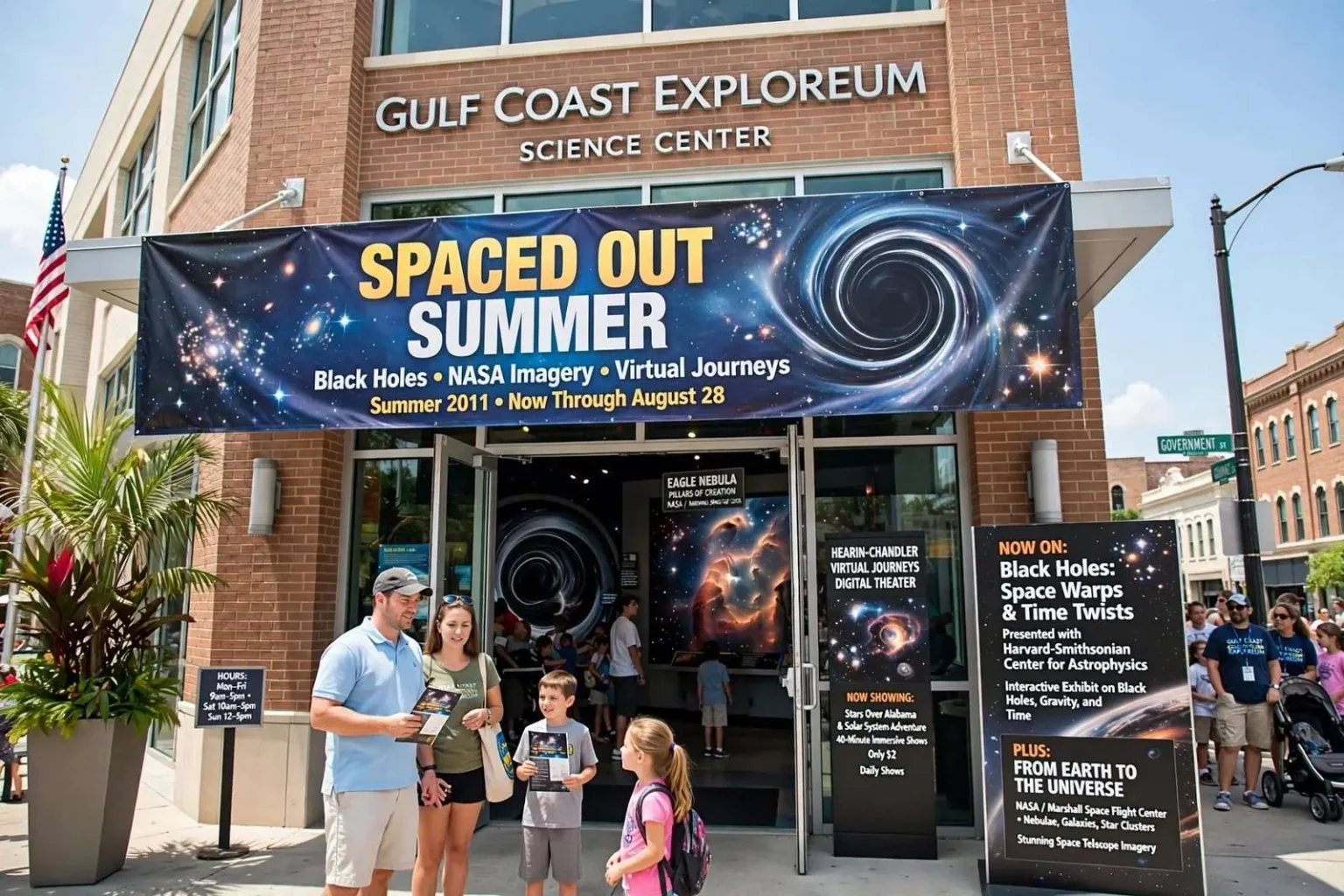
Downtown Mobile’s Gulf Coast Exploreum Science Center has gone interstellar for the summer of 2011, packing Government Street’s science museum with a slate of space-themed exhibitions and theater shows running through August 28. The summer program gives families along the Gulf Coast a destination that pairs air-conditioned relief from the heat with genuine science content, and the museum has built the season around two traveling exhibitions and a refreshed planetarium-style lineup.
The headline exhibition is Black Holes: Space Warps & Time Twists, produced by the Harvard-Smithsonian Center for Astrophysics, which lets visitors explore the physics of the universe’s most mysterious objects. The exhibition walks guests through what black holes are, how scientists detect objects that emit no light, and what happens to matter and time near an event horizon — turning some of the most abstract ideas in physics into hands-on stations that visitors of all ages can manipulate.
Alongside it runs From Earth to the Universe, a collection of astronomical images assembled with NASA’s Marshall Space Flight Center in Huntsville. The imagery — drawn from space telescopes and ground-based observatories — presents nebulae, star clusters and galaxies at a scale and detail that prints and screens rarely match, and its Huntsville connection ties the summer program to Alabama’s own aerospace legacy. Marshall has been the home of NASA’s rocket propulsion work since the Apollo era, and its collaboration on the touring exhibition gives Alabama visitors a direct line to the science happening in their own state.
Stars Over Alabama and the Digital Theater
Beginning June 4, the Exploreum’s Hearin-Chandler Virtual Journeys Digital Theater adds its own lineup of cosmic journeys. The theater projects onto an enormous wraparound screen — described by the museum as the size of an 18-wheeler — using high-end graphics hardware and a triple Galaxy Warp Display synchronized with specialty lighting. The effect surrounds audiences with imagery on all sides, closer to the immersion of a modern dome theater than a traditional auditorium, and the synchronized lighting pulls the room into each show’s atmosphere.
Shows run about 40 minutes and are offered to school groups and the general public for $2 per person, a price point that makes the theater an easy add-on for families buying general admission. The modest ticket also reflects the Exploreum’s role as an educational institution: school groups from across south Alabama and the Florida panhandle book the theater as part of field trips that the museum cultivates throughout the academic year.
Two shows anchor the summer schedule: Stars Over Alabama, a tour of the constellations visible in the summer sky over the state, and Solar System Adventure, a virtual flight past the planets. The former gives visitors a take-home skill — stepping outside on a clear Gulf Coast night and knowing what they are looking at — while the latter turns the solar system into a guided tour that younger audiences can follow from Mercury to the outer planets.
Hours and Tickets
The exhibition package runs Monday through Friday from 9 a.m. to 5 p.m., Saturday from 10 a.m. to 5 p.m., and Sunday from noon to 5 p.m. The weekday morning opening accommodates the summer camp groups and school programs that fill the museum’s earlier hours, while weekend schedules stretch the experience for families making the trip from across the region — Baldwin County, the Mississippi Gulf Coast and the Florida panhandle are all within easy reach of downtown Mobile.
Admission is $12 for adults 10 to 59, $11 for youth 13 to 18 and seniors 60 and older, and $10 for children, with combo tickets that include an IMAX film also available. The IMAX option has long been one of the Exploreum’s signature draws, with the theater’s large-format screen showing documentaries that complement the museum’s traveling exhibitions. For a family of four, the difference between a basic visit and a combo day is modest, and the pairing of an exhibition like Black Holes with a large-format film turns a museum stop into a full-day itinerary.
The Exploreum occupies a distinctive place in downtown Mobile’s cultural landscape. The science center on Government Street anchors a museum district that includes the history museums and galleries within walking distance, and its hands-on mission — touchable exhibits, live demonstrations and traveling programs — fills a role the city’s other institutions do not. Summer exhibitions of this scale are the museum’s highest-traffic seasons, when tourism from the beaches meets local families looking for weekday activities.
The 2011 space summer also lands amid a period of renewed public interest in space science, with the final shuttle missions drawing national attention and Huntsville’s Marshall Space Flight Center continuing its work on the next generation of launch systems. For Gulf Coast families, the Exploreum’s program offers children a first encounter with the physics their state’s aerospace workforce practices daily — from propulsion engineers in Huntsville to the aerospace contractors along the Gulf Coast who build and test rockets within sight of Mobile Bay.
Running through August 28, the summer schedule gives visitors roughly three months to catch both exhibitions and the digital theater lineup before the program rotates out. With the $2 theater shows, the tiered admission pricing and the IMAX combo options, the museum has assembled a package aimed at making the season’s science accessible to every budget — and at giving downtown Mobile another reason for families to spend the day.
Black Holes: Space Warps & Time Twists stands out among traveling science exhibitions for the way it translates one of physics’ hardest subjects into interactive experience. The Harvard-Smithsonian Center for Astrophysics, the collaboration behind the exhibition, operates at the frontiers of astronomical research, and the show distills questions its scientists study daily — how black holes form, how they warp spacetime, how astronomers find objects that swallow light — into stations where visitors experiment with gravity, spin and the strange consequences of crossing an event horizon. For younger visitors, the exhibition often serves as a first encounter with Einstein’s ideas; for adults, it offers the rare pleasure of exhibits that do not condescend.
From Earth to the Universe complements the physics focus with pure visual astronomy. The image collection, developed with NASA’s Marshall Space Flight Center, gathers observations spanning the electromagnetic spectrum — views of the cosmos in visible light, infrared, X-ray and radio wavelengths that reveal structures invisible to the eye alone. Presenting the universe at that range of scales, from planetary surfaces to galaxy clusters, gives the gallery a sweep that pairs naturally with the theater shows upstairs in the digital theater.
The Hearin-Chandler Virtual Journeys Digital Theater itself represents the Exploreum’s investment in immersive education. The wraparound screen — sized like an 18-wheeler by the museum’s description — and the triple Galaxy Warp Display put the venue among the more capable digital theaters on the Gulf Coast, and the 40-minute show format fits school group schedules while leaving time for exhibition floor visits in the same trip. Specialty lighting synchronized with the projection system amplifies the immersion, dimming and shifting with the on-screen journey.
Stars Over Alabama, one of the two anchor shows, doubles as an introduction to backyard stargazing. The program tours the constellations of the summer sky as they appear over Alabama, connecting the mythology and navigation traditions behind the star patterns to what viewers can actually find on clear nights along the Gulf Coast. Solar System Adventure, the second anchor, takes the virtual-flight approach, carrying audiences past the planets with narration and imagery that make the scale of the solar system tangible for elementary-age audiences.
For families planning a visit, the Exploreum’s downtown location makes the summer program easy to fold into a broader Mobile day trip. The museum sits within walking distance of Bienville Square and the restaurants along Dauphin and Government streets, and visitors combining the science center with the city’s other attractions can park once in the surrounding decks and spend the day on foot. The weekday 9 a.m. opening suits families with young children who do their best museum-going before the afternoon heat, while the weekend schedules serve the beach crowds who drive in from Gulf Shores, Orange Beach and Pensacola for a change of pace from the sand.
The Exploreum’s traveling exhibition strategy follows a model the museum has refined over the years: pair a headline touring show with an exhibition from a partner institution, add theater programming, and hold the package for a season long enough for school groups, tourists and repeat local visitors to all cycle through. Space themes have historically been among the museum’s strongest draws, appealing across age ranges in a way few subjects do, and the 2011 summer lineup — a physics-forward headline exhibition, a NASA-linked photo gallery and two anchor theater shows — covers the subject from multiple angles.
The museum’s educational mission runs through the whole program. Field trip programming brings school groups from across the central Gulf Coast during the academic year, and summer exhibitions keep those audiences engaged between school years. The $2 theater price for school groups and the general public alike lowers the barrier for teachers planning trips and for families stretching a summer budget, and the IMAX combo tickets build the kind of full-visit experience that museums use to compete with beach days and video screens at home.
As the summer of 2011 unfolds, the Exploreum’s interstellar season offers the Gulf Coast something increasingly rare: a single destination where visitors can grapple with black holes, fly past Saturn and learn the constellations over their own rooftops — all within a few blocks of downtown Mobile’s restaurants and parks, and all under one ticket structure designed to keep the universe within reach through August 28.


