Blood Clots in Both Arms, Two Surgeries, 11 Days to Kickoff: Spanish Fort’s Chase Smith Is Back at School Monday
Spanish Fort head football coach Chase Smith was hospitalized with blood clots in both arms and his lungs, underwent two surgeries and spent a night in the ICU. He returns to school Monday, 11 days before the Toros open against Daphne.
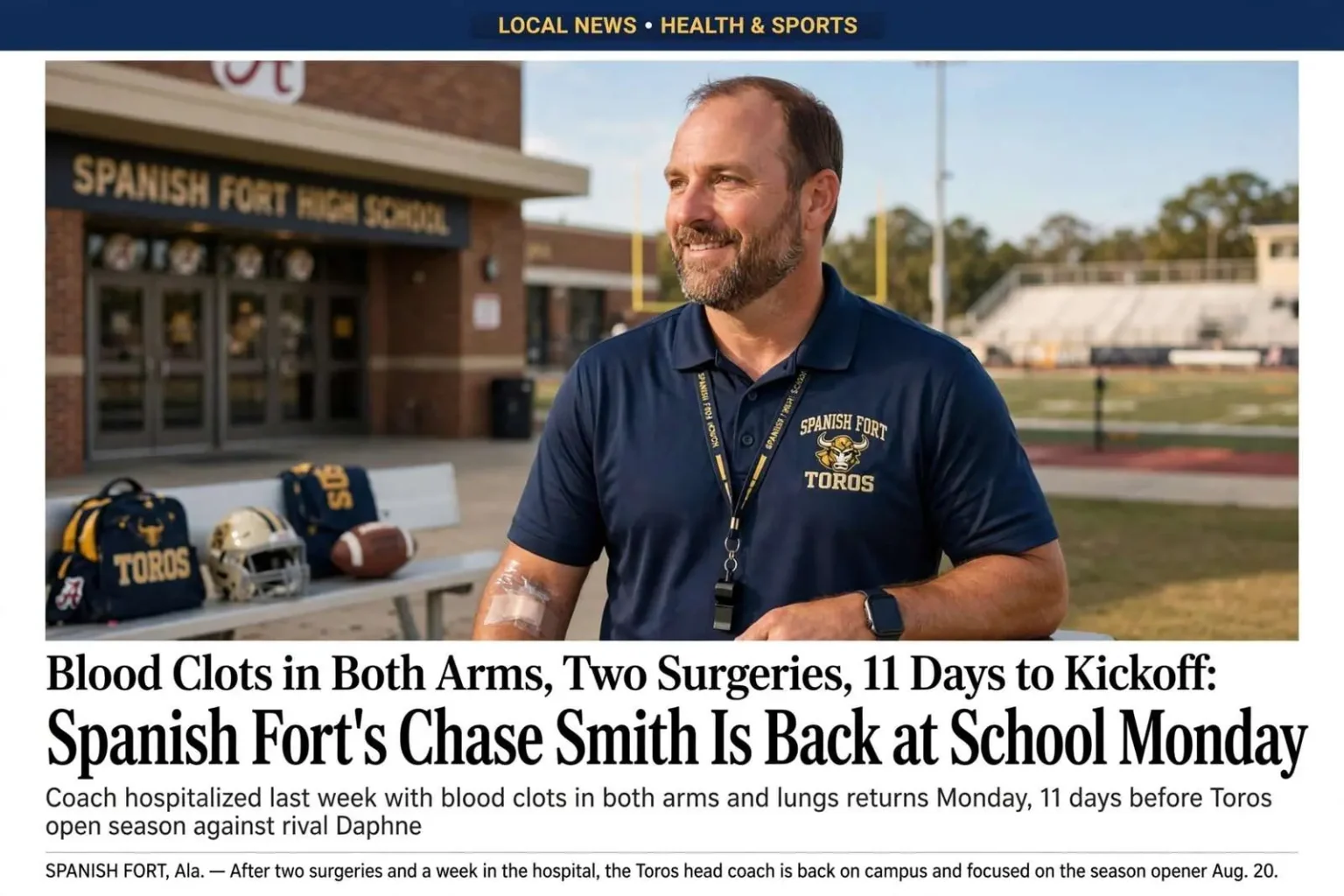
SPANISH FORT, Ala. — Chase Smith thought he had thrown his arm out.
He is 42 years old, he was tossing a football with his tight ends at a Monday practice, and his upper right arm started to hurt. It did not seem like the kind of thing that ends with two surgeries and a night in intensive care.
The Spanish Fort head football coach was hospitalized late Tuesday night into Wednesday morning last week with what turned out to be blood clots in both arms and several smaller clots in his lungs. He plans to be back at school Monday, 11 days before his Toros open the season against rival Daphne.
“It’s the type of whirlwind deal that certainly will open your eyes,” Smith said.
‘My Arm Had Blown Up’
Smith said the pain started at that Monday practice.
“I was thinking maybe I threw my arm out, but it wasn’t like I was throwing bombs out there,” he said. “I went to see (Spanish Fort trainer) Rob (Milam). We decided to ice it that night, didn’t really think it was any big deal.
“But later that night, when I was in the shower, my arm had blown up. There was some discoloration. I thought, ‘Man, I tweaked it more than I thought I guess.’”
By Tuesday’s practice the swelling had gone down, but Smith still could not throw. Milam scheduled him an appointment with Spanish Fort team doctor Dan Matthews for Wednesday morning.
“Through all that, though, the discomfort and pain never went away even with pain meds,” Smith said. “It was a different kind of feeling than I’d ever had.”
The Second Arm Changed Everything
Smith had planned to wait for the morning appointment. Then his left arm started to swell too.
“When I was leaving school Tuesday, I was thinking, ‘I’m going to the doctor in the morning. It will be ok for a night.’ But I went back to see Rob because my left arm had started to swell as well. He didn’t like what he saw. He called Dr. Matthews, and he said I needed to go to the ER right away.”
Smith arrived at Thomas Hospital in Fairhope at 2 a.m. Wednesday. Scans of his arms and lungs found three large blood clots across both arms and several small clots in his lungs.
What Doctors Found
Physicians ruled out a degenerative blood disorder. Instead, they diagnosed thoracic outlet syndrome, sometimes called effort thrombosis — a condition in which repetitive overhead arm motion compresses the vein running between the collarbone and the first rib, creating conditions for a clot to form in the arm. It is a diagnosis most often associated with baseball pitchers and other throwing athletes, which makes a football coach throwing routes to his tight ends an unusually fitting case.
“Thank God they found it quickly,” Smith said.
Two Surgeries, One Night in the ICU
Smith had surgery Thursday to remove the clots in his right arm and spent that night in the intensive care unit so doctors could monitor him.
“It went well,” he said. “There weren’t a lot of issues.”
Friday he underwent the same procedure on his left arm. With vitals stable, he was discharged early Saturday afternoon. He will have an additional operation after the season to remove his top two ribs so the compression does not recur.
Doctors were not concerned about the clots in his lungs. “They said they were small and were at the bottom of my lungs. They feel they will dissolve with blood thinners,” Smith said. “They said there was no risk of having a pulmonary embolism or anything like that. They don’t think there is any type of threat there.”
Easing Back In
Spanish Fort opens Aug. 20 against Daphne. Smith said he will return to school Monday and take it carefully.
“I will try to acclimate back in,” he said. “I feel OK. I know I just have to be smart. I’m on blood thinners, so I have to be aware of that. I will back off some and just be around. I’ll go inside when I need to.”
Being on blood thinners in an August Alabama two-a-day environment carries its own considerations, and Smith said he has been cleared but is not taking chances. “I’m not going to push it. I’m not going to do anything stupid,” he said. “They’ve said I’m not at a super high level for a heat stroke or anything like that. I’ll see the kids, take it one day at a time and just monitor how I feel.”
A Staff Built for This
Smith credited his assistants with holding the program together during his absence. Three of them — Nate McDaniel, Kyle Stanford and Justin Thomas — have previously been head coaches at other schools, an unusual depth of experience for a high school staff and one that mattered in a week when the head coach was in a hospital bed.
He said the Spanish Fort administration, parents, community and even opposing coaches were supportive throughout. He intends to be at Toros Stadium on Aug. 20.
“I plan to be there,” Smith said. “I’m not sure if I will be on the sideline or in the press box, but I plan to be there.”
‘Listen to Your Body’
Asked what he took from the past week, Smith did not hesitate.
“For my kids, my staff, everyone — if something is not right in your body, listen to your body,” he said. “If you feel something, don’t hesitate to get it checked out. I know you can’t go and get a full body scan whenever you feel like it, but we are probably all guilty of letting things slide.
“I was in that mindset Tuesday night. I thought, ‘I’m going to the doctor in the morning anyway. I’ll just wait.’ I’m glad I didn’t. If you ever question whether you should go to the doctor, yes you should go.”
About the Condition
Effort thrombosis in the arm is also known as Paget-Schroetter syndrome, a form of venous thoracic outlet syndrome. It is uncommon and tends to affect young, active people whose sports or jobs involve repeated overhead arm motion. Treatment typically combines blood thinners, and often clot-removing or clot-dissolving procedures, with later surgery that removes rib bone to relieve pressure on the subclavian vein, the reason for the operation Smith faces after the season.