
Stephen King’s ‘Gerald’s Game’ Brings Netflix Production to Lower Alabama
Director Mike Flanagan appears to have developed a fondness for what those in the regional film industry fondly call "The Other LA" - Lower Alabama.
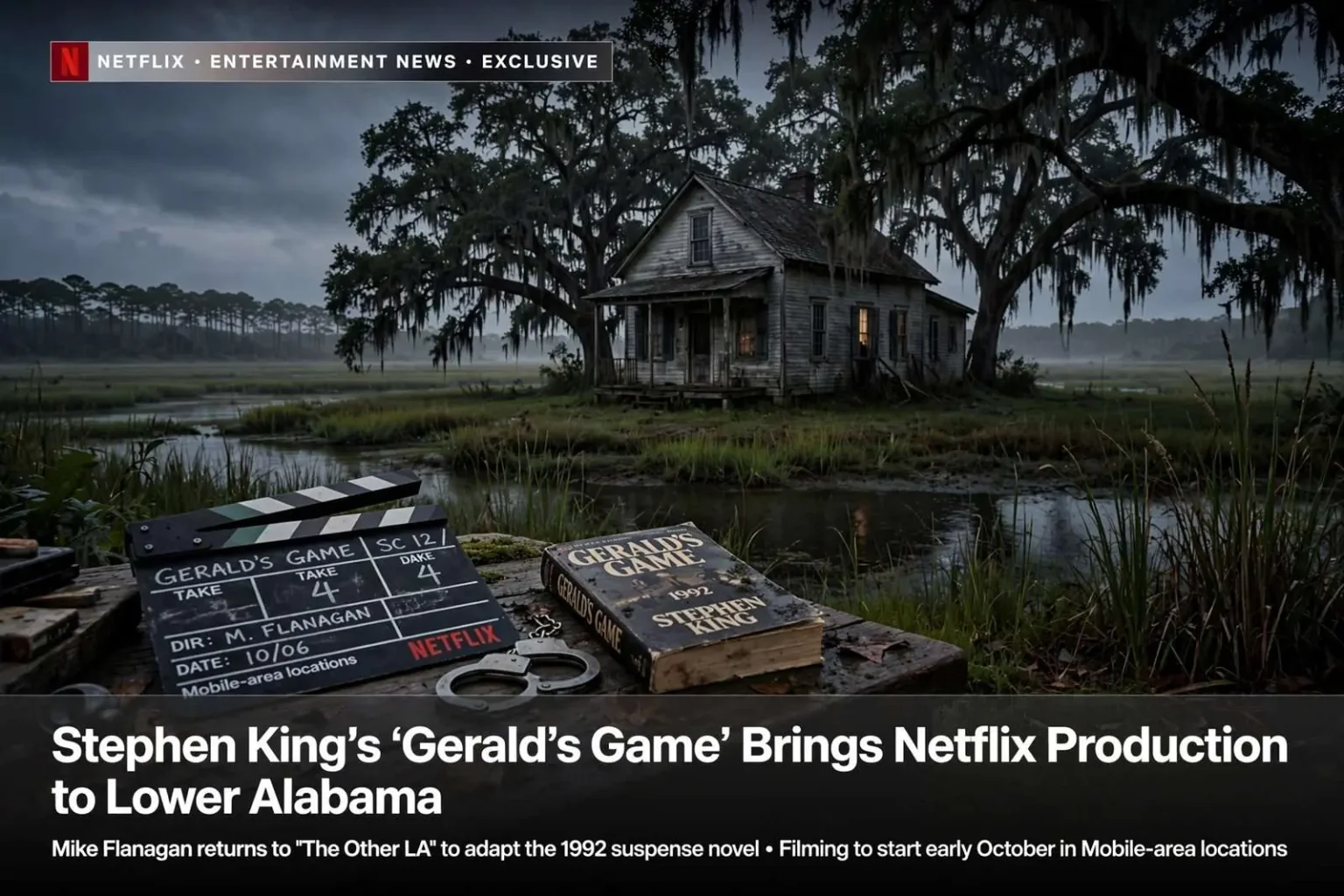
Director Mike Flanagan appears to have developed a fondness for what those in the regional film industry fondly call “The Other LA” – Lower Alabama. After filming 2013’s “Oculus” in the area, he returned repeatedly for additions to a run of horror projects, and his most ambitious undertaking yet was set to bring him back — with a Stephen King adaptation in tow.
“Gerald’s Game,” based on King’s 1992 suspense novel, follows a woman who accidentally kills her husband while handcuffed to a bed and, facing the likelihood of no rescue, begins to let the voices in her head take over. The premise is famously contained: one woman, one remote house, one impossible situation, and a story that lives almost entirely inside a single character’s mind.
After King publicly praised Flanagan’s “Hush” on Twitter, a collaboration between the two felt all but inevitable. “Hush,” Flanagan’s home-invasion thriller, had earned a devoted following among horror fans, and the author’s public appreciation of it signaled that the novelist whose work has defeated many an adapter saw something in Flanagan’s approach that others had missed.
A Notoriously Difficult Adaptation
For decades, “Gerald’s Game” was considered nearly unfilmable. The novel traps its protagonist in a single room for most of its length, with the drama unfolding through memory, hallucination and interior monologue — territory that works on the page but has historically defeated filmmakers. Described as one of Netflix’s most ambitious originals to date, the project represents the kind of bet the streaming service had been making as it built its original film slate: take a beloved, difficult property, hand it to a director with a track record, and let the concept’s intensity do the marketing.
The book itself is vintage King — a domestic scenario turned into a nightmare, with the horror emerging not from a monster but from circumstance, isolation and the wreckage of a marriage laid bare under extreme duress. The 1992 novel arrived in the middle of the author’s most prolific era, and fans have long debated which of his works would and would not translate to the screen. “Gerald’s Game” sat for years in the second category, which is precisely why its movement into production drew attention.
No actors had been announced at the time, but filming was set to begin in early October, putting the production on the fast track from optioned property to active shoot. For a project of this profile, the casting announcement would arrive with weight: the film rests on a lead performance capable of carrying nearly every frame of a movie alone, and the industry would be watching who Flanagan and Netflix selected.
The Other LA’s Growing Resume
Lower Alabama’s film credentials have been building steadily. “Oculus,” Flanagan’s breakout horror hit, was shot in the area in 2013, putting local crews, locations and vendors on the map for a production that went on to wide theatrical release. The film’s success made its director a name in the genre and, just as importantly for the region, made Mobile-area locations part of the visual signature of a well-received studio release.
Flanagan’s repeated returns underscore the practical reasons productions choose the region. South Alabama offers period architecture, coastal and rural landscapes, and a cost structure that stretches budgets further than major production hubs. Film crews based in the area provide the skilled labor — camera operators, grips, electricians, set builders — that turns a promising location into a functioning production center, and each successful shoot deepens that bench of local talent.
The economics ripple outward from the set. Hotels fill with cast and crew during a shoot, equipment rental and construction contracts flow to local businesses, and restaurants and services absorb the daily demands of a working production. For the cities and counties that host filming, each project is a demonstration for the next one: a region that has done it before is a region a producer can trust with a schedule.
The Netflix Factor
The involvement of Netflix changed the stakes for a project like this. The streaming service was in the middle of an aggressive expansion of original films, spending at a scale that traditional studios had not matched, and building a library that could reach audiences in more than a hundred countries the moment a film premiered. For a horror property, that reach mattered: the genre had proven itself a reliable driver of viewership on streaming platforms, with release windows that no longer depended on theatrical arithmetic.
For Lower Alabama, a Netflix production in the region carried a different kind of visibility. A theatrical release might pass through local screens for a few weeks; a streaming original carries the platform’s branding into millions of homes indefinitely, with the production’s locations embedded in its imagery. The phrase “filmed in Mobile” or “filmed on the Gulf Coast” in a streaming hit is advertising no tourism budget could buy.
Whether Stephen King himself would visit the set remained to be seen at the time. The author’s relationship with adaptations has ranged from distant disapproval to hands-on enthusiasm, and his public praise of “Hush” suggested goodwill toward this collaboration. A set visit by King would have been its own event for the local production community — a brush with one of the most famous living American writers, in the middle of the Gulf Coast.
What a Production Means for Local Film Professionals
For the region’s film workers, a production of this scale is more than a paycheck — it is a credential. Crews who work on a Netflix original carry that credit to the next negotiation, the next production, and the next company scouting the area. The run of Flanagan projects filmed locally gave south Alabama’s film professionals a connected body of work with a single, rising director, and “Gerald’s Game” was positioned to be the most prominent entry yet.
The film industry in Alabama has grown on the strength of exactly this kind of repeat business. State and local incentives help attract the first production to a region, but what keeps them coming back is the accumulated capacity: experienced crews, standing relationships with location owners, and a track record of completed shoots. Each Flanagan return added another layer to the case for making the region a default destination for mid-budget genre filmmaking.
The horror genre itself has been a strategic fit. Horror productions typically run leaner budgets than action or drama, making them natural candidates for regions offering cost advantages, and their devoted audiences make them reliable performers regardless of star power. A region that becomes known for competent horror production — as Lower Alabama was doing — fields a steady stream of candidate projects.
The Book, the Director and the Challenge
Flanagan’s approach to filmmaking had already shown the qualities “Gerald’s Game” would demand: atmosphere built slowly, performances that carry extended tension, and an ability to keep an audience inside a confined premise. “Oculus” demonstrated his command of psychological horror, and “Hush” showed he could sustain a feature around a single setting and a single perspective — the exact muscles this adaptation would test.
King’s novel asks its adapter to solve the interior problem: how to make a story of memory and voice dramatic on screen. The filmmakers’ answer would define the project, and the difficulty of the task was part of its appeal. Streaming-era originals built their reputations on ambitious swings, and a film adaptation of a novel long called unfilmable was as clear a swing as the platform’s slate contained.
With cameras set to roll in early October, the production’s return to Lower Alabama underscored the region’s growing appeal as a filming destination — and gave local film professionals another high-profile project to rally behind.
From “Oculus” to a Streaming Era
The distance between “Oculus” and “Gerald’s Game” traces the broader change sweeping the film industry during those years. In 2013, a director’s breakout horror film succeeded the traditional way — theatrical release, festival buzz, box office over several weekends. By the time “Gerald’s Game” went before cameras, the industry’s center of gravity was shifting toward platforms that premiered films simultaneously to a global audience, and directors who had made their names in genre cinema were being recruited to lead that shift.
For Flanagan, the King adaptation represented a career milestone within reach. Adapting Stephen King has long functioned as a rite of passage in American film, with results ranging from all-time classics to notorious failures, and a successful take on a famously unadaptable novel would place a director in rare company. The author’s praise of “Hush” had opened the door; the adaptation was the walk through it.
For the Gulf Coast production community, the project’s local filming schedule meant weeks of work for crews, vendors and location partners across the region. Every department — from transportation and catering to construction and post-production services — shares in a shoot of this scale, and the concentration of activity around an early October start put the region’s film infrastructure on display.
Watching the Region’s Star Rise
The pattern these projects establish tends to compound. A director who returns twice becomes a repeat client; a repeat client brings colleagues; colleagues bring their own productions. Lower Alabama’s growth as a filming destination rests on that network effect, with each completed shoot adding names to the roster of professionals who can vouch for the region when someone else asks where to make a movie.
“Gerald’s Game” carried that momentum forward at the highest profile the region had yet enjoyed in the streaming era. An adaptation of one of America’s most famous living novelists, produced by the world’s largest streaming service, filmed on the Gulf Coast — the combination made the project a marker for how far south Alabama’s film industry had come, and a preview of where it could go.
From the novel’s publication in 1992 to the production’s arrival in the region, the path of “Gerald’s Game” had been long and considered unlikely. That it would be filmed in Lower Alabama — the other LA — was the part of the story the region’s film community could take most personally, as cameras prepared to roll in early October on the most ambitious project the area had hosted to date.