
Stolen Mercedes Crashes After Brief Mobile Police Chase
A stolen Mercedes crashed near Pleasant Valley and Montlimar after a brief Mobile Police chase, the third stolen-car pursuit in three days, the owner said.
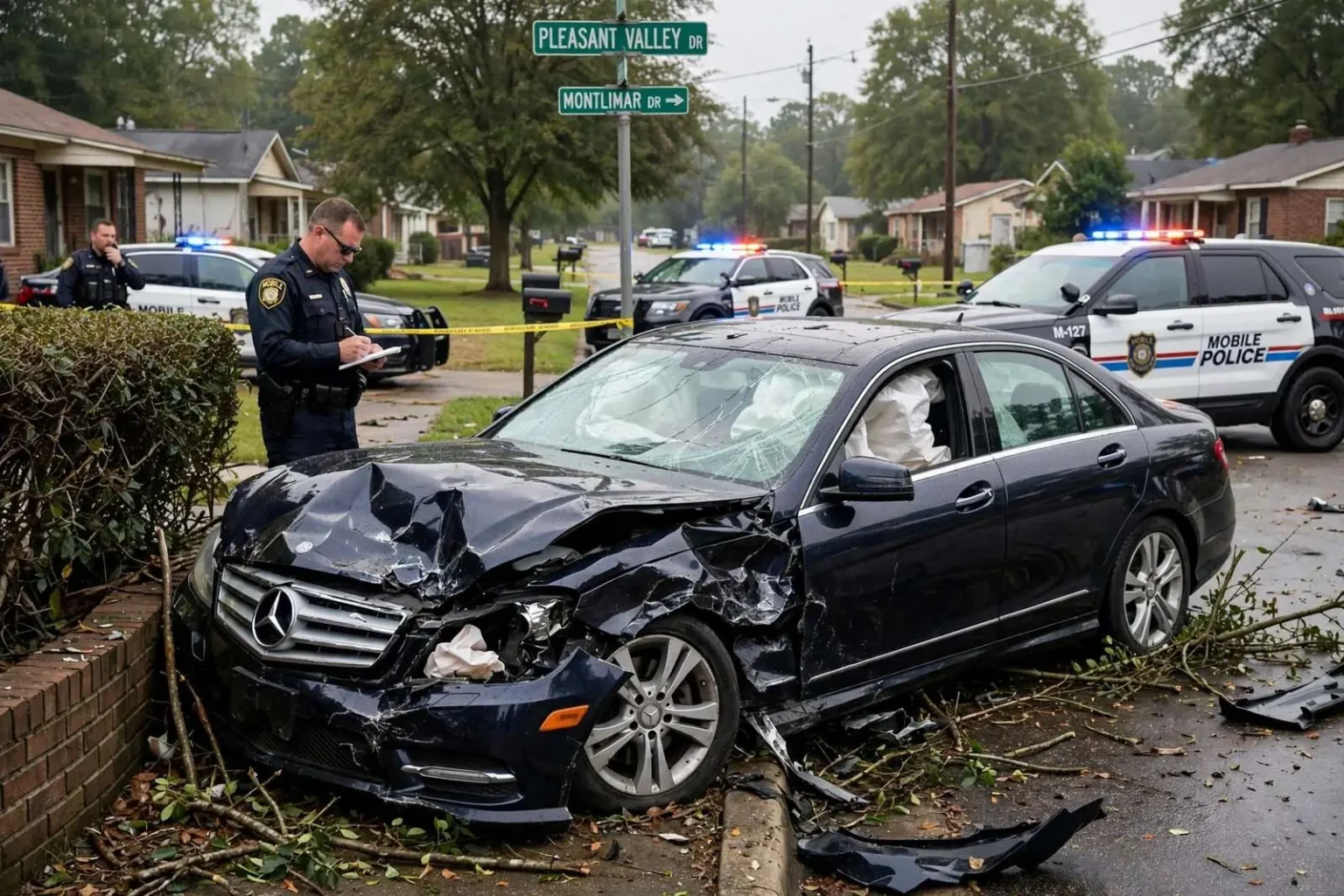
Mobile Police are investigating after a stolen Mercedes crashed during a short pursuit Wednesday morning, the third such chase in as many days. The string of pursuits put west Mobile streets at the center of three separate police operations in quick succession and left one family reunited with a damaged but recovered car.
According to investigators, officers spotted the stolen vehicle near Airport Boulevard and Azalea Road, one of west Mobile’s busiest intersections, where the two commercial corridors cross amid shopping centers, restaurants and office parks. When they tried to stop it, the driver fled. The car crashed a short time later near Pleasant Valley and Montlimar, a residential pocket of streets just south of the intersection where the chase began.
The distance involved was brief — a matter of blocks between the initial spotting and the crash — but the outcome was the ending officers hope for in any pursuit: the driver’s flight cut short without a collision involving innocent motorists, and a stolen vehicle off the streets. What happened next in the investigation would determine charges, and police said the case remained open while they worked it.
Three days, three pursuits
That the Mercedes crash marked the third chase in as many days drew attention on its own. Pursuits are among the most closely scrutinized actions in policing, and a cluster of them in a single week is unusual enough to register with residents who follow police activity in the area. Each pursuit follows its own facts — the suspected crime, the decision to pursue, the conditions on the streets — and departments evaluate them individually afterward.
The geography of the Wednesday morning incident is typical of west Mobile police work. Airport Boulevard runs east-west through the heart of the city’s western commercial district, and Azalea Road crosses it on the way south toward the interstate. Pleasant Valley and Montlimar sit nearby in a neighborhood of homes and small apartments, the kind of area where a fleeing driver’s options narrow quickly and a chase ends, as this one did, in a crash.
For the officers involved, the sequence — spotting a stolen car, attempting a stop, and seeing it flee — unfolds in seconds. The decision to pursue weighs the seriousness of the underlying crime against the risk the pursuit itself creates, a calculation departments across the country have tightened in recent years as the dangers of vehicle pursuits have become better understood.
The owner’s side of a stolen car
The car belonged to a daughter of Martie Lysas, who recognized it after watching a video of the chase. That moment — seeing your family’s car on the news as the subject of a police pursuit — is a jolt few owners anticipate, and it ended better than most such stories do.
“Relief, because at least we know they found our car,” Lysas said. Relief is the word stolen-car owners typically reach for when the search ends, even when the vehicle comes back damaged. A crashed Mercedes is a problem for insurance; a missing one is weeks of uncertainty about whether it will ever be found, stripped or shipped far from Mobile before anyone locates it.
She said the family was thankful to the Mobile Police Department despite the damage, since personal belongings inside the vehicle were recovered. That detail matters more than it might seem: cars stolen in this part of Mobile often carry the owner’s daily life in them, and items left inside are frequently gone by the time a stolen vehicle is found. The family got the car and its contents back, an outcome they credited to the department’s work.
“My daughter has a lot of her school stuff in her car so I think she was more worried about that than anything else,” Lysas said. The school belongings — the everyday materials of a student’s routine — were the family’s first worry once the car turned up, a reminder that the cost of auto theft is measured less in the vehicle’s blue-book value than in the disruption to the life that revolves around it.
How vehicle theft cases move forward
The investigation is ongoing. Once a stolen vehicle crashes and the driver is accounted for, detectives work backward: confirming the theft report, processing the car for fingerprints and other physical evidence, pulling footage from the businesses and traffic cameras that line the Airport Boulevard and Azalea Road corridors, and tracing how the vehicle came to be taken. The driver’s identity, the circumstances of the theft and any connection to other incidents all form part of the case file that determines what charges result.
Stolen vehicle cases often connect to wider patterns. Investigators routinely check whether a recovered car ties to other thefts, break-ins or pursuits, and whether the person behind the wheel was involved in the original theft or simply in possession of the vehicle afterward — a distinction with very different legal consequences. The crash itself adds a separate layer, since fleeing and eluding carries its own exposure once a pursuit begins.
For west Mobile residents, the morning served as a familiar drill: streets briefly occupied by a pursuit and its aftermath, a neighborhood crash scene while investigators worked, and a family getting its car back with a story to tell. The case remained in the hands of Mobile Police detectives, who said updates would come as the investigation allowed.
Living with vehicle theft on the Gulf Coast
Auto theft touches thousands of Gulf Coast drivers every year, and the aftermath follows a pattern owners describe almost identically: the disbelief of finding an empty parking space, the police report, the insurance calls, and then the wait — sometimes days, sometimes never — for word that the car has been found. When a recovery comes with damage, as this one did, owners face a second round of decisions about repairs, deductibles and whether the car will ever feel secure again.
Police departments consistently advise owners to take the precautions that make recovery faster and theft less likely. Locking vehicles, removing keys and fobs from sight, parking in well-lit areas and keeping records of valuables all shorten the distance between a theft and its resolution. Technology helps too — many modern vehicles can be tracked once a report is filed, and surveillance cameras along commercial corridors like Airport Boulevard have become routine tools for detectives tracing a stolen car’s route.
The belongings inside a vehicle deserve their own precautions, as the Lysas family’s focus on school materials illustrates. Documents, electronics, garage door openers and personal items left in a car multiply the harm of a theft, giving thieves identity information and access beyond the vehicle itself. Recovery teams recommend owners inventory what was inside as soon as they report the theft, both for insurance and for their own security.
What a pursuit review looks like
Every police pursuit generates a review. Supervisors reconstruct the route, the speeds, the traffic conditions and the timeline from initiation to termination, checking the pursuit against department policy on when to continue and when to call it off. The review exists because pursuits endanger everyone in the vehicle’s path — officers, the fleeing driver, and the public — and departments treat each one as a data point in refining when the risk is justified.
A chase that ends in a crash of the fleeing vehicle alone, with no bystanders hurt, is the least-bad outcome a pursuit can produce, and that is what Wednesday morning delivered. The review will examine whether the pursuit remained within policy throughout its short life, just as the investigation into the theft and the driver’s identity proceeds separately.
The week’s pattern in context
Three pursuits in three days will prompt attention beyond the individual cases. Residents who follow west Mobile police activity noticed the cluster, and the natural question is whether it reflects a trend — more stolen cars, more drivers willing to run, or simply coincidence compressed into a single week. Departments answer that question with data rather than impressions, comparing the week’s incidents against longer-term patterns before drawing conclusions.
What the three days demonstrate without ambiguity is the routine interplay between vehicle crime and police response in a busy urban corridor: cars get stolen, officers spot them, and some drivers make the situation worse by running. The Mercedes crash closed one of those episodes with a recovery, a grateful family and an ongoing investigation — the kind of ending that, in the world of stolen vehicles, counts as a good one.
Anyone with information about the stolen Mercedes or the events of Wednesday morning was encouraged to contact Mobile Police as the investigation continues. Tips from drivers and residents along the route — dashcam footage, camera video, or simply something seen from a porch — routinely become the details that close cases like this one, and investigators said the door remained open for whatever witnesses could add.