Study ranks Alabama the most car-dependent state in the nation
A CoPilot study using federal data ranks Alabama the most car-dependent state in the U.S., led by high vehicle-miles traveled and household car ownership.
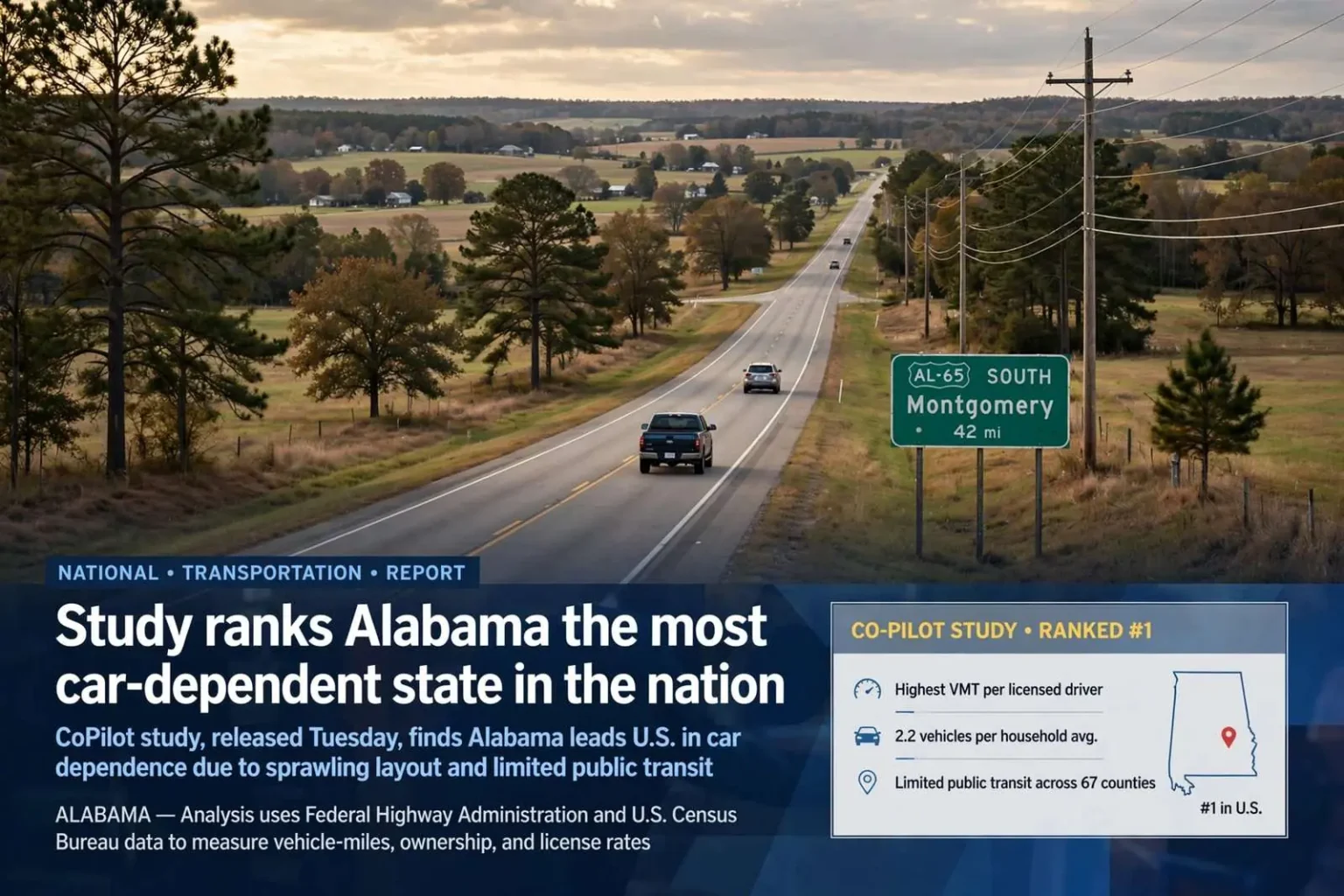
ALABAMA — Alabama is the most car-dependent state in the United States, according to a study released Tuesday by the automotive research company CoPilot. The analysis examined travel patterns, vehicle-miles traveled and vehicle ownership across the country, and it placed Alabama at the top of the national ranking for reliance on cars. The result reflects the state’s sprawling layout and limited public transit options across much of its rural landscape — a combination that makes the private automobile, for most Alabamians, less a choice than a necessity.
Researchers built a composite measure using data from the Federal Highway Administration and the U.S. Census Bureau. The index weighted annual vehicle-miles traveled per licensed driver at 40%, the average number of vehicles per household at 30%, the number of licensed drivers per 1,000 driving-age residents at 15%, and the share of working adults with at least one vehicle available at 15%. Those four measures, taken together, are designed to capture the whole shape of a state’s relationship with the car: how far its residents drive, how many vehicles they keep, how universally they hold licenses and how completely their working lives depend on having one.
The weighting tells its own story. Annual vehicle-miles traveled per licensed driver counts for the largest share of the index, on the theory that distance driven is the most direct evidence of dependence — a state where the average driver covers long distances to reach work, school and shopping is a state built around the car. Household vehicle ownership counts next, and the two remaining measures test whether the dependence is universal: whether nearly everyone who could hold a license does, and whether working adults can reach a job without one.
What the numbers measure
Each component of the index maps onto a visible feature of Alabama life. Vehicle-miles traveled, compiled by the Federal Highway Administration, runs high in a state where interstates and rural highways carry residents across long distances between spread-out destinations. The average number of vehicles per household reflects the multi-car household that becomes standard when no practical alternative exists — a household where two adults work in two different directions, with no transit connecting them, keeps two cars if it can.
The share of licensed drivers per 1,000 driving-age residents rises when driving is the only way to function, and Alabama’s figure fit the pattern the study described. In states with dense transit systems, a meaningful share of driving-age residents — students, retirees, city dwellers — simply never get licenses, because daily life can be arranged without one. In Alabama, the license arrives close in time to the sixteenth birthday and functions as a prerequisite for nearly everything that follows: the first job, the commute, the errands that define daily life in a place where the nearest grocery store may be a half-hour drive away.
The final component — the share of working adults with at least one vehicle available — measures the point where dependence becomes near-total. When almost every working adult in a state has a car available, employment itself is effectively gated by vehicle access, and workers who cannot drive or cannot afford a car are locked out of most of the job market. That is the condition the study found in Alabama, and it is the practical meaning of ranking first on a car-dependence index.
Why Alabama ranks where it does
The study attributed Alabama’s standing to the state’s sprawling layout and its limited public transit options across much of its rural landscape, and both factors are visible on the ground. Alabama is a state of long distances and dispersed destinations: its major cities anchor separate regions of the state, its suburbs stretch outward along highway corridors, and its rural counties hold small communities separated by miles of farmland and forest. Public transit in the state’s largest metropolitan areas — Birmingham, Montgomery, Huntsville, Mobile — consists of bus systems that serve limited routes, and in most of Alabama’s counties there is no public transit at all.
Mobile’s Wave Transit runs fixed bus routes across the city and Birmingham’s MAX system serves Jefferson County, but service in both is limited in frequency and coverage compared with metro areas of similar size elsewhere in the country.
The rural pattern is the decisive one. A county without a transit system leaves its residents with exactly two options for every trip — drive or depend on someone who does — and rural Alabama covers the majority of the state’s land area. The doctor’s office, the courthouse, the community college, the job: all sit in towns that may be twenty or thirty minutes away by car for the county’s outlying residents. In that geography, the car is infrastructure, as essential as electricity, and every measure in CoPilot’s index rises accordingly.
The economics of dependence
Ranking first in car dependence carries a cost, and Alabamians pay it per mile. Every household in a car-dependent state bears the expense of the vehicles the dependence requires — payments, insurance, fuel and maintenance multiplied across the multiple cars a household must keep on the road. Those costs fall hardest on the households least able to absorb them, because in a state where the job market assumes a car, the worker who cannot afford one loses access to work itself. Transportation economists have long noted that the burden of car dependence is regressive: the wealthiest households choose their second and third vehicles, while the poorest pay a disproportionate share of their income for the single car that stands between them and unemployment.
The state’s highway budgets reflect the same dependence from the public side. Roads and bridges are Alabama’s transportation system in a way that has no real parallel in states where rail, transit and highways share the load, and the state’s spending priorities follow. Maintenance backlogs, reconstruction projects and the perpetual widening of interstate corridors absorb transportation dollars that in other states are divided among modes — because in Alabama, if the road fails, nothing else carries the traffic.
Much of that road program is paid for with fuel taxes, including the state per-gallon gas tax increase enacted in 2019.
For the state’s economy, the index cuts both ways. Car dependence supports an enormous ecosystem of dealerships, repair shops, fuel stations and trucking that employs Alabamians across every county, and the state’s position along Gulf Coast shipping and interstate freight routes has made automotive manufacturing itself a pillar of the economy, with major assembly plants and their supplier networks clustered along the interstate corridors. The state that depends on cars most is also, fittingly, one of the states that builds them.
How the states compare
CoPilot’s ranking placed Alabama at the top of a spectrum on which the states at the other end are its near-opposites: dense, transit-rich places where a large share of households own no car at all and daily life proceeds on foot, bus and rail. The distance between those poles is the distance between geographies as much as policies — a state built before the automobile around harbor and rail, and a state whose settlement patterns were shaped by the automobile itself. Alabama’s cities grew outward as the car made growth possible, and the pattern locked itself in: suburbs along highway corridors, shopping centers sized to parking lots, and a transit system with no ridership base dense enough to expand.
Break the index into its components and the comparison becomes concrete. The 40% weight on annual vehicle-miles traveled per licensed driver rewards the long commute, and Alabama drivers post high annual mileage as a matter of distance between home and everything else. The 30% weight on household vehicle ownership captures the multi-car household, which in Alabama is close to the default. The two 15% measures — licenses per driving-age resident and vehicle availability among workers — capture universality, and it is on universality that Alabama separates itself: in most of the state, the answers are as close to “everyone” as measurement allows.
What it means for residents
For Alabamians, the study’s finding mostly confirms what daily life already teaches. The teenager counts the days until a license because the license is freedom in a way that has no substitute. The parent schedules the workday around school pickup because the school bus ends where the route ends. The retiree who can no longer drives loses independence abruptly, because the alternative — a ride from family, a senior service, a taxi forty miles out — is thin in most counties. Every household organizes itself around the number of drivers it has, and the study’s index is simply that way of life rendered in federal data.
The dependence also shapes the state’s policy debates. Proposals for expanding transit in the state’s metros, regional ride services for rural counties and passenger rail connections between major cities all run into the arithmetic that the study exposes: with a population this dispersed and this fully car-equipped, transit serves a narrow slice of trips at high cost per rider, and the political constituency for it is small. The result is a cycle that perpetuates itself — sparse transit keeps car dependence total, and total car dependence starves transit.
Change, where it comes, arrives slowly and at the edges. Demographic shifts in the state’s fastest-growing metros, the arrival of employers whose workforces include residents who cannot drive, and the aging of the state’s rural population all put incremental pressure on the assumption that everyone drives. For the foreseeable future, though, the study’s conclusion stands as a description of the state as its residents already know it: a place where the measure of independence is a set of car keys, and where almost no one — not the student, not the worker, not the retiree — gets through a week without one.
The study in context
CoPilot’s release of the study on a Tuesday made it the latest entry in a familiar genre: the state-by-state ranking that measures a condition residents already sense. What gives this one weight is its sourcing — Federal Highway Administration data on miles driven, Census Bureau data on ownership, licensing and vehicle availability — rather than survey impressions. The composite index does not claim to say anything about driving skill, safety or preference; it measures structure. Alabama ranked first because its structure leaves its residents no other way to move.
That structural reading is the useful takeaway from the ranking. A state that ranks first in car dependence is not a state whose people love driving more than others, and the study stops short of any such claim. It is a state whose distances, development patterns and transit gaps make the car the only practical instrument for daily life — a fact that households live every day, that the index now records, and that every future debate about transportation in Alabama will begin from.