
Suspect in jail after early morning shooting at Mobile’s Watering Hole
A 23-year-old man is in jail after two people were wounded in an early morning shooting at the Watering Hole on Old Shell Road in Mobile.
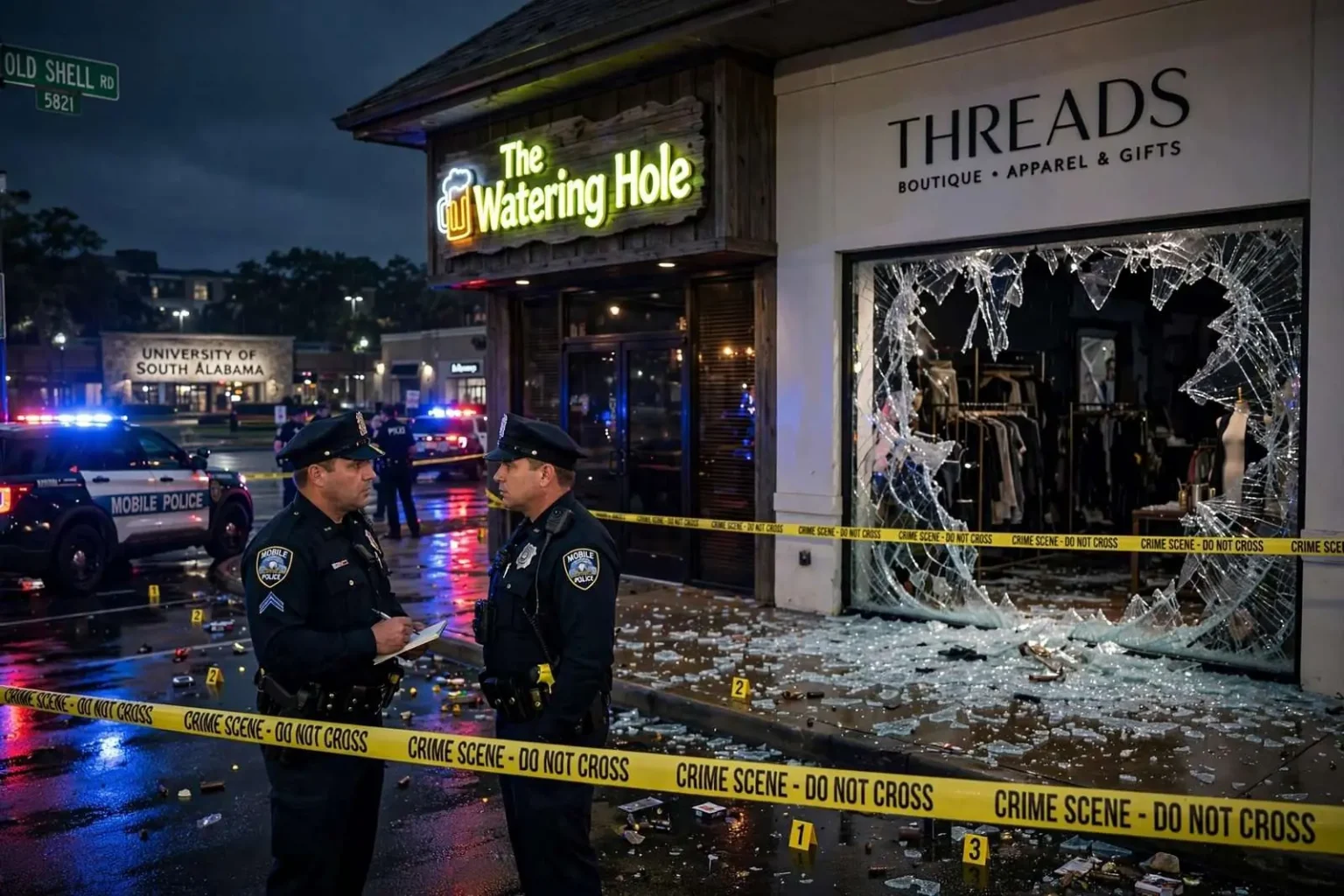
A suspect is behind bars after two people were hurt in an early morning shooting at a Mobile business. According to a Mobile Police news release, officers responded around 2:45 a.m. to the Watering Hole at 5821 Old Shell Road after receiving a report of two people shot. The call brought officers to a west Mobile commercial strip in the pre-dawn hours, a time and place that shaped much of what the investigation would involve.
Upon arrival, officers found two adult male victims in the parking lot suffering from gunshot wounds. Both victims were taken to the hospital. One was listed in critical condition and the other in stable condition, and their treatment set the first hours of the case on two tracks at once — medical teams working to stabilize the wounded men, and detectives working to establish who fired and why.
During the investigation, a male suspect turned himself in to police. Paul Baldwin, 23, was arrested. Jail records indicate it was his first time being booked into Mobile Metro Jail, a detail that marked the case as the suspect’s first documented entry into the county’s adult booking system even as the victims’ conditions remained uncertain.
The incident happened in a shopping center across the street from the University of South Alabama campus. A large window of a nearby clothing boutique was smashed, which a witness attributed to the shooting. The damage placed a second business at the center of the crime scene, and investigators documented the broken glass and any bullet damage as part of reconstructing the sequence of events in the parking lot.
The scene on Old Shell Road
The Watering Hole sits in a shopping center along Old Shell Road, one of Mobile’s principal east-west corridors, directly across from the University of South Alabama’s main campus. The area is a familiar landscape to students, faculty and area residents: quick-service restaurants, small shops, apartments and nightlife businesses clustered along the roadway where the campus meets the surrounding neighborhoods. A bar in that location draws its share of late-night traffic, and the 2:45 a.m. shooting report came at the hour when patrons are dispersing and parking lots are at their emptiest except for the people leaving them.
Officers arriving in those first minutes face a standard and difficult sequence. The parking lot is secured as a crime scene, victims are prioritized for medical care, potential witnesses — often few at that hour — are identified and separated, and surveillance cameras from the businesses in the center are canvassed for footage. A smashed boutique window adds physical evidence and a probable link to the gunfire, whether caused by a stray round or by the chaos of people fleeing.
The shopping center’s proximity to the USA campus guarantees attention when violence occurs there. University students live in apartments and rental housing throughout the surrounding blocks, and parents across the state send students to the area each fall with the assumption that the commercial corridors serving campus are safe. Incidents like the Watering Hole shooting test that assumption and prompt the kinds of patrol adjustments — increased late-night presence along Old Shell Road — that police departments make in response to concerns from the university community.
The arrest and the jail record
The suspect’s decision to turn himself in during the investigation resolved the search that detectives would otherwise have conducted. Paul Baldwin, 23, was arrested and booked into Mobile Metro Jail, the facility that serves Mobile County’s municipal and county agencies. Jail records indicating a first booking mean that, at least under that name, the suspect had no prior stay in the county’s adult jail — a notable detail in a case involving gunfire that wounded two people and left one fighting for his life.
First bookings carry significance in how the justice system processes a case. A defendant with no prior record faces different bail arguments, different prosecutorial assessments and, if convicted, different sentencing considerations than a repeat offender. In the hours after the arrest, the case’s early posture — the victims’ conditions, the charges filed, and the evidence gathered from the scene — determined how seriously the file would weigh in those decisions. A critical-condition victim sharpened the stakes considerably, since prosecutors factor a victim’s outcome directly into charging decisions for violent crimes.
Turning oneself in also shapes the case’s narrative. Suspects who surrender during an investigation typically do so through counsel or with family assistance, and the act removes the dangers of a manhunt — armed encounters, extended searches and the public-safety risks of an at-large suspect. For the neighborhood around Old Shell Road, the arrest in the investigation’s early hours provided the reassurance that a suspect was in custody while the victims were still being treated.
Police procedure in a late-night bar shooting
Shootings at late-night businesses present investigators with a familiar set of challenges. Witnesses are frequently patrons who have been drinking, whose accounts must be corroborated, and who disperse quickly once the immediate danger passes. Cameras help fill the gaps: bars, storefronts and nearby intersections often hold the footage that establishes who was present, when the shots were fired and which direction people fled. In a shopping center like the one at 5821 Old Shell Road, multiple businesses’ cameras pointing across a shared parking lot can effectively document the entire scene.
Physical evidence matters equally. Shell casings mark where a shooter stood; bullet strikes in vehicles, walls and storefront glass map the gunfire’s paths; and the victims’ wounds, documented by trauma teams, help establish positions and distances. The smashed boutique window that a witness attributed to the shooting fit into that reconstruction — either as a round’s destination or as damage from people fleeing — and its repair became part of the businesses’ recovery while the criminal case moved forward.
Mobile Police Department detectives handle cases of this kind through the department’s investigative structure, coordinating with the district attorney’s office on charges. The department’s news release, the source for the account above, represents the standard channel by which such cases enter the public record: the time and location of the call, the condition of victims, and the arrest that followed.
The context: late-night violence near campus
The Watering Hole case joined a longer pattern of concern about late-night violence in commercial districts near the university. Cities across the country have wrestled with the safety of businesses that operate in the hours when alcohol service ends and crowds disperse, and Mobile is no exception. Late-night incidents tend to involve a limited set of locations and hours, which allows police to focus patrols, and the department’s response to such patterns includes visibility in parking lots, coordination with business owners on lighting and camera coverage, and follow-up with the establishments where incidents recur.
For the businesses in the shopping center, the aftermath included more than the boutique’s broken window. Foot traffic dropped after a shooting; owners installed or upgraded cameras; and conversations with police about security became routine. Centers like the one at Old Shell Road serve the campus community daily, and their economic health depends on customers feeling safe both in the stores and in the parking lots that connect them.
The two victims taken to the hospital represented the human cost of the night: one man in critical condition, another stable, their families arriving at trauma center waiting rooms in the hours after the 2:45 a.m. call. The suspect’s arrest, his first booking into Mobile Metro Jail, and the charges that followed set the case on the legal track where its resolution would occur — a track that began, as these cases do, with officers in a dark parking lot, gunshot victims on the pavement, and a shattered storefront window telling the earliest part of the story.
The victims and the hospital response
The two men found in the parking lot were transported to the hospital with wounds of very different severity, and the distinction between critical and stable condition mattered immediately for everyone involved. For the family of the critically wounded victim, the hours after the shooting were spent at the hospital awaiting updates from trauma surgeons; for detectives, a critical victim represented both a human emergency and a potential complication, since the loss of a victim transforms the case from an assault investigation into a homicide investigation.
Mobile’s trauma resources are concentrated at the city’s hospitals, which handle the region’s gunshot victims alongside the everyday emergencies of a Gulf Coast metro. Trauma teams activate for patients with serious penetrating injuries, and the survival of shooting victims often turns on the speed of transport and the readiness of surgical teams — factors that begin with the officers who secure a scene and summon EMS promptly. In the Watering Hole case, the quick arrival described in the news release meant the wounded men reached surgical care within the window that trauma medicine treats as decisive.
The second victim’s stable condition offered the investigation a witness as well as a patient. Victims who survive frequently provide the most direct account of what happened, and detectives coordinate with medical staff to speak with wounded men as their conditions permit. The combination of victim accounts, witness statements and surveillance footage forms the evidence base on which charges are built in cases like this one.
What comes after the arrest
Following a booking into Mobile Metro Jail, the suspect’s case moves through the early stages of the criminal process: an initial appearance before a judge, the setting of bond, and the district attorney’s review of the evidence for formal charges. Charges in a parking-lot shooting that wounds two people can range from assault counts to attempted murder depending on the evidence of intent, and a victim’s death would add homicide counts. The prosecutors’ decisions typically follow the conclusion of the medical treatment picture, since the victims’ ultimate outcomes shape the offenses available.
For the suspect, a first booking does not guarantee leniency, but it does mark the beginning of a record. Defendants charged with serious violent crimes in Mobile County face the circuit court system, where cases of this gravity move through grand jury indictment and trial preparation over months. Defense counsel will examine the evidence gathered in the parking lot — the shell casings, the camera footage, the smashed window — and the case’s strength will be tested as it proceeds.
The community’s stake in that process is straightforward. A shooting across the street from a university campus, in a shopping center where students and families shop daily, draws attention not just to the individuals involved but to the conditions that allowed it: the late hour, the weapons on the street, and the security of the businesses that anchor the corridor. The arrest answered the immediate question of public safety; the court process that follows answers the question of accountability, and it runs on the evidence collected in the first hours after that 2:45 a.m. call to Old Shell Road.
What the record preserves, in the end, is the sequence that Mobile residents know from similar cases: a late-night report of gunfire, two wounded men in a parking lot, a fast police response, a suspect in custody by way of his own surrender, and a neighborhood — anchored by the university across the street — waiting to learn whether the victim in critical condition would survive. The Watering Hole shooting entered the city’s record in those terms, and its resolution belonged to the courts that handle such cases.