
Suspect in Mobile Bubble Lounge Shooting That Wounded Employee Turns Himself In
Mobile police say Elijah McCarty surrendered after a July shooting outside the Bubble Lounge left a bar employee wounded.
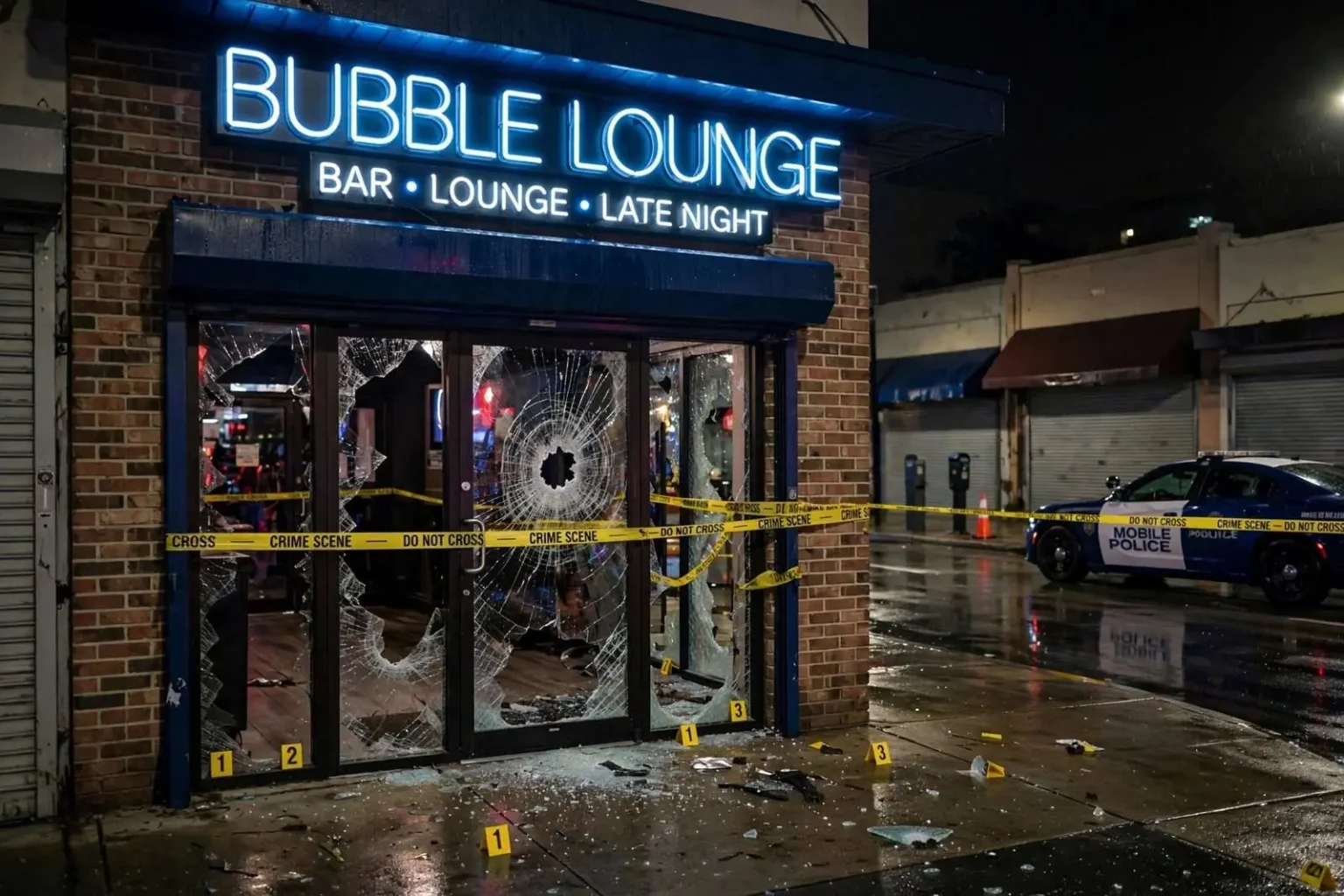
The man Mobile police say fired shots through the door of a local bar and wounded an employee is now in custody, after surrendering to authorities this week. According to the Mobile Police Department, 22-year-old Elijah McCarty turned himself in at the Mobile County Metro Jail on Monday, ending a search that began after a shooting at the Bubble Lounge in mid-July.
Investigators had identified McCarty as a suspect in the July 15 shooting, which sent one bar worker to the hospital with a gunshot wound. Details about how officers came to name McCarty as the suspect have not been released, but police confirmed that his surrender at the jail facility on Monday closed the manhunt phase of the case. What remains is the legal one, as the investigation stays active and prosecutors weigh formal charges connected to the early-morning shooting.
The case is the kind that Mobile police and prosecutors handle routinely but that residents never get comfortable with: gunfire outside a business in the middle of the night, a worker hurt while simply doing a job, and a suspect whose capture depends on witnesses, detectives and, in this instance, a decision to walk into the jail and turn himself in.
How the Night Unfolded
Officers were called to the Bubble Lounge around 3 a.m. on Friday, July 15, on a report of shots fired. According to police, a man had been refused entry to the bar shortly before the shooting. Moments after being turned away, that man fired shots into a door of the establishment, and at least one of the rounds struck an employee who was inside.
The wounded worker was taken to a local hospital for treatment. Police have not released the employee’s name or an account of his or her condition in the days since the shooting, which is consistent with how such cases are typically handled while an investigation is underway. What police did confirm was the basic sequence: a denial at the door, gunfire aimed at the business itself, and an innocent bystander on the payroll caught by the rounds.
Firing into an occupied business carries serious exposure under Alabama law, and investigators treat cases like this one as potentially among the most serious they handle, since a bullet fired through a door cannot be aimed at any particular person. The fact that the victim was an employee rather than a patron underscores the indiscriminate nature of the act, and it is likely to factor into any charging decisions that follow.
Mobile police typically assign shooting cases of this kind to detectives who work the scene, collect shell casings, review any surveillance video from the business or neighboring properties, and interview witnesses who were present at the time. Bars along many of Mobile’s commercial corridors keep camera systems, and that footage often proves decisive in identifying a suspect when no one is struck or when victims cannot immediately provide a description.
The Search and the Surrender
In the weeks between the shooting and Monday’s surrender, McCarty was identified as the suspect and presumably became the subject of a warrant or an active effort to locate him. Police have not detailed the intermediate steps, but the standard path in such a case is for investigators to present evidence to a magistrate, secure an arrest warrant, and then either locate the suspect or wait for the suspect to surface.
Surrendering at the Mobile County Metro Jail, rather than being taken into custody during a traffic stop or a raid, is a decision that defense attorneys sometimes advise because it demonstrates cooperation and spares a client the added complications of a resistance or flight. The jail, located on St. Stephens Road, is the main intake facility for people arrested in Mobile County and books arrestees from city police departments across the area.
By turning himself in, McCarty spared everyone the uncertainty of an open manhunt, but the surrender is not a legal judgment in his favor. It simply means the case now moves to the next phase, where prosecutors, not police, control what happens next.
What Comes Next in the Court Process
Because the investigation remains active, officials have not said what specific charges prosecutors will pursue. In Alabama, the decision on formal charges in a case like this typically falls to the Mobile County District Attorney’s Office, which reviews the evidence gathered by detectives and files the appropriate counts, whether assault-related, shooting-into-an-occupied-vehicle-or-building, or some combination depending on what the facts support.
Shooting into an occupied building is a felony under Alabama law even when no one is injured, precisely because of the randomness of the danger it creates. When someone is wounded, prosecutors can pursue assault charges as well, and the range of potential penalties depends on the degree of injury and the circumstances the evidence establishes. A person struck by gunfire inside a business faces potential long-term consequences, and the law reflects that severity in the exposure a defendant faces if convicted.
After formal charges are filed, an arrestee booked into the Metro Jail appears before a judge for an initial hearing, where bond is set and the defendant learns what he is accused of doing. From there, the case proceeds through the district court system in Mobile County, with preliminary hearings, grand jury review when required, and ultimately either a plea agreement or a trial.
None of those steps has happened yet in this case, at least not publicly. The active status of the investigation suggests that detectives may still be completing work that supports the charging decision, or that prosecutors are still reviewing what has been gathered. Either way, the surrender has moved the case from an open investigation with no one in custody to a standard prosecution track.
The Bubble Lounge and Mobile’s Nightlife Landscape
The Bubble Lounge is one of the many small bars and nightclubs that operate across Mobile, particularly in areas where late-night business is common. Establishments like it employ bartenders, servers, door staff and cleaners, and the people who work those hours are exposed to the same risks that come with any late-night business: intoxicated patrons, disputes at the door, and, occasionally, violence that spills over from arguments that begin inside or outside the premises.
Door decisions — who gets in and who does not — are among the most common flashpoints in bar-related violence across the country. A person refused entry may react angrily, and in the worst cases, that anger turns to gunfire directed at the building, with no regard for who is inside. In this case, the person who paid the price was an employee, not the person who made the door decision, a detail that stands out even among the routine reports of bar-area shootings that police handle each year.
Mobile police have worked for years to address late-night violence in and around the city’s commercial and entertainment areas, including increased patrols during peak hours in corridors where bars cluster. Businesses themselves take precautions as well, from camera systems to private security to coordination with officers who work the overnight shift. None of it eliminates the risk entirely, as this case shows, but it is part of the reason the suspect was identified relatively quickly and why an arrest, even through a voluntary surrender, came about.
The Road Ahead for the Case
For the wounded employee, the arrest of a suspect is a meaningful step, though it does not undo the injury. Victims of gunfire often face long recoveries, medical bills and time away from work, and the criminal case, whatever its outcome, is only one part of the aftermath. Alabama does provide some support for victims of violent crime, including compensation programs administered at the state level that can help qualifying victims with certain out-of-pocket expenses tied to their injuries.
For people who live and work near the Bubble Lounge, the surrender is reassurance that the person police believe responsible is no longer at large. In neighborhoods where late-night businesses operate, an unsolved shooting can leave residents uneasy for weeks, and news that a suspect is in custody tends to settle those fears even before the case itself is resolved. Business owners in the area, meanwhile, will likely keep watching how the case progresses, since outcomes in cases like this one shape how seriously potential troublemakers take the consequences of violence near local establishments.
Police have not said whether additional arrests are expected or whether anyone else was involved in the July 15 shooting. The active status of the investigation leaves that question open, and authorities have generally encouraged anyone with information about a case like this to come forward, either directly to detectives or through the department’s tip channels, which allow callers to share what they know without giving their names. Tips from the public routinely make the difference in cases where camera coverage is incomplete or witnesses hesitate to get involved, and investigators weighing formal charges will want every available statement on the record before the file leaves their hands.
The immediate facts, though, are settled: a worker was shot and wounded while on the job, a suspect was identified and taken into custody without incident, and on Monday that suspect walked into the Mobile County Metro Jail and gave himself up. From here, the case belongs to prosecutors and, eventually, to a judge or jury. For the employee who was struck, and for the city’s late-night workforce more broadly, it is the closest thing to accountability the system can offer while the courts do their work.