SUV catches fire in Chickasaw bank parking lot
An SUV caught fire in a Chickasaw bank parking lot Tuesday evening; no injuries were reported, and the cause of the fire remains under investigation.
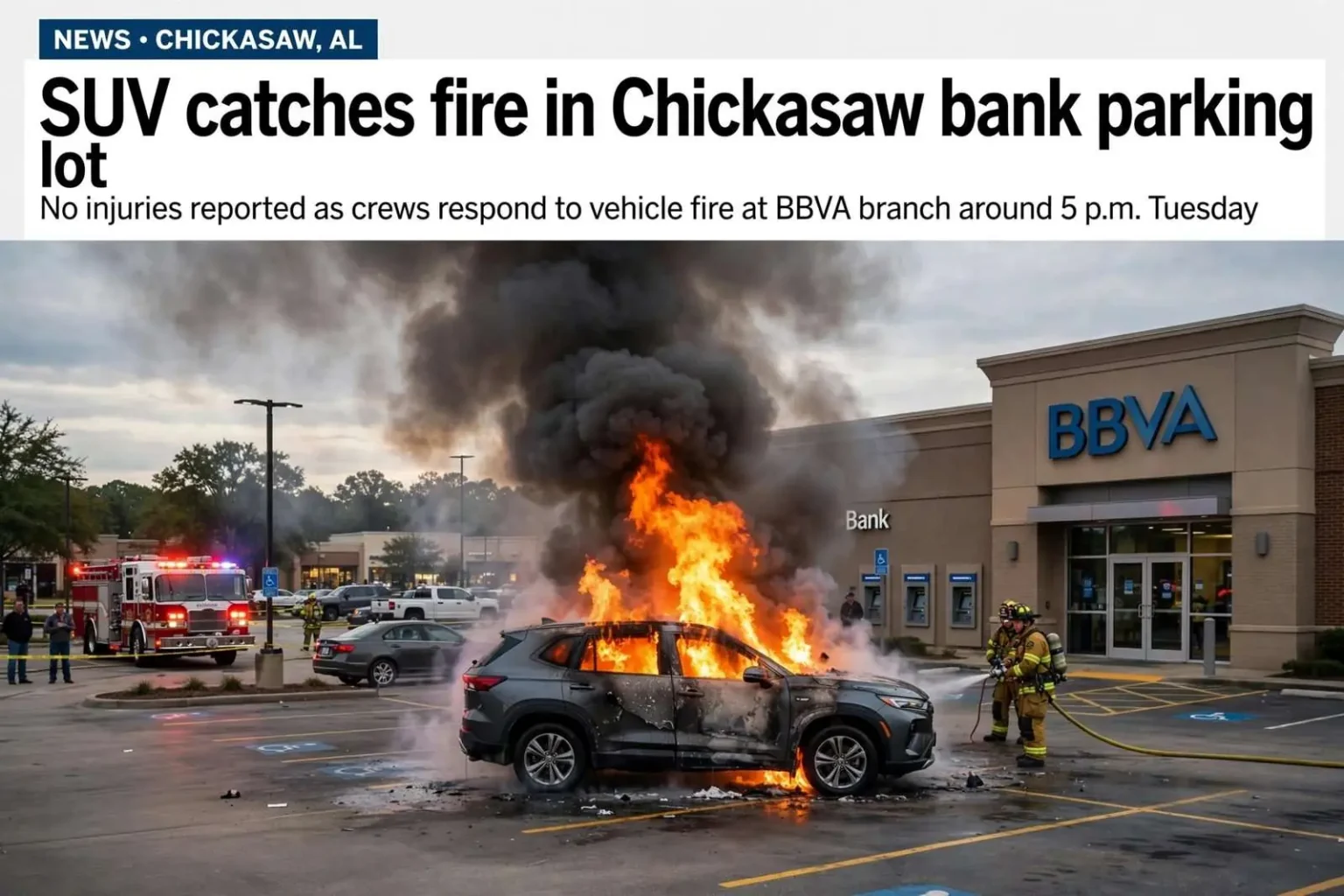
CHICKASAW — An SUV caught fire at the BBVA bank in Chickasaw around 5 p.m. Tuesday, sending flames and smoke billowing from inside the vehicle in a parking lot that drew onlookers and a rapid emergency response. No injuries were reported in the blaze, which unfolded at one of the busiest times of the afternoon for a branch parking area, when customers and employees are typically moving in and out of the lot. The sight of a burning vehicle in the middle of a commercial parking lot is rare for the small Mobile County city, and the response to it demonstrated how quickly local emergency resources mobilize when fire breaks out close to occupied businesses.
Vehicle fires move fast. A fire that begins inside the passenger compartment or engine bay of a modern sport utility vehicle can escalate within minutes, as interior materials, fuel lines, lubricants, and plastic components feed the flames. In this case, witnesses saw flames and heavy smoke coming from within the SUV, the pattern typical of a fire that has reached the interior after starting elsewhere in the vehicle. Fires of that kind produce thick, toxic smoke that can carry across a parking lot with the wind, which is one reason responders ask bystanders to keep their distance and why nearby buildings are monitored when a vehicle burns close to them.
The timing of the fire, at roughly five in the afternoon, placed it during the heart of the post-work rush, when roads and parking lots around the city fill with drivers heading home. A burning vehicle in a bank parking lot at that hour creates immediate complications: customers arriving for late-afternoon transactions, vehicles needing to be moved out of the danger zone, and passersby slowing to look. First responders arriving at such a scene typically prioritize several things at once, confirming that everyone is out of the vehicle, protecting nearby structures and parked cars from the heat, and blocking off enough space for engines to work safely.
Chickasaw and Its Emergency Services
Chickasaw is a small city in Mobile County, incorporated in 1946 and sitting just north of Prichard along the corridor that connects downtown Mobile to the northern suburbs and the industrial riverfront beyond. The city grew up around shipbuilding and industrial work in the first half of the twentieth century, and its compact residential core gives it the character of a close-knit community where word of an incident like a vehicle fire spreads quickly. For a city of its size, Chickasaw maintains its own police department and relies on a combination of local and mutual-aid fire response, an arrangement common among the small municipalities that ring Mobile.
Fire response in the small cities of Mobile County operates on a system of mutual aid, in which neighboring departments assist one another when a call requires more resources than one department can field. A vehicle fire is generally a manageable call for a single engine company, requiring water supply, hand lines, and the protective equipment that keeps responders safe from the hazards a burning vehicle presents. But the locations where vehicle fires occur are rarely convenient, and a fire in a commercial parking lot requires attention to exposures, the businesses and vehicles adjacent to the burning car, in a way a fire in an open parking area would not.
The bank setting added its own considerations. A branch parking lot in the late afternoon holds customers’ vehicles close to the fire, and heat from a fully involved vehicle can damage or ignite nearby cars long before flames actually spread across the pavement. Emergency responders typically clear a perimeter around the burning vehicle, and any cars within that zone may be moved or shielded if conditions allow. The bank’s building, with customers and staff inside, sits within that calculation as well, and responders keep an eye on how wind and heat behave in the lot as the fire burns down.
Why Vehicles Catch Fire
Vehicles catch fire for a range of reasons, and investigators generally sort them into a few familiar categories. Mechanical failures, including leaking fuel lines, failing fuel pumps, and engine problems that allow flammable fluids to contact hot surfaces, are among the most common causes. Electrical problems rank alongside them, from wiring faults and battery issues to aftermarket accessories installed without proper protection. Collisions can ignite fires, though many vehicle fires happen without any crash at all, and in some cases fires are started deliberately. Determining which of these applies requires an examination of the remains, which fire investigators conduct once the flames are out.
Modern vehicles carry both more fuel and more potential ignition sources than the models of decades past. A typical SUV holds not only a tank of gasoline but a web of electrical systems, plastic components, lubricants, and in some cases high-voltage battery packs, and each of those elements changes how a fire behaves and how hard it is to extinguish. Burning vehicles release heat that is intense enough to damage pavement, shatter glass at a distance, and set off the vehicle’s own tires and fuel system in stages, which is why firefighters approach even a seemingly small vehicle fire with full protective gear and a wide safety margin.
For the public, the most important lessons about vehicle fires concern early recognition and quick decisions. Drivers who notice smoke, a burning smell, or electrical problems while operating a vehicle are advised to pull over, shut the engine off, and get everyone out of the vehicle immediately, moving well away rather than trying to retrieve belongings or investigate under the hood. Once out, the guidance is to stay back and call 911, because opening a hood or approaching a burning vehicle exposes a person to flare-ups that can erupt without warning. In parking lots, bystanders should move themselves and their vehicles away and let trained crews handle the fire.
No injuries were reported in the Chickasaw fire, an outcome that reflects both the timing and the response. Vehicle fires in occupied parking areas carry the risk of injury to drivers, passengers, and bystanders, and fires that break out while a vehicle is occupied, or close to people who approach to help, too often end differently. That this fire ended with property damage alone is the result that every part of the response works toward, from the driver or witnesses who got information to emergency crews quickly to the responders who kept the scene under control while the vehicle burned.
After the Flames Are Out
Once the fire is extinguished, a vehicle fire scene changes but does not immediately clear. Burned vehicles remain hazardous, with hot components, unstable remains, fluids that leak onto the pavement, and the possibility of rekindling if fire has worked into materials that hold heat. Fire crews typically remain on scene to monitor the wreckage, and the vehicle is eventually removed by a towing service equipped to handle burned-out cars. The pavement beneath and around the vehicle is often stained by fuel, oil, and firefighting water runoff, and property owners in commercial lots sometimes face cleanup after the emergency itself is resolved.
The investigation that follows aims to determine where and how the fire started. Fire investigators examine the pattern of burning on the vehicle, which points back toward the area of origin, and look at the vehicle’s mechanical and electrical systems for evidence of a failure that could have ignited the blaze. Insurance companies take a strong interest in those findings, since vehicle fire claims involve questions of cause and coverage. In cases where investigators find evidence that a fire was set intentionally, the matter becomes a criminal investigation, and the findings are handed to law enforcement for that separate track.
For the businesses in the lot where the SUV burned, the episode passes quickly in operational terms once the scene is cleared, but it leaves behind the kind of story that residents of a small city retell for years. A parking lot at a bank branch is one of the most ordinary settings in town, and seeing it transformed for an hour or two into the site of a fully involved vehicle fire makes an impression. The essential facts of the Chickasaw fire were simple: an SUV caught fire around five in the evening on a Tuesday, flames and smoke poured from inside the vehicle, crews responded and brought the fire under control, and no one was hurt. In the ledger of vehicle fires, that combination is the best available outcome, and it is the one that the drivers, bystanders, and responders at the scene can be grateful for.
Bank branches hold a particular place in the commercial geography of cities like Chickasaw. Branch locations anchor small commercial strips, generate steady daily traffic, and serve customers who may bank at the same corner for decades, which is why a disturbance in a branch parking lot registers with so many people. The banking industry itself has gone through enormous change in recent years, with mergers consolidating familiar names under larger banners and online banking reducing some of the daily traffic that branches once handled. Even so, branches remain community landmarks, and incidents at them are remembered in the way that incidents at a town’s most familiar corners always are.
Fire departments across the Gulf Coast respond to vehicle fires as a routine part of their call volume, but routine does not mean risk-free. Nationally, fire services treat vehicle fires as among the more hazardous ordinary calls, because of the stored energy in fuel systems, the toxicity of burning automotive materials, and the unpredictability of components that can fail violently as heat builds. Struts can become projectiles, fuel tanks can vent explosively, and modern materials burn hot enough to require sustained water application. The crews that responded to the Chickasaw parking lot worked with all of that in mind, which is why vehicle fire scenes look the way they do, with apparatus positioned at a distance and crews advancing lines from protected angles.
For residents who witnessed the fire, the afternoon offered an unplanned lesson in how quickly ordinary situations become emergencies. A vehicle parked while its owner runs an errand can develop a fire from a fault the owner never suspected, and the escalation from first smoke to fully involved can happen in the time it takes to walk across a parking lot. The advice that fire officials repeat after incidents like this one is consistent: report fires immediately, keep clear, and never assume a burning vehicle will burn itself out harmlessly. Those habits, applied by the first people to notice trouble, are often the difference between a property loss and a tragedy.
As Chickasaw moves past the episode, the visible signs will disappear quickly. The burned SUV will be towed away, the parking lot will be cleaned, and the bank branch will carry on with the business of its neighborhood. What remains is the record of an afternoon when a city’s emergency response worked as intended, a fire that could have injured people instead ended with none, and a community briefly gathered around a scene that reminded everyone how fast ordinary life can change. The essential facts, an SUV on fire at the bank around five o’clock on a Tuesday, flames and smoke visible from inside the vehicle, and no injuries reported, tell a complete story on their own, and they are the facts by which the day will be remembered.