As Hanukkah arrives this month, Mobile’s Jewish community traces a presence in the city back more than 250 years, to the 1760s. That long history has shaped two congregations that remain active in the Mobile Bay area today.
Jewish settlers were arriving in Mobile while it was still a colonial outpost on the Gulf — a French-founded town that had passed into British hands in 1763, opening it to a wider range of European settlers. Jewish merchants were part of the commercial life of the Gulf Coast from those early years, and their presence has continued, unbroken, through Spanish rule, American statehood, Civil War, and every era since. Few religious communities anywhere in Alabama can claim a local history that stretches back further.
The holiday being celebrated this month is a fitting lens for that longevity. Hanukkah, the eight-day Festival of Lights, commemorates the rededication of the Second Temple in Jerusalem more than two thousand years ago, and its themes of endurance and continuity resonate in a community that has sustained itself in a Gulf Coast port city for two and a half centuries.
Two Congregations, Two Traditions
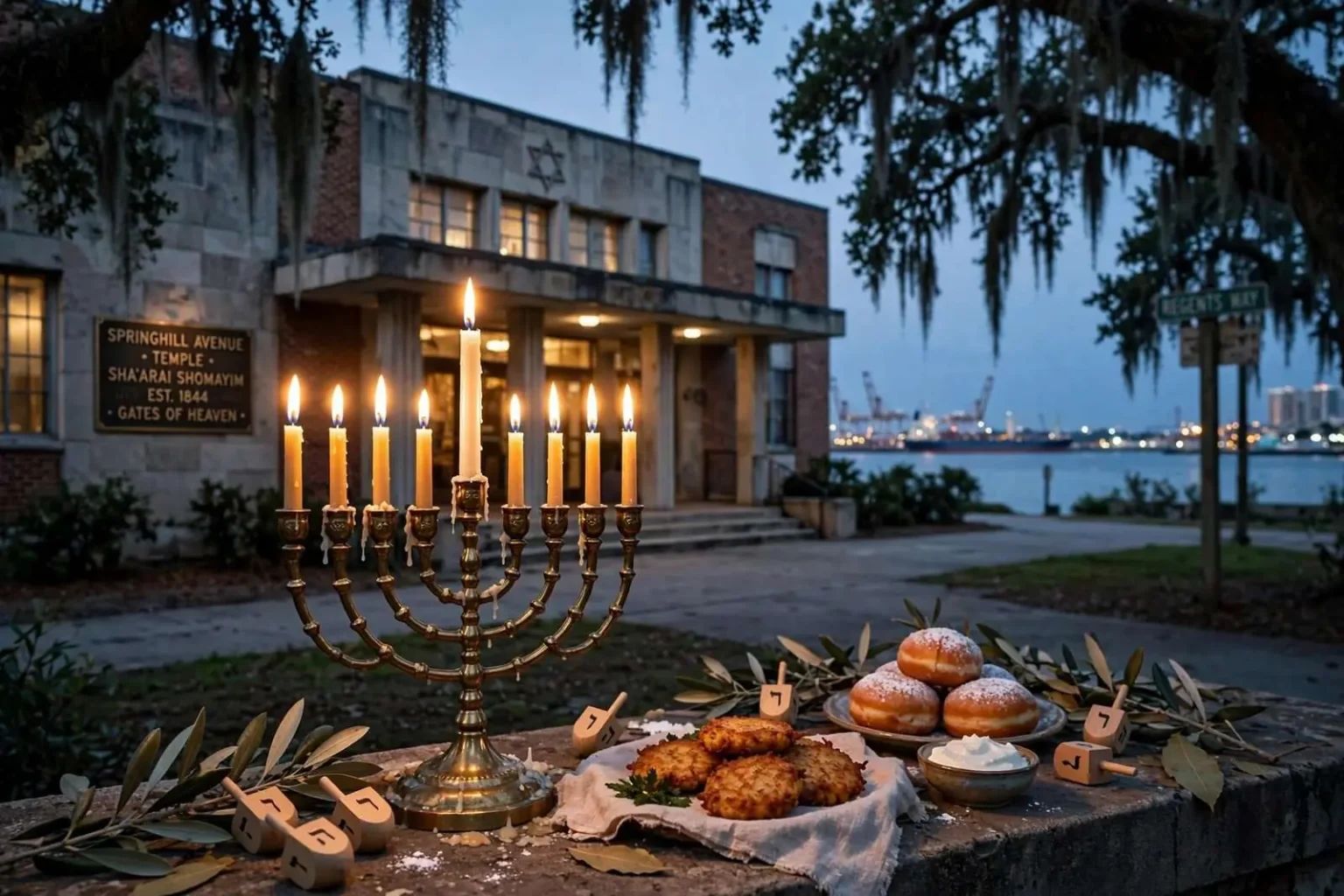
The Reform Congregation Sha’arai Shomayim — known in English as “Gates of Heaven” and formally organized as the Society of Friends of the Needy — was founded in 1844, making it the oldest Jewish congregation in Alabama and among the oldest in the United States. The congregation’s current home, Springhill Avenue Temple, was completed in 1954.
That founding date places Sha’arai Shomayim in the first wave of organized Jewish religious life in the American South. The mid-nineteenth century was the era when Jewish communities across the region moved from informal gatherings in homes and storefronts to chartered congregations with buildings, cemeteries, and rabbis — and Mobile’s congregation was among the earliest in the entire country to make that transition.
A later wave of Jewish immigration, largely from Russia and Eastern Europe, led to the founding of the Ahavas Chesed Congregation in 1894. That congregation is now located on Regents Way. The immigrants who founded Ahavas Chesed arrived in the great eastern European migration that transformed Jewish America in the decades around the turn of the twentieth century, and many came to Mobile through the port or by rail from the port cities of the Eastern Seaboard, joining the established community their predecessors had built a half-century earlier.
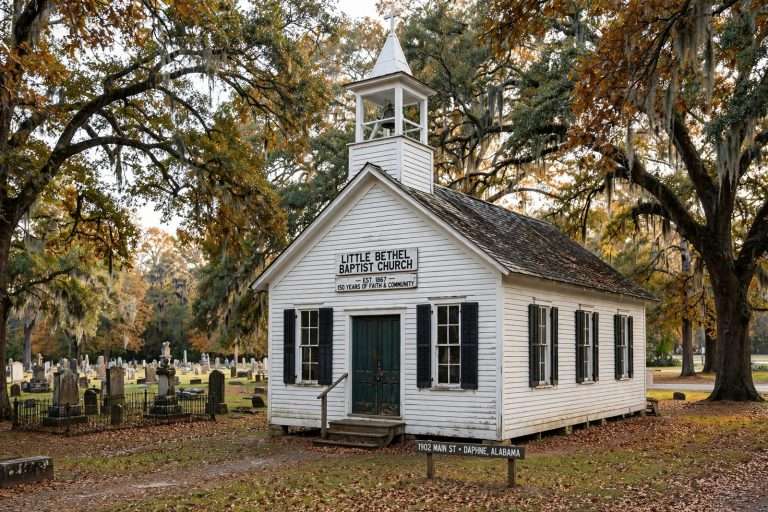
Both congregations maintain cemeteries near Magnolia Cemetery in Mobile, the historic burial ground that holds generations of the city’s most prominent families. The adjacent Jewish cemeteries are among the oldest continuous Jewish burial sites in the Deep South, and they trace, stone by stone, the same community history that the congregations’ buildings record.
A Lasting Civic Imprint
Jewish Mobilians have long been active in civic and social life beyond their congregations. Two of the city’s historic Mardi Gras organizations, the Comic Cowboys and the Fidelia Club, were predominantly Jewish, and Thomas Cooper De Leon, who founded the Mobile Carnival Association, was Jewish as well.
That Mardi Gras connection is a distinctive feature of Mobile’s Jewish history. Mobile is the original home of American Carnival, celebrating weeks before New Orleans borrowed and grew the tradition, and its mystic societies have shaped the city’s social hierarchy since the 1830s. The Comic Cowboys, founded in the 1880s, became famous for satirical parades and newspaper broadsides skewering local politics and society, while the Fidelia Club carried Jewish participation into the formal society side of the celebration. That Jewish Mobilians were central to founding and sustaining Carnival organizations speaks to how deeply the community embedded itself in the city’s cultural life rather than standing apart from it.
Several Jewish families — including the Eichold, Haas, Leinkauf, Lowenstein and Cherniak families — became prominent in Mobile’s business and civic life over the generations. Their names remain visible across the city: on storefronts and buildings from an earlier commercial era, on schools and civic institutions that received their philanthropy, and in the rosters of the civic organizations that have guided Mobile’s development.
That tradition of philanthropy and community service continues today, including through the ongoing work of the Mitchell family. The pattern is characteristic of Jewish communal life across the American South, where small communities typically punched above their demographic weight in founding hospitals, supporting the arts, and leading charitable institutions that served the entire city regardless of faith.
Jewish Life on the Gulf South Frontier
Mobile’s experience mirrors the broader history of Jewish settlement in the Gulf South. In the colonial and antebellum eras, port cities like Mobile, New Orleans, and Charleston drew Jewish merchants because commerce was the profession open to them and harbors were where opportunity concentrated. Peddlers and shopkeepers who arrived in the early nineteenth century often grew into wholesalers, and wholesalers into the merchant families whose names defined Southern downtowns by the century’s end.
The Russian and Eastern European immigration of the 1880s through 1920s added a second, larger layer to that established community. Those immigrants — fleeing conscription, pogroms, and poverty — fanned out across smaller cities and towns that the earlier wave had already proven hospitable, and Mobile’s Ahavas Chesed stands as the local monument to that migration. In many smaller Southern towns, the Jewish communities those immigrants founded have since disappeared as younger generations moved to cities; Mobile’s two active congregations make it an exception that preserves the region’s fuller story.
The continuity is the point. A community that arrived in the 1760s, organized its first congregation in 1844, absorbed a new immigrant wave in 1894, and still worships publicly today has outlasted every political and economic transformation the Gulf Coast has experienced since before the United States owned the land.
Springhill Avenue and Regents Way
The two congregations’ buildings tell their own part of the story. Springhill Avenue Temple, completed in 1954, represents the postwar confidence of a community that had put down two centuries of roots — a substantial, purpose-built home for a Reform congregation that had outgrown the spaces that came before it. Its name preserves the location of an earlier sanctuary, the way Southern congregations often carry their old addresses forward as part of their identity.
Ahavas Chesed’s move to Regents Way reflects the migration that reshaped Mobile’s Jewish geography in the later twentieth century, as families moved westward from the downtown and midtown neighborhoods where the first synagogues stood and the community’s institutions followed them. That pattern — congregations relocating along with their members — is visible in Jewish communities across the South, and it records where the community’s daily life actually happens in each era.
Together, the two congregations preserve both of the community’s founding traditions: the early Reform congregation of the established merchant families, and the Orthodox-rooted congregation of the later immigrant wave, now both active in the same city and both maintaining their historic cemeteries near Magnolia Cemetery. Their continuing presence is why Mobile, unlike many smaller Southern cities, still has a living Jewish community rather than only a historical one.
Hanukkah in the Port City
The holiday that arrives this month is among the most visible on the Jewish calendar, observed over eight nights with the lighting of the menorah’s candles, one added each evening, and traditional foods fried in oil — latkes and sufganiyot — that recall the single day’s supply of oil that, according to the tradition, kept the Temple’s lamp burning for eight. For families across the Mobile Bay area, the observance is a blend of ancient ritual and local tradition, celebrated in homes and in gatherings at the city’s two congregations.
In a city where the Christmas season has long been intertwined with Mardi Gras preparations and the port’s winter rhythms, the presence of an ancient Jewish festival adds one more thread to Mobile’s unusually layered cultural fabric. The congregations’ holiday observances are part of that fabric, as they have been through every winter the community has marked on the Gulf Coast since the era of Spanish Florida.
Where to Learn More
Mobile-born author Roy Hoffman has written about the region’s Jewish life and broader Mobile Bay culture in several books, including “Back Home,” “Almost Family” and “Chicken Dreaming Corn.” Hoffman’s work — shaped by his own childhood in Mobile and his family’s deep roots in the city — is widely regarded as some of the finest writing ever produced about the Gulf Coast’s blend of cultures, and his novels in particular explore the Jewish merchant families who became part of the South’s small-town and city life.
“Chicken Dreaming Corn,” the novel whose title echoes the longing of immigrant families for the world they left behind, follows a Romanian Jewish family in turn-of-the-century Mobile, placing the city’s docks, storefronts, and Carnival seasons at the center of an immigrant story that is rarely told about the Deep South. His nonfiction extends the portrait to the broader region’s people and foodways.
Readers interested in learning more about Mobile’s Jewish congregations can find information directly through Springhill Avenue Temple and Ahavas Chesed. Both congregations maintain active schedules of worship, education, and community events, and both welcome inquiries from those interested in the history they carry — a history that stretches from the 1760s, through the founding of Sha’arai Shomayim in 1844 and Ahavas Chesed in 1894, to the menorahs being lit across Mobile this Hanukkah.
Two and a half centuries in, the story continues. The families who built it — the ones whose names are on the congregations’ rolls, the cemeteries’ stones, and the city’s institutions — have left Mobile a heritage that belongs to the whole city, and each December’s festival of lights is the most visible reminder that it is still being lived.