
The Elsewhen Orchestra links Mobile back to classical video game music
The Elsewhen Orchestra performs a free 'Link to the Past' concert July 29 at Davidson High School, featuring Koji Kondo's Legend of Zelda and Mario music.
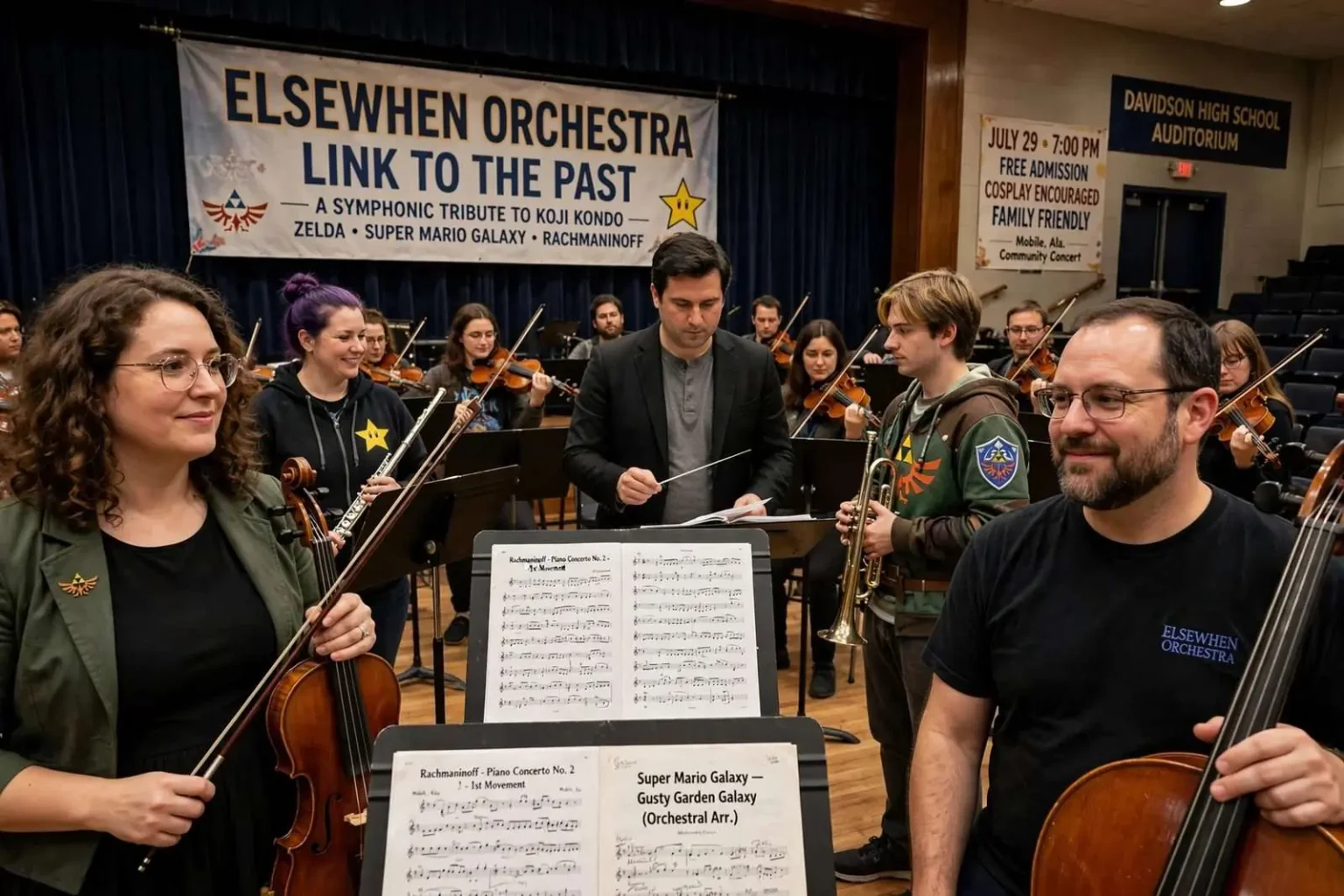
MOBILE, Ala. — The Elsewhen Orchestra performs July 29 at 7 p.m. at the Davidson High School Auditorium, and the program looks like nothing else on Mobile’s classical calendar: a full symphonic tribute to the music of “The Legend of Zelda” and “Super Mario Bros.,” opened with Rachmaninoff and closed, if the organizers get their way, with the beginnings of a permanent local institution. Admission is free, though seating is limited, and family-friendly cosplay is encouraged — an invitation that tells you immediately this is not a typical orchestra concert.
The concert, titled “Link to the Past,” is the work of a volunteer ensemble built from scratch by local musicians, and it represents one of the more interesting experiments in Mobile’s community music scene: an orchestra whose primary mission is to prove that symphonic music and video game culture belong in the same room.
An Orchestra Built From Scratch
The group started around 2014 as an idea from organizer Jonathan Reynolds, who loved orchestral music but had no outlet to perform full symphonic repertoire. After attending Mobile Symphony concerts regularly, he began asking around and slowly built a roster of local musicians — a process that turned out to be harder in some sections than others.
The challenge, Reynolds said, was finding string players willing to volunteer. The Mobile area has strong wind bands — community concert bands and school band programs with deep traditions — but few full orchestras with a wind section, meaning that adult string players looking for a regular ensemble have historically had slim options. A community orchestra lives or dies on its string sections, which carry the largest workload and the largest note count in nearly all symphonic repertoire. Brass and woodwind chairs fill quickly from the region’s band culture; strings take recruiting.
That gap says something about how music education has evolved along the Gulf Coast. School band programs — marching bands in the fall, concert bands in the spring — are a fixture of nearly every middle and high school in Mobile County, and they produce adults who still want to play. Orchestra programs, which require the more specialized study of violin, viola, cello, and bass, exist in fewer schools, so fewer adult string players come out the other end. Reynolds’ recruiting effort, musician by musician, was effectively an attempt to assemble in one room the string section the region’s music education pipeline had not kept together.
The payoff for the players is the repertoire itself. Full symphonic works — the kind of music that demands a dozen cellos, rows of violins, and a complete wind section — are almost impossible for volunteers to experience without an organization like this one. Community bands play arrangements; the Elsewhen Orchestra, with a full complement of players, can play the real thing.
“Link to the Past”: A Tribute to Koji Kondo
The concert is a tribute to composer Koji Kondo, whose work on “Super Mario Bros.” and “The Legend of Zelda” is among the most recognized in the world. Kondo’s themes have outlived the hardware they were written for, hummed by generations who never learned his name, and his melodies for Nintendo’s flagship franchises are among the most transcribed pieces of music on earth.
The orchestra will feature several Zelda arrangements alongside a selection from “Super Mario Galaxy,” the first Mario game to use recorded orchestral music. That distinction matters to musicians: “Galaxy” marked the moment the Mario series stepped from synthesized chiptunes and sampled sounds into music written for real instruments, with sweeping cues that sit comfortably next to film scores. Hearing it performed live by an orchestra closes a circle — music composed for orchestra, finally played by one.
Kondo has cited Rachmaninoff’s Piano Concertos as an influence, and the concert takes that connection seriously: the evening opens with the first movement of Rachmaninoff’s Piano Concerto No. 2, featuring Daniel Driskell of Full Scale School of Music. The pairing is more than a novelty. Rachmaninoff’s Second is one of the most beloved of all piano concertos, famous for its long, singing melodies, and its influence on Kondo’s lyrical approach is audible to anyone who listens for it — the way his themes unfold over accompaniment, the way a simple tune can carry an entire scene.
Programming the Rachmaninoff first is also a deliberate bridge between audiences. Parents who come for the Zelda music will hear a masterpiece of the romantic repertoire; students who think they have no use for classical music will discover that the composer behind their favorite game was listening to it all along. Few concert programs could claim to serve both audiences at once, which is precisely the point.
The Rachmaninoff itself carries a storied history worth a moment for any first-time listener. Written in the years following the composer’s early career crisis, the Second Piano Concerto opened with a performance that restored Rachmaninoff’s reputation and went on to become one of the most performed concertos in the world, its melodies so enduring that they have been borrowed by popular songs for generations. Opening the evening with its first movement — the dark, bell-like chords building toward the soaring main theme — gives pianist Daniel Driskell a showcase that is as demanding as anything on the program, and gives the orchestra’s string sections a workout that sets up the game music to follow.
Video Game Music Grows Up
The Elsewhen Orchestra’s program reflects a broad transformation in how video game music is presented. Over the past two decades, symphonic game-music concerts have grown from novelty events into a worldwide circuit, with dedicated productions touring major halls and game composers taking bows in the same venues that host pops concerts. Orchestras have discovered what game composers always knew: the music was written to be listened to for hours, melodically rich enough to survive repetition, and emotionally direct in a way that welcomes listeners who find the standard concert repertoire intimidating.
For a volunteer community orchestra, the repertoire has an added advantage. Game music is written to be exciting to play — exposed strings, driving rhythms, brass fanfares — and it gives amateur musicians the experience of performing music their audience already loves. There is no warm-up period where the hall politely tolerates unfamiliar repertoire; the audience arrives knowing every theme.
Building Something New
Reynolds’ other goal was to reach people who might not consider themselves classical fans. If the response is strong and the musicians want to continue, he is considering forming a nonprofit to make the orchestra official — a step that would open the door to grants, donations, and a regular season rather than one-off performances.
The nonprofit question is the practical frontier for any volunteer ensemble. An official organization can apply for arts council funding, accept tax-deductible contributions, and plan concerts around an actual calendar instead of around whoever happens to be available. It can also formalize the thing volunteer groups struggle with most: keeping a consistent roster of string players from concert to concert, with rehearsal schedules that respect the fact that everyone has a day job.
Mobile’s cultural landscape gives the idea room to grow. The city already supports the Mobile Symphony Orchestra at the Saenger Theatre, a strong network of school music programs, and a series of community and university ensembles, yet gaps remain between them — particularly for adult amateur players and for audiences under 30. A game-music community orchestra sits directly in that gap, offering players an ensemble to join and offering young audiences a first orchestral experience that starts from music they already know.
The Details
The July 29 performance begins at 7 p.m. in the Davidson High School Auditorium. Admission is free, but seating is limited, so early arrival is the practical ticket; cosplay is welcome, and families are explicitly part of the target audience. Davidson High School, one of Mobile County’s public high schools, offers the kind of auditorium a startup orchestra needs — a real stage, real acoustics, and no rental bill that would force a volunteer group to charge admission on its first outing.
The free-admission model is itself part of the orchestra’s mission. By removing the ticket price, the group lowers the barrier for exactly the audience it wants — teenagers in costume, parents with young children, curious concertgoers who would never pay $60 for a symphony subscription. The cost of the experiment is carried by the players and organizers themselves, in rehearsal hours and logistics, which is why the nonprofit question matters: passion builds a first concert, but structure is what builds a second and a third.
For the musicians on stage, the evening is the culmination of months of organizing, recruiting, and rehearsing. For the audience, it is a chance to hear a full orchestra play the soundtrack of their childhoods — preceded, fittingly, by Rachmaninoff, the composer Kondo never quite left behind. And for Mobile’s music community, it is an experiment worth watching: if the auditorium fills and the players want more, the city may find itself with a new orchestra whose repertoire looks like nothing else on the Gulf Coast.