
‘The Girl Who Kicked the Hornet’s Nest’ Opens Two-Week Run at Crescent
The Millennium Trilogy finale plays at Mobile's Crescent Theater Nov. 26-Dec. 9, with nightly showtimes plus weekend and Wednesday matinees.
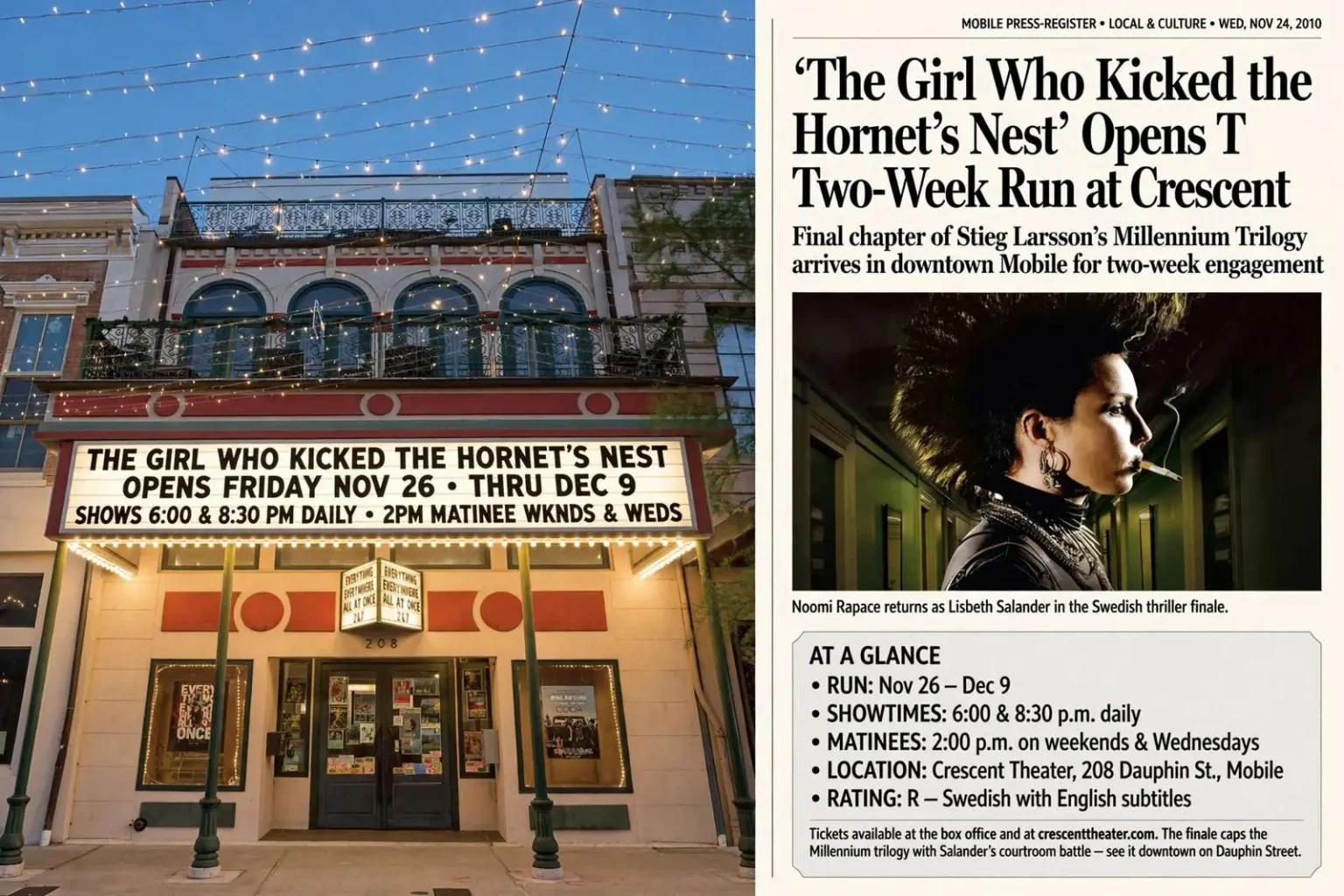
The final chapter of Stieg Larsson’s Millennium Trilogy arrives in downtown Mobile this week, giving local film fans a chance to finish the Swedish thriller saga on the big screen. The Girl Who Kicked the Hornet’s Nest opens Friday, November 26, at the Crescent Theater for a two-week run through December 9, capping the downtown house’s engagement with the series that gripped readers and moviegoers on both sides of the Atlantic.
Showtimes are 6:00 and 8:30 p.m. daily, with a 2:00 p.m. matinee on weekends and Wednesdays. The schedule gives audiences nearly two weeks to catch the conclusion without traveling to the multiplexes out west, and it fits the pattern the Crescent has followed with specialty and imported releases: longer runs, daily evening screenings, and matinee slots carved out for weekend crowds and the downtown lunch-and-a-movie set.
The Story So Far
The film picks up with Lisbeth Salander gravely wounded — a bullet in the head — and rushed into surgery alongside Alexander Zalachenko, the man she attacked with an axe at the end of the previous chapter. Those two hospital rooms, side by side, set up the final confrontation the trilogy has been building toward since the first installment. Salander, the brilliant and deeply antisocial hacker at the heart of Larsson’s novels, survived an ordeal that would have killed anyone else, and the opening act of the new film dwells on her fight simply to live.
From her hospital bed, Salander plots revenge on those who tried to kill her and on the government that nearly destroyed her life, but first she has to get out of intensive care and beat murder charges standing between her and the truth. The framing device turns the action thriller into something closer to a courtroom drama for its middle stretch, as journalist Mikael Blomkvist and the staff of Millennium magazine work to expose the conspiracy that ensnared her while the state prepares to lock her away indefinitely.
From Page to Screen
Larsson, a Swedish journalist, died in 2004 before the Millennium novels were published, and the trilogy’s posthumous success — tens of millions of copies sold worldwide — made the film adaptations inevitable. The Swedish productions shot back-to-back, and the third film arrived in American theaters with a devoted audience already waiting. The series’ blend of financial journalism, cold-war-era secrets and visceral suspense made it a phenomenon unusual for subtitled fare, and the Crescent’s willingness to book the conclusion speaks to the appetite local audiences showed for the first two chapters.
For viewers who missed the earlier chapters, the story so far runs like this: Salander, a gifted investigator with a courtroom record declaring her legally incompetent, helped Blomkvist crack a decades-old family mystery in the first film, then disappeared. The second film pulled her into a sex-trafficking investigation that ended with her buried alive, her liberation, and her axe-wielding reckoning with Zalachenko — the man whose abuse years earlier had made her a ward of the state. The final film answers the questions that reckoning raised, and it does so largely through lawyers, hospital corridors and newsroom deadlines rather than the chase sequences that marked the first two movies.
The Crescent and Downtown Mobile
The Crescent Theater at 208 Dauphin Street has become a fixture of the Dauphin Street entertainment corridor, an independent single-screen house that books a mix of independent films, documentaries, foreign-language releases and select mainstream titles that the big chains overlook. Its location in the heart of the Lower Dauphin entertainment district means a screening can anchor a full evening downtown — dinner within walking distance, the film at 6:00 or 8:30, and the street’s nightlife afterward. For a subtitled Swedish thriller, the intimate house is a fitting venue; the Crescent has built its reputation on exactly the kind of programming that struggles to hold a screen at a multiplex for more than a weekend.
The two-week commitment matters for a film like this. Independent houses live and die on word of mouth, and a run through December 9 gives the film time to build an audience across two weekends rather than disappearing after three days. The theater’s model of daily evening shows plus targeted matinees has proven durable for specialty titles, allowing regulars to plan around work schedules while visitors to downtown Mobile can slot a screening into a weekend itinerary.
Why the Trilogy Resonated
Part of what made the Millennium books and films such a worldwide sensation was their refusal to let their heroine be rescued. Salander spends the trilogy damaged, distrustful and self-sufficient, and the final chapter’s tension comes from watching institutions — hospitals, courts, psychiatric services, security services — decide her fate while she lies immobilized. American audiences embraced the Swedish films even as a Hollywood remake of the first book went into production, and the conclusion earned strong reviews for its patient, procedural approach to the saga’s ending.
The Thanksgiving-weekend opening also gives the film a natural window. Families in town for the holiday, college students home for break and downtown shoppers all pass through the Dauphin Street corridor in late November, and the Crescent’s matinee slots on weekends and Wednesdays capture exactly that audience. For moviegoers who read the books when they dominated bestseller lists, seeing the finale in a theater — subtitles and all — is the last chance to experience the story the way it played in Stockholm theaters before home video.
Tickets are available at the box office, and audiences are advised that the film is in Swedish with English subtitles and carries an R rating for violence and disturbing content, consistent with the rest of the trilogy. The run continues through December 9; after that, the Crescent moves on to its next booking, and Mobile’s chance to close the book on Lisbeth Salander goes with it. For anyone who has followed the trilogy this far, the advice is simple: see it on Dauphin Street, where a small theater has made a habit of giving big stories a proper home.
What to Expect From the Finale
Unlike the first two films, which built their momentum through investigation and pursuit, the finale plays out on three fronts at once. In the hospital, Salander recovers and waits for the state to decide whether she will be returned to secure psychiatric custody. In the newsroom, Blomkvist assembles the Millennium issue that could topple the secret section of the security police responsible for her childhood suffering. And in the courtroom, prosecutors build a murder case against the woman who has been, from the beginning, more victim than villain. The pacing is deliberate, and audiences expecting nonstop action should come for the payoff of a story twenty-five years in the making rather than for car chases.
The supporting cast expands in this chapter, most significantly in the form of the attorney who takes Salander’s case and becomes her unlikely advocate, and the group of hacker associates who rally to her defense when the state moves against her. The trilogy’s recurring themes — institutional betrayal, the vulnerability of women failed by the systems meant to protect them, and the power of information — all come to a head in the final hour. Viewers who have read the novels will find the adaptation faithful to the book’s structure, compressing where it must but preserving the ending that made readers cheer.
Downtown Mobile audiences have supported the Crescent’s specialty bookings consistently, and the theater’s location makes the trilogy’s conclusion an easy addition to a weekend in the historic district. Street parking and the city’s garages serve the Dauphin Street corridor, and the evening showtimes leave room for dinner before or drinks after. For the two weeks of the run, the Crescent holds the only screen in the area showing the film, which has been the pattern for imported titles throughout its history.
The Girl Who Kicked the Hornet’s Nest runs Friday, November 26, through Thursday, December 9, at the Crescent Theater, 208 Dauphin Street. Showtimes are 6:00 and 8:30 p.m. daily, with 2:00 p.m. matinees on weekends and Wednesdays. Admission is at standard theater pricing, and the box office recommends arriving early for evening shows, which have drawn the largest crowds for the series’ earlier chapters. It is the end of a trilogy that began with a Missing Persons case and ends in a courtroom — and downtown Mobile gets to see how it all comes out.
Moviegoers planning to catch up before the finale should note that the theater has periodically paired new bookings with encore screenings of the earlier chapters when schedules allow, and home video remains an option for those who need the backstory in a hurry. The final film assumes familiarity with the first two — character histories, the Millennium staff, and the government apparatus behind Salander’s childhood commitment all carry over without explanation. Newcomers who arrive cold will still follow the courtroom plot, but the emotional weight lands very differently for those who have watched Salander fight through the entire saga.


