The Independent Music Spot Brings All-Ages Live Music to a Mobile Warehouse
The Independent Music Spot opened on Mill Street in Mobile, offering all-ages live shows in a converted warehouse across genres.
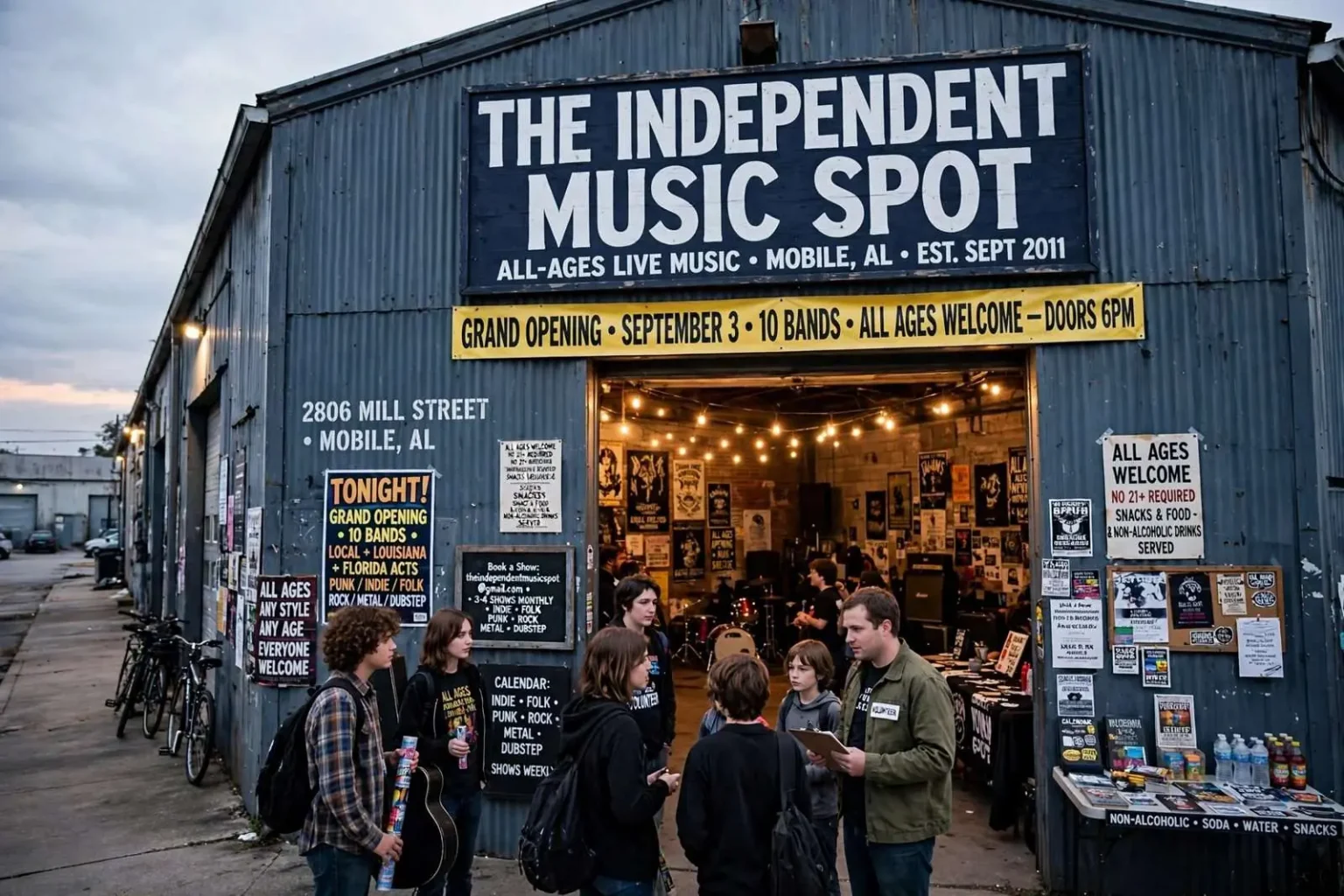
A new all-ages music venue called The Independent Music Spot opened its doors at 2806 Mill Street in Mobile in the fall of 2011, offering an alternative to the city’s bar-and-club scene for music fans of every age group. The converted warehouse space arrived with a simple but ambitious proposition: live, original music in Mobile should not require a driver’s license, a 21-year-old wristband or a bar tab.
A venue for everyone
The concept behind The Independent Music Spot was straightforward: give teenagers and adults alike a place to enjoy live local music without the typical bar or party atmosphere. Owner Beige envisioned a space where solo musicians, touring acts and hometown bands could all share a stage, regardless of genre. That flexibility — one room, any style, any age — has long been the model for the independent venues that anchor music scenes in larger cities, and Mobile’s version set out to prove the model could work on the Gulf Coast.
While the venue held a license to serve alcohol to adults at shows, its central mission was inclusivity. Minors were welcome at events and could purchase snacks, food and non-alcoholic drinks, while no alcoholic beverages would be served to anyone underage. The arrangement let the venue operate as a business while keeping its doors open to the teenagers who, in most American cities, have nowhere to see a touring punk band or a friend’s first show without sneaking into a club.
The need for such a space is familiar to anyone who has been a young musician or fan. Most performance venues in Mobile and cities like it are bars, both by licensing and by economics, which means performers under 21 often cannot play their own sets and audiences under 21 cannot watch them. An all-ages room changes that equation entirely, giving high school bands their first stage and teenage listeners their first taste of a live, local scene.
Grand opening lineup
The Independent Music Spot launched with a grand opening show on September 3, 2011, featuring a lineup of ten bands. Most of the acts were local to the Mobile area, with a handful traveling in from Louisiana and Florida for the occasion. The event was open to all ages, and the venue invited the entire community to come see what the new space had to offer.
Ten bands in a single night is a statement of intent. Marathon opening bills like this one function as both a party and an audition — they introduce a venue to every scene it hopes to serve at once, from metal and punk crowds to singer-songwriter audiences, and they signal to bands that the room is open for business. The visiting acts from Louisiana and Florida reflected the natural touring circuit that runs along the Gulf Coast, where independent bands hop between New Orleans, Pensacola, Mobile and smaller towns in between.
Operating out of a converted warehouse on Mill Street, the venue saw itself as a work in progress with big ambitions. Warehouse venues carry a particular character that purpose-built clubs rarely match: high ceilings, bare walls that bands can decorate with show posters, room for merch tables and the flexible floor plan that lets a solo songwriter night transform into a full-band rock bill the next evening. The industrial corners of American cities have incubated most of the country’s celebrated independent music rooms, and Mobile’s warehouse districts offered the same raw material.
Plans for a diverse music calendar
Looking beyond opening night, The Independent Music Spot planned to host three to four shows per month spanning a wide range of genres, from indie and folk to punk, rock, metal and even dubstep. That pace — roughly one show a week — is deliberate for a young venue: frequent shows build the habit of attendance among local fans, while a genre-spanning calendar keeps any single scene from carrying the room alone.
The genre spread also acknowledged how fragmented modern music audiences have become. A Mobile teenager into dubstep and a Baby Boomer who follows folk acts rarely want the same bill, but they can share the same venue on different weekends. Bookers at independent venues describe this as scene-farming: give every niche a night, and each niche brings its own crowd, its own bands and its own reason to return.
Local bands of any genre hoping to get on the calendar could reach the venue by email at [email protected] to inquire about booking. The open invitation mattered. Young bands without managers, demos or connections need exactly this kind of low-barrier entry point, and venues that answer their emails tend to become the places where a city’s next generation of musicians first learns to play a full set, run a merch table and load in at soundcheck.
The venue’s opening came at an interesting moment for live music everywhere. Streaming had begun to collapse recorded-music revenue, touring was becoming the way artists actually earned a living, and mid-sized cities across the country were discovering that their small independent rooms mattered more than ever. For Mobile, a city with a rich musical heritage but a largely bar-bound club circuit, a dedicated all-ages room plugged an obvious gap in that ecosystem.
The economics of all-ages venues are famously difficult. Ticket prices have to stay low enough for a teenager’s allowance, alcohol sales are limited by design to adults at the show, and the door split with touring bands leaves thin margins for rent and sound equipment. Venues that survive do it on volume, volunteer labor and community loyalty — the same ingredients that have sustained all-ages institutions in cities many times Mobile’s size.
Mill Street’s location also suited the mission. Sitting in an industrial part of the city, the warehouse was close enough to downtown to be reachable, far enough from residential blocks to keep late-night volume from becoming a neighborhood dispute, and affordable enough that a start-up venue could survive the lean early months. Those trade-offs are the classic calculus of independent venue founders, who invariably choose character and cost over convenience.
The Independent Music Spot’s founders hoped to grow the space into a significant part of Mobile’s live-music landscape, filling the gap for audiences who wanted to experience original music in a welcoming, all-ages environment. If the room did its job, the benefits would compound: teenagers who saw their first shows on Mill Street would form their own bands, book their own tours through the Gulf Coast circuit and someday look back on the warehouse as the place where Mobile’s music scene felt like theirs.
For now, the venue’s calendar promised three or four chances a month for Mobile to find out what its young musicians could do — no bar tab required, no age limit, and a stage open to anyone with songs to play.
The distinction between an all-ages venue and a bar with music became the heart of the Mill Street experiment. In a bar setting, the music is often an accessory to drinking; in a room like The Independent Music Spot, the music is the reason everyone came, and the audience — whether it numbers twenty people or two hundred — is there to listen. Musicians who cut their teeth in all-ages rooms often describe the difference as formative: they learn to hold an attentive crowd rather than compete with bar noise.
The venue’s drink policy deserves particular attention because it reflected a deliberate middle path. Rather than banning alcohol entirely, which would have cut off a large portion of the adult audience, the venue held the proper license and served adults at shows — while enforcing a firm line against serving anyone underage. That combination let families, older fans and teenage bands share the same bill without the room becoming either a nightclub by default or a rec hall by necessity.
Mobile’s broader music landscape in 2011 included a handful of respected bars and theaters that booked original music, a long-running jazz and blues heritage, and active scenes in the surrounding towns. What the city lacked, according to the people who opened the Mill Street warehouse, was a neutral ground where all of those threads could cross — where a metal band, a folk singer and a touring punk act from Pensacola could all find a stage, and where the kids who would form the next wave of Mobile bands could finally get through the front door.
Organizers encouraged anyone curious about the space to come out to a show, follow the venue’s announcements and, most of all, support the local acts on each bill. Independent venues live and die by word of mouth in their first year, and the early shows on Mill Street were designed to build exactly that: a regular crowd that treats the room as its own, week after week, from indie and folk nights to the loudest metal and dubstep bills the calendar could hold.