
The Revivalists Bring New Orleans Funk and Soul to the Soul Kitchen
New Orleans' The Revivalists packed Mobile's Soul Kitchen Music Hall on June 30, 2012 with funk, soul and rock — here's what they played.
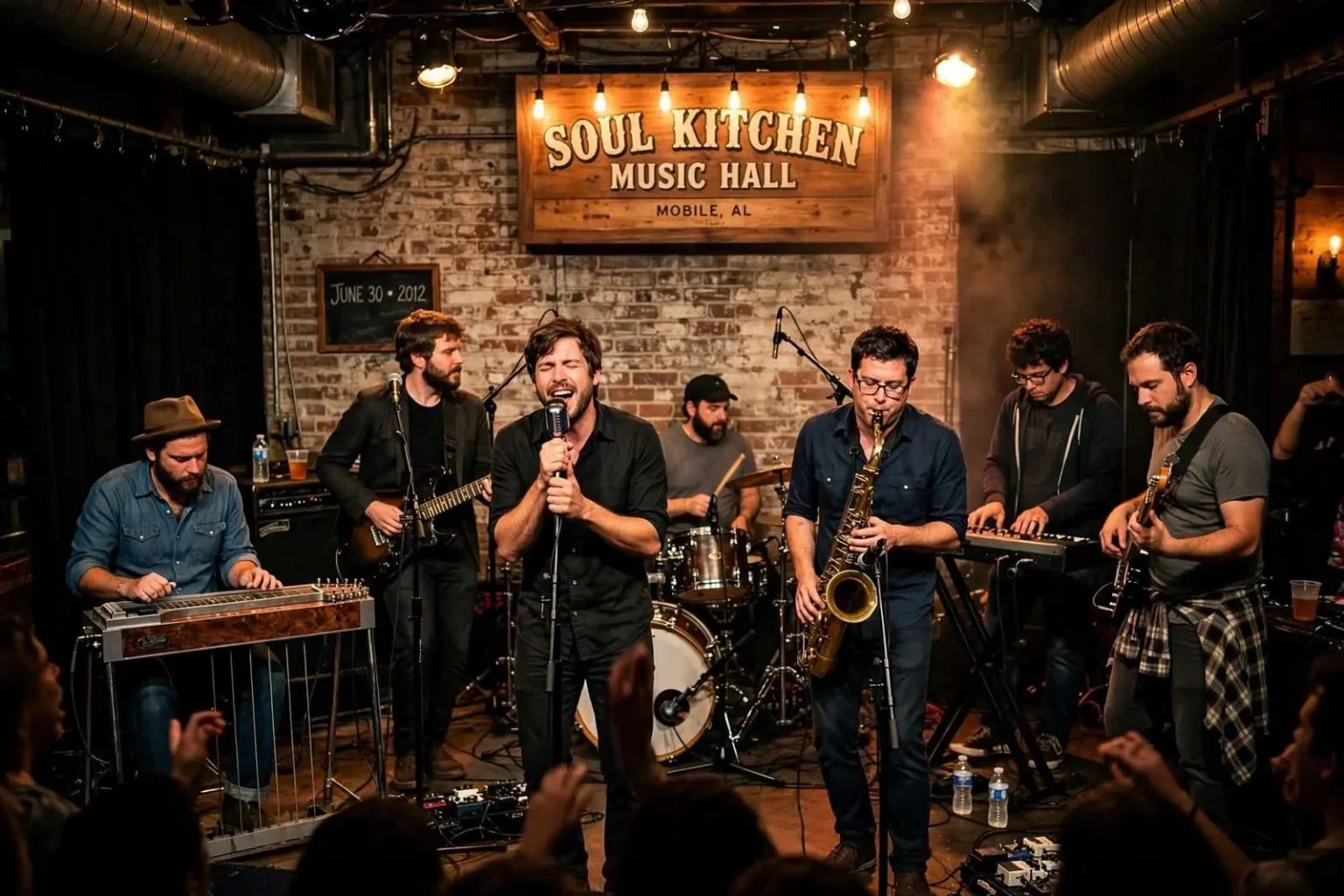
MOBILE, Ala. — New Orleans’ The Revivalists carried their blend of funk, soul and rock across the state line on June 30, 2012, packing the Soul Kitchen Music Hall and leaving the crowd’s ears completely satisfied after a set that drew heavily from the band’s growing catalog.
The seven-piece band, then several years into building a reputation as one of the hardest-working acts on the New Orleans club circuit, delivered a run of songs that showed off the group’s signature mix of groove-forward rhythms and soulful songwriting. Among the songs that landed during the Mobile show: “When I’m Able,” “Elementary,” “Up in the Air,” “When I Die,” “Chase’s House,” “All in the Family” and “Common Cents.”
For anyone who had followed the band’s rise from New Orleans venues to regional festival stages, the setlist read like a survey of a group finding its voice — originals written or refined in the years before the band’s national breakout, played with the full-bore energy that made their live shows the engine of their growth.
The Mobile date capped a busy Gulf Coast summer for the band, which had also sat down for an interview earlier in the season during Hangout Fest 2012 in Gulf Shores — the Alabama beach festival that has long served as a showcase for rising acts passing between New Orleans and the Southeast.
The band and its New Orleans roots
The Revivalists formed in New Orleans in the late 2000s, assembling a lineup unusual even by the standards of a city famous for its bands: David Shaw on vocals, Zack Feinberg on guitar, Ed Williams on pedal steel guitar, Rob Ingraham on saxophone, George Gekas on bass, and Andrew Campanelli on drums, with keyboardist Michael Girardot rounding out the group. The pedal steel and saxophone combination gave the band a sound rooted in New Orleans soul but reaching toward the expansive jam-rock of the era.
By 2012, the band had already released its debut album, “Vital Signs,” and was a fixture of the New Orleans club scene, playing rooms like Tipitina’s and the Maple Leaf while building a following that stretched along the Gulf Coast. A key milestone had come at the 2011 New Orleans edition of the Guitar Center’s national “OnStage” contest — a victory that earned the band an opening slot and signaled that the group’s live reputation was translating into broader opportunity.
The Soul Kitchen Music Hall itself was a natural fit for the band. The venue, located in downtown Mobile, had established itself as a stop for touring acts who had outgrown barrooms but not yet filled theaters, with a listening-room layout and a stage that rewarded bands built around live performance. The Revivalists, with seven musicians on stage and arrangements that shifted from soul ballads to full-band improvisation, were exactly the kind of act the room was made for.
The songs that landed in Mobile
The material the band carried to Mobile that June night came from the period when the group was sharpening the songs that would fill its early records. “When I’m Able,” a groove-driven plea, and “Elementary,” among the band’s earliest fan favorites, showed the group’s knack for melodies that felt both rootsy and immediate. “Up in the Air” and “When I Die” stretched into the improvisational territory that became a hallmark of the band’s shows, giving Feinberg’s guitar and Ingraham’s saxophone room to trade lines over the rhythm section.
“Chase’s House” and “All in the Family” dug into the funk end of the band’s repertoire, the kind of tracks that connected the band to the New Orleans tradition of dance-floor endurance — songs built to keep a crowd moving through long instrumental passages. “Common Cents,” meanwhile, offered the socially minded songwriting that has always run through the band’s catalog alongside the party-starting material.
What those songs share, and what the Mobile crowd heard in sequence, is the approach that would carry the band to national attention later in the decade: Shaw’s gravel-and-soul vocal delivery, a rhythm section steeped in New Orleans grooves, and arrangements that treated the pedal steel guitar as a lead instrument rather than a country-music curiosity. Within a few years, that formula would produce “Soulfight” and, eventually, the platinum-selling “Wish I Knew You,” the 2016 single that turned the band into festival headliners nationwide.
From the Soul Kitchen to the Gulf Coast circuit
The June 30 stop in Mobile also illustrated how the Gulf Coast touring circuit worked in the early 2010s for New Orleans bands. The drive east along Interstate 10 is barely an hour, and bands rising through the Louisiana club scene routinely played Mobile, Pensacola, and the Florida Panhandle towns as extensions of their hometown audiences. The Hangout Music Festival in Gulf Shores each May gave those same acts a chance to play in front of festival crowds drawn from across the region.
For Mobile music fans, shows like this one were part of a stretch when the Soul Kitchen consistently booked the New Orleans pipeline —funk and soul acts, jam bands, and singer-songwriters who would go on to larger rooms. The June 30, 2012, date captured The Revivalists at the moment just before that leap: still playing a mid-size hall across the state line, still drawing their setlist from early material, but already sounding like the band that would soon be selling out much bigger venues.
Nearly a decade and a half later, the show stands as a snapshot of that trajectory — a New Orleans band with funk, soul and rock in its bloodstream, a Mobile audience that got to see the early chapters of the catalog live, and a summer on the Gulf Coast that began with a festival interview in Gulf Shores and ended with a packed room on Dauphin Street leaving, as the report had it, with their ears completely satisfied.
Why the 2012 Gulf Coast run mattered
Summer tours along the Gulf Coast served a practical purpose for a band like The Revivalists in 2012. Regional runs kept travel costs low, built familiarity market by market, and let the group test new material on audiences that had already embraced the old songs. A band could leave New Orleans on a Saturday afternoon, play Mobile that night, and be home by morning — a schedule that allowed the group to keep its New Orleans residencies while steadily widening its reach.
The interview slot at Hangout Fest 2012 in Gulf Shores fit the same pattern. The festival, held annually at the beachfront end of Highway 59, mixed national headliners with rising regional acts, and the season’s media coverage gave Gulf Coast fans a preview of the bands they would find in club shows like the Soul Kitchen date weeks later. For a New Orleans band, playing Hangout Fest amounted to a homecoming in another state — the crowd was full of Alabamians and New Orleanians who followed the same music scene across the state line.
The setlist from June 30 also documents how the band’s repertoire evolved. “When I’m Able” and “Elementary” predate the band’s second album, “City of Sound,” which arrived in 2014, and several of the songs played that night would be reworked or retired as the band’s catalog grew. Shows from this era circulate among the group’s fans as evidence of a band in transition — the same arrangements that filled New Orleans clubs, stretched and retested in front of neighboring Gulf Coast crowds.
Mobile audiences in 2012 were particularly primed for the band’s sound. The city’s live-music scene has long leaned on New Orleans imports — the proximity, the shared radio market, and the ferry of musicians moving along Interstate 10 made the two cities’ club scenes extensions of one another. A funk-and-soul band with a horn player and a pedal steel guitarist was an easy sell on Dauphin Street, where crowds turned out for anything with a groove and a brass line.
The venue and the moment
The Soul Kitchen Music Hall earned its place in the region’s touring geography during exactly this period, anchoring downtown Mobile with national and regional acts in a room intimate enough that fans could stand within a few yards of the stage. The June 30, 2012, show was the kind of booking that defined the venue’s early identity: a band on the way up, caught in a room where the connection between stage and floor is direct.
In retrospect, the Mobile date sits in the last stretch before the band’s breakthrough years. “City of Sound” arrived in 2014, followed by “Men Amongst Mountains” in 2015 — the album that carried “Soulfight” and “Wish I Knew You” — and by the end of that run, The Revivalists were headlining theaters and festivals across the country, including return appearances in Alabama. The songs Mobile heard on June 30, 2012, were the foundation of all of it: the funk of “All in the Family” and “Common Cents,” the sway of “When I Die,” the momentum of “Up in the Air.”
For the packed house that Saturday night, though, none of that future was knowable. What they got was a New Orleans band at full stride — seven musicians deep, groove-forward, generous with solos — in a Mobile room built for exactly that kind of night. The ears, as the report had it, were completely satisfied.