The Southern Hospitality of SouthSounds 2018 Shone Across Downtown Mobile
The Southern Hospitality of SouthSounds 2018 Shone Across Downtown Mobile — local South Alabama news from southalnews.com.
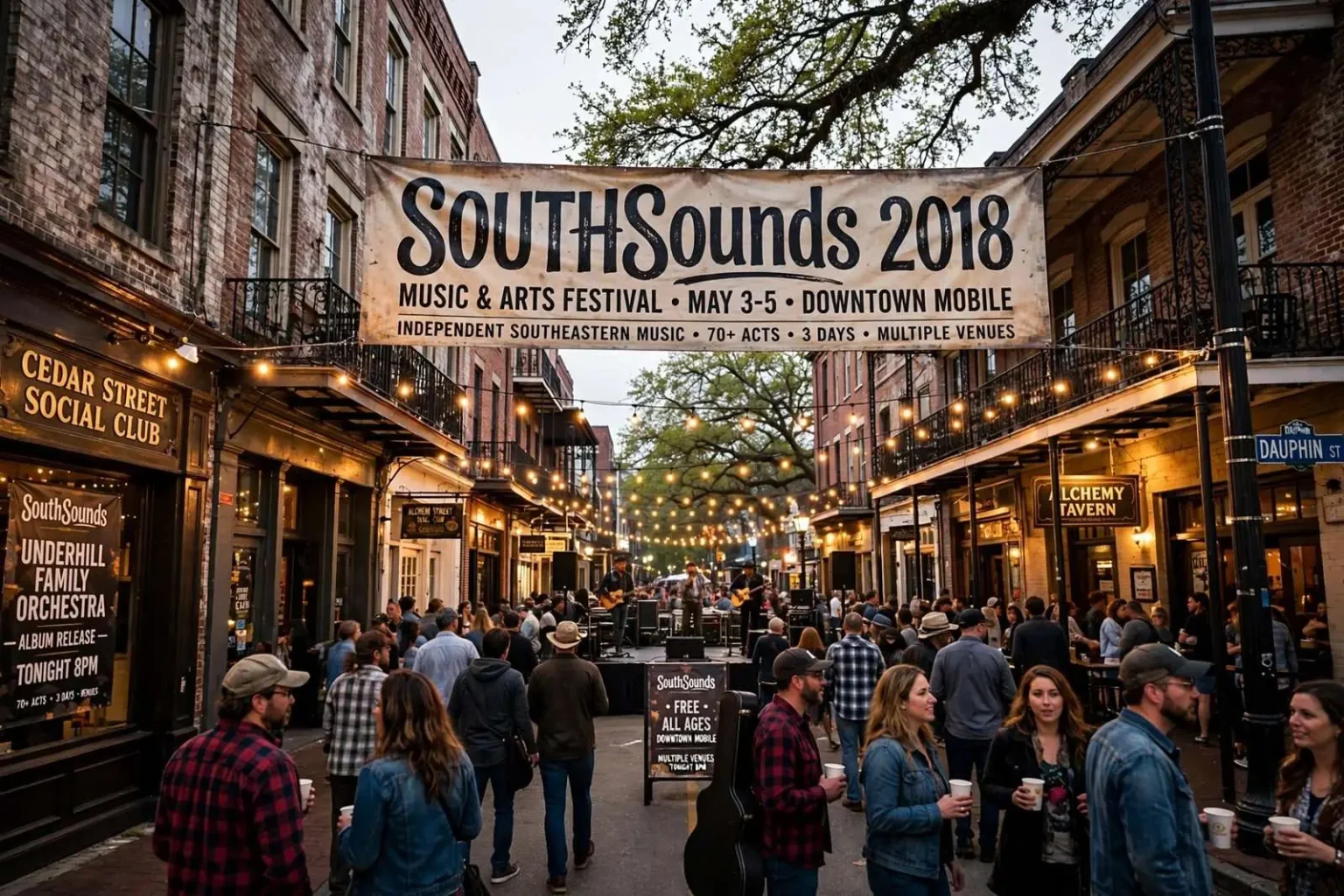
SouthSounds Music and Arts Festival gathered more than 70 acts in Mobile this spring, from local bands to well-known regional names, cementing its place as one of the country’s only festivals focused solely on independent Southeastern musicians. The three-day event spread across downtown venues and stages, turning blocks of the city into a walkable showcase of what the region’s independent scene has to offer.
Mobile’s own Underhill Family Orchestra, riding the May 4 release of its album “Tell Me That You Love Me,” was a centerpiece of this year’s lineup. The band’s hometown status and the timing of its release made it a natural focal point for a festival that has always prided itself on giving regional artists a stage equal to the touring acts it books.
SouthSounds occupies a distinctive niche in the festival landscape. While major festivals across the Southeast book national headliners and sell large general-admission grounds, SouthSounds keeps its focus on discovering and elevating independent artists from Alabama, Louisiana, Mississippi, Georgia, Florida, Tennessee and beyond — the same bands that play small clubs and college towns and are working toward wider audiences.
The festival’s multi-venue format is part of that identity. Rather than one gated site, SouthSounds uses downtown Mobile’s clubs, halls, and outdoor stages, letting attendees move between acts the way they would at a conference. For Mobile, it also fills a spot on the calendar in a city whose entertainment identity is dominated by Mardi Gras each winter.
Three nights of music downtown
Friday opened with New Orleans acts Sweet Crude and Dumpstaphunk plus Georgia songwriter Corey Smith, giving the festival a first-night lineup that stretched from indie rock with Cajun French lyrics to the funk Dumpstaphunk has carried out of New Orleans for more than a decade. Smith, a longtime fixture of the Georgia college-circuit songwriting scene, brought the singer-songwriter thread to the opening night.
Underhill Family Orchestra introduced fans to a new venue, Cedar Street Social Club, as part of the album-release moment. The band has built a following on the Gulf Coast for a sound rooted in family harmonies and Southern storytelling, and the chance to debut new material in front of a hometown crowd gave the festival one of its emotional anchors.
Of Montreal brought a theatrical set to the Lagunitas Stage at The Merry Widow, one of the most anticipated bookings of the weekend. The Athens, Georgia band’s elaborate stage presence and two-decade catalog have made it a reliable draw across the Southeast, and its appearance on a Mobile stage underscored the festival’s reach beyond the region’s club circuit.
Saturday’s rain didn’t deter the crowd. Surfer Blood, Boyfriend and late-night local sets from Glass War and The Hallers at Alchemy Tavern kept the energy up as weather moved through downtown. The indie-rock band Surfer Blood, with a national following built in the early 2010s, drew one of the weekend’s most attentive crowds, while New Orleans-based performer Boyfriend delivered a genre-blending set that has become a signature of her live shows.
Alchemy Tavern, a longtime spot on the downtown circuit, hosted the late-night block, and the venue’s intimacy gave local bands Glass War and The Hallers a packed-room setting. For Mobile’s own musicians, those late slots are among the festival’s most valuable — a chance to play for audiences assembled to see touring acts, with the whole scene watching.
Sunday closed the festival with Delta Smoke, The Shunnarahs and Lee Bains III & The Glory Fires, a finale that leaned into the region’s musical roots. Lee Bains III & The Glory Fires, from Birmingham, have spent a decade building a reputation for Southern rock that wrestles honestly with the region’s identity, and their set gave SouthSounds a closing statement in keeping with its mission.
Delta Smoke brought a blues-heavy sound to the final day, and The Shunnarahs rounded out the bill with the kind of regional harmony-driven songwriting the festival has consistently championed. The Sunday lineup, like the rest of the weekend, mixed Gulf Coast acts with touring bands at similar career stages — a pairing organizers see as the point of the whole event.
Artists praised Mobile’s warmth
Artists praised Mobile’s warmth throughout the weekend. Underhill’s Ben Cook said the city is “a huge part of what we are,” a sentiment that reflected the band’s deep roots in the local scene and its role in this year’s festival as both headliner and hometown host.
Surfer Blood’s JP Pitts called the people friendly and hospitable, echoing a reaction touring acts have described at SouthSounds before. For bands rolling through from larger markets, Mobile’s combination of walkable venues, engaged crowds, and Gulf Coast hospitality has become part of the festival’s reputation among musicians themselves.
Underhill bassist Joe Grove noted the album carries references to being from Mobile, a detail that ties the band’s new record directly to the city hosting its release-weekend showcase. The album “Tell Me That You Love Me,” released May 4, arrived just as the festival put the band in front of its largest hometown audience of the year.
The exchanges between artists and audiences are what organizers point to when describing the festival’s character. In a market without a major arena circuit, a festival that puts national-caliber indie acts alongside Mobile and regional bands creates a cross-pollination that is hard to replicate in ordinary club bookings — touring musicians meet local ones, and audiences hear both in a single weekend.
More than a festival
SouthSounds has helped acts like Underhill and Surfer Blood reach new listeners while bringing top independent talent to the Azalea City. The festival’s model — dozens of short sets across multiple downtown venues — is built on discovery, and its alumni list has grown into a catalog of bands that went on to wider regional and national attention after early SouthSounds appearances.
For downtown Mobile, the weekend also carries a practical benefit. Bars, restaurants, and hotels along Dauphin Street and the surrounding blocks see a festival crowd that arrives as spring turns toward summer, a season that sits outside the city’s Mardi Gras peak. The multi-venue format puts attendees on the street between sets, spreading the economic activity across the district rather than concentrating it behind one gate.
The festival’s focus on Southeastern independent music has also made it a marker of the region’s creative momentum. Cities like Athens, Nashville, Atlanta and New Orleans have long dominated the Southeastern music story, but the scene SouthSounds documents — Mobile, Pensacola, Birmingham, the Mississippi Gulf Coast and the smaller towns between — has been building its own network of bands, venues, and fans.
Organizers say the mutual support among Southern artists and fans may be the local scene’s greatest asset — and it only grows as the festival does. This year’s edition, with its hometown album release, its rain-soaked Saturday, and its three nights of lineup-wide collaboration, offered as clear a picture as any of that dynamic at work.
As the festival looks toward future years, the elements that defined 2018 — the venues, the local headliners, the touring bands willing to route through Mobile — remain the same ingredients organizers will build on. For the musicians who played it, the three days were another step in a regional scene that keeps proving it can sustain its own festival, its own venues, and its own audience.
The lineup’s geographic spread told the story of the region the festival serves. Sweet Crude arrived from New Orleans with a bilingual indie-pop sound, Dumpstaphunk carried the funk lineage of the Neville family, Corey Smith drove over from Georgia, and Lee Bains III & The Glory Fires represented Birmingham’s rock scene — all alongside more than a dozen acts from Mobile and the immediate Gulf Coast.
That balance between discovery and familiarity is deliberate. Festival organizers have described the booking approach as building a bill where attendees can see a band they love and, an hour later, walk into another venue and hear something they have never encountered. The format rewards the curious, and it gives smaller acts audiences they would never draw on their own club nights.
The festival’s identity as a showcase for the Southeast also reflects Mobile’s own position on the regional map. Sitting between New Orleans and the Florida panhandle, the city has long absorbed musical influences from both directions — Delta blues, New Orleans funk and jazz, Gulf Coast swamp pop, and the college-rock traditions of the Southeast’s university towns.
Local acts like Glass War and The Hallers, who played the late-night slot at Alchemy Tavern, are the continuity beneath that history. Their sets, played to the biggest crowds of their weekend, represent the pipeline SouthSounds was built to support: hometown bands earning slots beside touring artists, year after year, until their names draw those crowds on their own.