The Tontons Bring Hangout Fest Energy Back to Mobile for Alabama Music Box Show
Houston indie rockers the Tontons play their second-ever Mobile show Aug. 17, 2013 at the Alabama Music Box, with 20,000 Leagues Under the Sea opening.
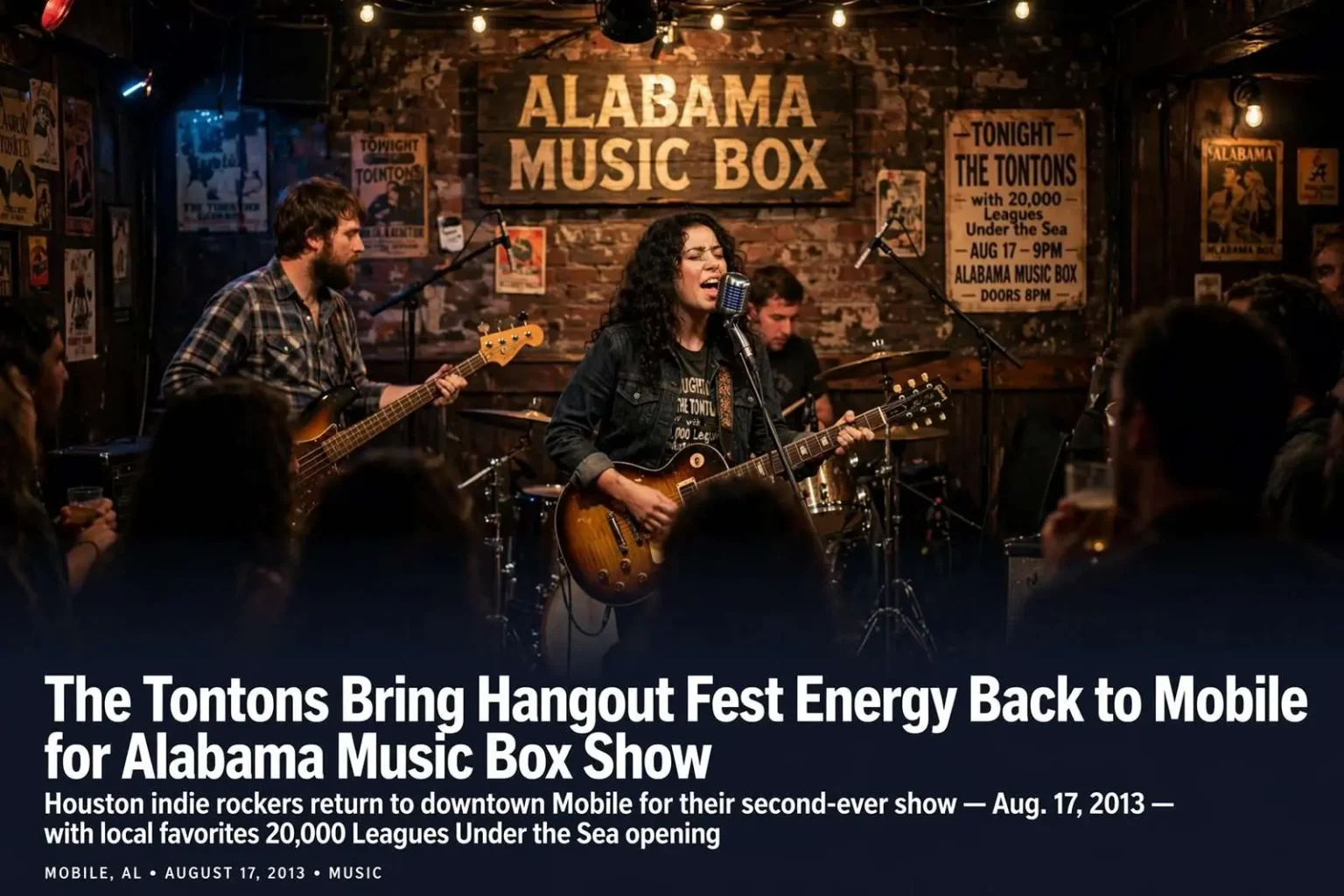
Houston indie rockers the Tontons returned to Mobile on Saturday, Aug. 17, 2013, for only their second-ever show in the city, headlining the Alabama Music Box with local favorites 20,000 Leagues Under the Sea opening.
From Gulf Shores Beach to Dauphin Street
Mobile audiences had first crossed paths with the band at the Hangout Music Festival in Gulf Shores earlier that summer, where the group’s beachfront set and offstage charisma left an impression. Booking a club date in Mobile just months later was a quick turnaround — and a sign the band wanted a closer look at the Port City.
The Tontons occupy a distinctive corner of the Texas music scene. The Houston band built its reputation on kinetic live performances fronted by a magnetic singer, with a sound that fuses indie rock’s guitar-driven energy with pop hooks and rhythm-section swagger. Houston’s music scene, sprawling and under-known nationally, has long produced bands that win audiences one city at a time, and the Tontons’ approach was exactly that: relentless touring, festival appearances wherever they could land them, and club shows that converted curious first-timers into repeat ticket buyers.
The Hangout Music Festival, held each May on the white-sand beachfront of Gulf Shores, is the Gulf Coast’s marquee music event — a multi-day festival that books national headliners and draws tens of thousands to the Alabama beach town. For a touring band, a Hangout set is both an opportunity and an audition: play well at midday on the beach and hundreds of new listeners leave with the name in their phones. The Tontons evidently made the most of it, because within months the band was booked back into the region, this time indoors, in a much smaller room, in a city where almost no one had seen them play.
A Hometown Opener
The bill gave local fans a double reason to show up: 20,000 Leagues Under the Sea, one of Mobile’s most reliable young acts, handled opening duties, pairing the visiting Texans with a homegrown draw at one of downtown’s favorite music rooms. The Saturday-night slot made the show an easy pick for the weekend’s must-see concert in the city.
The Alabama Music Box
The Alabama Music Box has been one of downtown Mobile’s essential music rooms — a bar and stage venue that books touring indie acts, local bands, and everything between. Its size is its virtue: a room where a touring band and its audience share the same air, where the front row is an arm’s length from the stage, and where a band playing its second show in a city can build the kind of direct connection that festival stages never allow. Venues like it form the actual infrastructure of touring music — the rooms where bands earn their living between festival paydays and where scenes grow from the floor up.
For Mobile audiences, the club’s Dauphin Street-adjacent location put the show at the center of the city’s nightlife corridor, where a night out can move from venue to venue without ever leaving downtown. A Saturday show there competes with everything else the street offers, which is why the pairing mattered: a touring band worth catching plus a local opener worth watching gave Mobile’s music fans a clear answer to the weekend’s scheduling question.
The Hangout Festival Effect
The route from Gulf Shores to Mobile is well worn by touring bands, and it illustrates how the regional music economy actually works. The Hangout Festival’s draw is national — the beach, the lineup, the May weather — but its benefit to Gulf Coast cities extends well past the festival grounds. Bands that play the festival are already in the region, already mobile, and already exposed to audiences from Mobile, Pensacola, and New Orleans who drove down for the weekend. A club date in those cities in the following months is the natural conversion of festival exposure into ticket sales, and promoters know it.
For the Tontons, the Mobile date served the same function every second show in a new city serves: converting the festival’s passing impression into something durable. First shows introduce; second shows build audiences. A band that returns to a city months after a festival set is making a bet that the crowd will come back, and the presence of a beloved local opener stacked the odds further.
Twenty Thousand Leagues’ Moment
The opener earned its billing. 20,000 Leagues Under the Sea had spent years establishing itself as one of Mobile’s most dependable young acts — the kind of band that local promoters trust to open for touring acts because they deliver a crowd as well as a set. In a market the size of Mobile, that role is vital: touring bands need local partners who bring their own following, and the city’s music scene needs its homegrown acts sharing stages with national visitors. The pairing with the Tontons gave the local band’s fans a look at a rising Texas act, and gave the touring band’s new Mobile audience a reason to arrive early.
August 2013 in Downtown Mobile
The date placed the show in the heart of Mobile’s August — a month when the city’s music calendar typically slows against the heat, and when a strong touring bill is a genuine event. Downtown Mobile in the summer of 2013 was in the middle of its long revitalization arc: Dauphin Street’s bar and venue corridor was already established, loft conversions were filling historic buildings, and the weekend foot traffic that now defines the district was building year by year. Music venues like the Alabama Music Box were part of that engine — drawing crowds downtown on nights when nothing else would, and giving the street its identity as the city’s live-music address.
The show’s Saturday placement mattered as well. Saturday is the night a touring band wants in a second-time city, and it is the night a club like the Music Box can put its full audience in the room. For fans, the logistics were simple: one downtown block, one ticket, two bands worth seeing, and the entire Dauphin Street corridor on either side of the show for the rest of the night.
Why Second Shows Matter
Ask anyone who books bands in mid-sized Gulf Coast cities and they will tell you: the second show is where a market is won. A band can stumble into a good first crowd on the strength of a festival set or a lucky opening slot. Coming back requires the promoter’s confidence that the first show created followers, and the band’s willingness to make the tour stop a commitment rather than a drive-through. Cities like Mobile sit in the middle stretch between New Orleans and Pensacola — markets a touring act can hit in an afternoon’s drive — and the bands that play them repeatedly are the ones that build lasting regional followings.
The Tontons’ quick return — festival stage in May, club headline in August — followed the playbook exactly, and the presence of a local act on the bill showed a touring band that had done its homework: in a city where you have played once, borrow someone else’s audience, and earn your own.
The Night Itself
For the people who filled the Alabama Music Box that Saturday, the show offered the two extremes of live music in one room: a homegrown Mobile act in its element, then a Houston band with festival credentials playing a club small enough to see every expression on stage. That contrast is the standard pleasure of club shows, and it is why the room has hosted so many versions of the same bill — touring act, local opener, Saturday night, downtown crowd.
By the end of the night, the Tontons had played their second Mobile show, and the ledger that every band keeps — which cities return the energy — had gained another entry. The distance from a Gulf Shores beach stage to a Dauphin Street club floor is about an hour of Interstate 10, but in career terms it is the longer road every touring band walks: from being seen once to being sought out. On August 17, 2013, the Tontons made that walk into Mobile for the second time — and left the city with every reason to expect a third.
Houston’s Export: A Scene Worth Watching
Understanding the Tontons means understanding the Houston scene that raised them. Texas’s largest city has one of the country’s most productive music economies relative to its fame — a sprawling metro that supports hundreds of active bands, a club circuit that keeps them working, and studios that keep them recording. What Houston has historically lacked is national attention, which forces its bands to do their marketing on the road. The result is a distinctive export: acts that arrive in towns like Mobile already road-tested, with tight sets and crowd instincts honed across Texas, Louisiana, and the Gulf South.
The Tontons fit that profile precisely. Their Houston credentials came from the city’s club circuit and its festival showcases; their regional reputation came from the same relentless movement that brought them through Gulf Shores and then Mobile within a single summer. For a Houston band, the Gulf Coast is not a foreign market — it is a natural corridor, tied to home by the interstate and by a shared audience that moves between Houston, New Orleans, and the Alabama coast for music all year long.
The Festival-to-Club Pipeline
The mechanics of how a festival set becomes a club booking are worth spelling out, because they explain much of what Gulf Coast audiences see on local calendars. Festivals like the Hangout pay in exposure as much as fees: a band’s midday set runs in front of a crowd that did not come to see them, many of whom are seeing the band for the first time. The successful ones leave with new streams, new follows, and — the part that matters to promoters in nearby cities — a demonstrated ability to hold a large, indifferent audience. That demonstration is what makes a club date in Mobile, Pensacola, or New Orleans a safe bet a few months later.
Clubs, in turn, bank on the reverse flow: the festivalgoer who liked the band on the beach will pay a cover to see them up close. The economics only work when the turnaround is quick — which is why the Tontons’ August return, barely three months after the May festival, read as shrewd rather than routine.
Mobile sits at the center of that pipeline. Close enough to Gulf Shores to catch festival spillover, far enough from New Orleans to sustain its own club scene, the city has spent years building the venue base that lets touring bands justify the stop. The Alabama Music Box’s Saturday headlining slots are part of that infrastructure — proof that a mid-sized Alabama city can deliver the same audience quality that Nashville or Austin rooms offer, on a scale where a touring band’s second show can actually sell.
That is the story the August 17 date told in miniature: a Houston band, a Mobile opener, a downtown room, and a crowd assembled from festival memory and local loyalty. The Gulf Coast’s music economy runs on exactly such nights, one second show at a time.