
The Traveling Metals Show Brings Six Artists to Firehouse Wine Bar
Six local and regional artists, led by Lebaron Heathcoe, show metal, photography and canvas work at Firehouse Wine Bar through October.
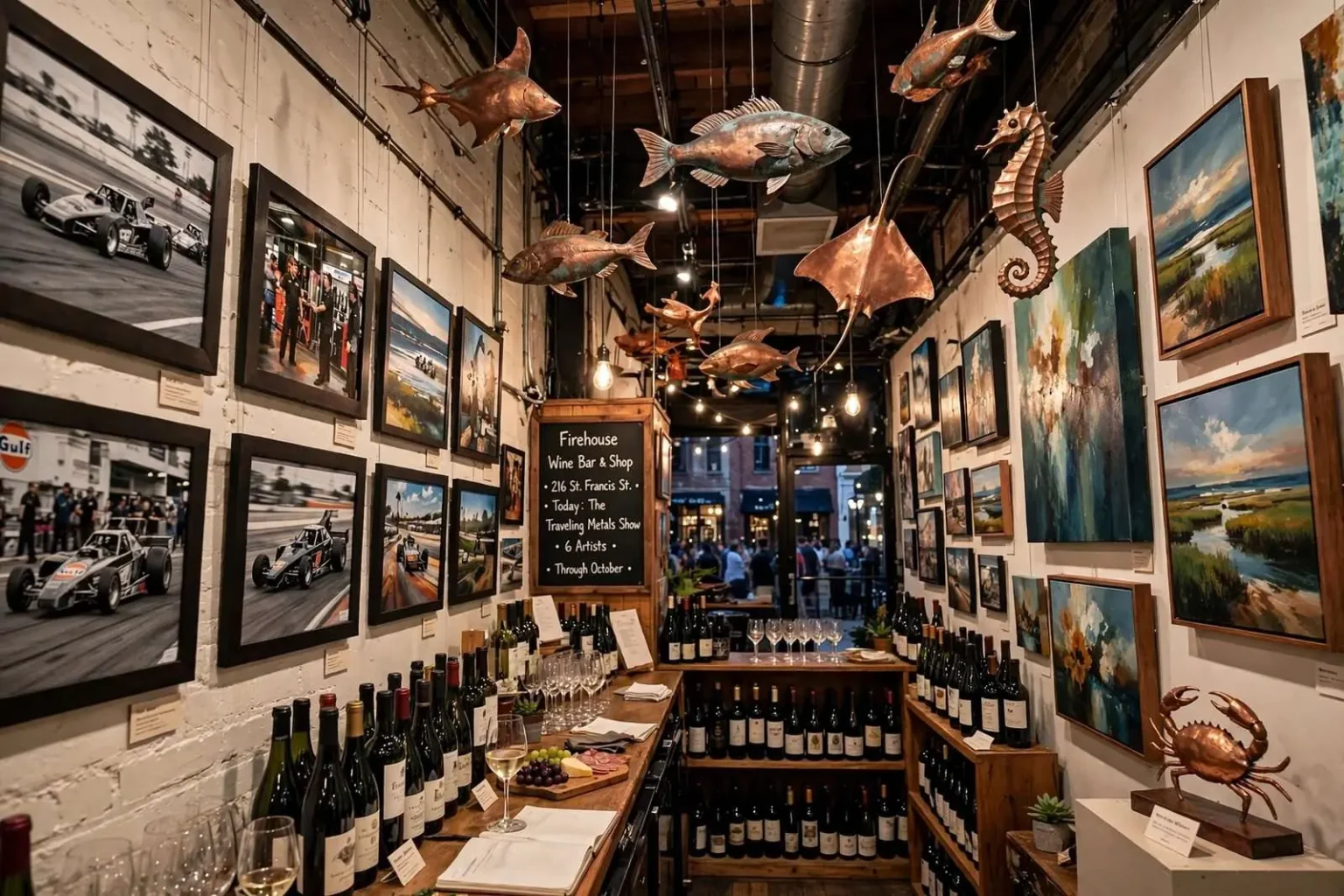
Firehouse Wine Bar & Shop, at 216 St. Francis St., is featuring the work of six local and regional artists as part of The Traveling Metals Show, an exhibition that fills the long, narrow storefront with metalwork, photography and canvas. Patrons have plenty to take in while enjoying a glass of wine, with pieces arranged along both walls of the building and sculpture suspended overhead. The exhibit remains on display through October, though Mobile’s monthly ArtWalk offers a particularly lively chance to view it, when the streets downtown fill with gallery-goers and the wine bar becomes one of the walk’s busiest stops.
The show takes its name from its center of gravity: metal. Copper sculptures, fabricated forms and metal-framed work anchor the exhibition, surrounded by photography and painting from artists whose paths cross at studios, galleries and shows across the Gulf Coast. For a venue the size of the Firehouse — a narrow building on a side street just off Dauphin Street’s main strip — the density of the display turns a simple wine stop into a proper gallery visit.
Lebaron Heathcoe anchors the show
Lebaron Heathcoe of Azalea City Copper Creations is the exhibition’s primary featured artist, and his presence is impossible to miss. Known for metal sculptures of subjects such as sea creatures, Heathcoe has several pieces hanging above the wine racks and from the ceiling, where copper fish and sealife forms drift over the heads of patrons like a stationary aquarium. The placement turns the bar’s vertical space into part of the exhibit — a trick few galleries can manage and that suits the building’s high, narrow interior.
“[I am] dedicated to handcrafted copper art, highlighting it’s natural beauty, properties and form,” Heathcoe explained, in the statement that accompanies his work. Copper is a demanding medium: it moves with heat, patinas with age and reflects light in ways painted work cannot, which is part of why Heathcoe’s creations draw the eye even in a room full of wine bottles. His Azalea City Copper Creations has become a recognizable name in Mobile’s arts community, producing commissioned and one-of-a-kind pieces from a workshop devoted to the material.
Anchoring a six-artist show puts Heathcoe’s work in conversation with the rest of the exhibit rather than above it. The sea creatures overhead answer the drag-strip photography on the wall; the copper’s warm tones play off the canvas pieces across the room. Visitors moving through the space get a cross-section of how several regional artists approach material, subject and scale at once.
The supporting artists
Supporting artists include Kathleen Cope, Gail Rancier Wilson, Claire Noojin and Yevette Ward, each bringing a distinct medium and background to the show. Wilson, Noojin and Ward may be familiar to many Mobilians as three of the artists behind Art(ology), the business and gallery on Dauphin Street that has served as a working studio space and showcase for local art. Their participation links the Firehouse exhibit to the established gallery scene a block away, and gives ArtWalk visitors a reason to continue off the main strip to St. Francis Street.
Cope, a Kentucky native, blends a love of photography with drag racing into a distinctive style, chasing a subject that few fine-art photographers document with her patience. Her images capture the speedway culture of the Gulf Coast — the machines, the crowds and the characters of the track — with an eye that treats pit lane and starting line as studio. “Art is a self expression of one’s feelings inside. More and more schools are removing art classes. Children are losing the concept of self expression,” Cope emphasized, tying her work to a concern shared by working artists across the region as school art budgets continue to shrink.
That concern is a recurring theme among the artists in the show. Mobile’s creative community has long depended on venues outside formal institutions — bars, restaurants and shops that hang work — precisely because commercial galleries are few and institutional wall space is limited. Shows like The Traveling Metals Show function as a bridge: artists get exposure and sales, the venue gets an atmosphere that keeps customers lingering, and the public gets art in the ordinary places where it already gathers.
A wine bar that doubles as a gallery
Firehouse Wine Bar & Shop has quickly become a recognized destination for viewing art in downtown Mobile. Exhibits change monthly and often spotlight local artists, so the walls never stay the same for long, and regulars have learned to look up from their glasses to see what has gone on display since their last visit. The building itself — a narrow storefront with long walls suited to hanging work — makes the arrangement feel natural rather than decorative.
With more than 150 wine varieties plus a draft beer selection, the venue has built a following that extends well beyond the arts crowd, and many visitors become regulars. The wine list covers a wide range of regions and price points, and the staff’s willingness to talk customers through the selection has made the shop a resource as much as a bar. Whether during ArtWalk or the weekly Tuesday Tasting, the space offers another outlet for area artists to gain exposure — and one more reason downtown Mobile’s side streets keep pulling visitors off the beaten path.
ArtWalk and the downtown circuit
The timing of the show matters as much as its contents. Mobile’s ArtWalk, held on the second Friday night of each month in the Lower Dauphin and downtown historic districts, draws hundreds of visitors into galleries, studios and storefronts between roughly 6 and 9 p.m., when artists set up easels and musicians play on the sidewalks. The Firehouse, two blocks off Dauphin on St. Francis Street, sits just far enough from the main corridor to benefit from the spillover: visitors who walk the full grid of the event consistently find their way to the side streets, and a well-lit storefront full of copper sculpture is an effective invitation to step inside.
St. Francis Street itself is part of the story of downtown Mobile’s gradual revival. Running parallel to Dauphin and Government streets, the block around the Firehouse pairs older commercial buildings with a mix of new businesses that have opened as foot traffic has returned to the city center. Each venue that programs live music, tastings or monthly art shows adds to the critical mass that keeps people downtown after the offices close — which is precisely the behavior the city’s revitalization efforts have been working to encourage.
For collectors, a six-artist show at a wine bar is also one of the most approachable ways to buy original work in Mobile. Prices at venue shows tend to be well below gallery commission levels, the artists are often present during ArtWalk to talk about their process, and a purchaser can see a piece in domestic lighting rather than under gallery spots. Several of the artists in the show work on commission — Heathcoe’s copper creations in particular are frequently made to order — so a first encounter at the Firehouse can turn into a longer relationship with a studio.
Six artists, one narrow room
The diversity of the roster is deliberate. A metals-focused show could easily have stayed narrow, but the inclusion of Cope’s racing photography and the canvas work from the Art(ology) artists broadens the appeal: patrons who wander in for a pour and a look at copper sea creatures leave having considered photography of the drag strip, and vice versa. That cross-pollination is typical of Mobile’s artist community, which is small enough that many of the same names recur across shows, studios and volunteer-run events throughout the year.
It also reflects the practical economics of being a working artist on the Gulf Coast. Few local artists support themselves through sales alone, so shows are scheduled around day jobs, and group exhibitions spread the labor of promotion across several participants at once. A traveling format like The Traveling Metals Show — work that can move between venues as walls open up — lets the artists keep the pieces in front of the public for months at a time without anyone footing the cost of a standalone gallery run.
The Copper Creations workshop behind Heathcoe’s centerpiece pieces is part of a small but active metals community on the Gulf Coast, where artists forge, form and finish work by hand in studio spaces scattered from Midtown to the Eastern Shore. Working copper requires patience as much as strength: sheets are cut, annealed, hammered into shape and soldered, then polished or left to weather, depending on the effect the artist wants. Sea creatures have suited the material well — the metal’s warm glow and flowing lines echo the water that surrounds the city on three sides.
For the Firehouse, meanwhile, the show is the latest entry in a monthly rotation that has made the shop a fixture of the downtown arts circuit in a short time. The formula is simple enough that other businesses have copied it: good wine, a room that invites conversation, and walls that change often enough to give regulars a reason to look up. It is also quietly significant for the artists — a venue that sells a piece and hands over the proceeds without heavy commission keeps a working painter or sculptor funded for the next body of work.
The show’s run through October gives the six artists a full month of the fall social season, from ArtWalk crowds to the regular Tuesday Tasting nights when the shop pours a rotating selection for a seated room. By the time the exhibit comes down, the Firehouse’s walls will be hung with something new — and a fresh group of Mobile artists will get their month in the window on St. Francis Street.