Theatre Scramble Mobile Brought Reimagined Fairy Tales to Life at Space 301
Theatre Scramble Mobile staged original plays reimagining classic fairy tales at Space 301, showcasing local writers and actors in Mobile.
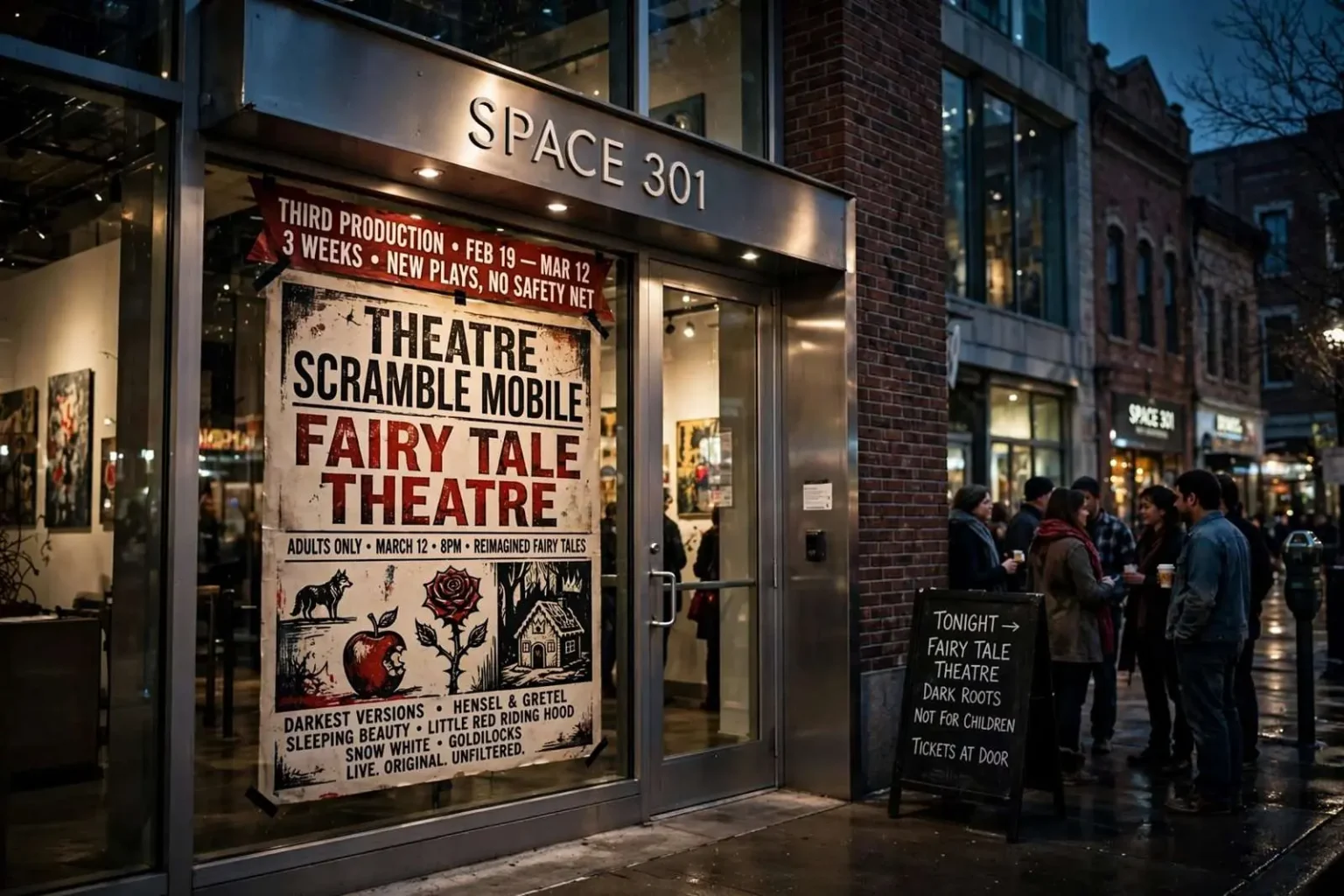
Theatre Scramble Mobile brought its unique brand of high-energy, original theater to Space 301 in downtown Mobile on March 12, 2011, with an evening of reimagined fairy tales that promised audiences something far removed from the sanitized versions found in children’s storybooks.
A Creative Challenge With Dark Roots
The event, dubbed Fairy Tale Theatre, was the culmination of an intensive creative process that began on February 19, when teams of writers and actors were given a single prompt: reimagine a classic fairy tale. Over the course of roughly three weeks, each team developed a short, original play drawn from stories like Goldilocks and the Three Bears, Hansel and Gretel, Sleeping Beauty, Snow White, and Little Red Riding Hood.
While these stories are widely known today as lighthearted children’s fare with cheerful endings, their historical roots are far darker. Traditional versions of many fairy tales contained themes of violence, cannibalism, and other grim subject matter, and the characters did not always live happily ever after. The Theatre Scramble teams were encouraged to dig into these deeper, cross-cultural origins and given complete creative freedom with their interpretations, making the evening strictly an adults-only affair.
The darkness was never an embellishment added by cynical modern adapters. Early printed collections of European folk tales, including the seventeenth-century versions assembled by Charles Perrault in France and the nineteenth-century collections of the Brothers Grimm in Germany, preserved stories that had circulated for generations as oral tales told by adults for adults. Famine, abandonment, stepfamily cruelty, and punishment that bore no relation to the crime appeared throughout the earliest recordings, and many tales carried explicit warnings about hunger, poverty, and strangers on the road. The cheerful versions familiar to twenty-first-century audiences are, in many cases, the product of a long softening process that unfolded over two centuries of reprinting, adaptation, and, eventually, animation.
That history gave the March 12 teams fertile ground. A story like Hansel and Gretel arrives pre-loaded with child abandonment and a cannibal witch; Sleeping Beauty begins with a curse over an uninvited guest; and Goldilocks concerns a home invasion that ends, in the oldest tellings, considerably worse for the intruder. The prompt did not require the teams to stay faithful to any single version, only to engage seriously with material most audiences knew exclusively in its softened form.
Live Theater in a Pressure Cooker
Theatre Scramble Mobile was founded by Stefanie Bencsath and Trey Lane with a straightforward mission: give local writers and actors a platform to showcase their talents through short, original plays created under tight deadlines of two to three weeks. The format was designed to spark spontaneity and raw creativity, stripping away the lengthy rehearsal periods of traditional theater in favor of something more immediate and unpredictable.
The scramble model follows a pattern that has spread through community theaters across the country under names like play-in-a-day and 24-hour play festivals. The premise is the same in every version: remove the luxury of revision, force writers to commit to ideas quickly, and ask actors to build characters on a compressed schedule with minimal rehearsal. What emerges is rarely polished in the traditional sense, but it tends to be vivid, risky, and unmistakably alive in ways that over-rehearsed material often is not. For writers, the deadline is the point; it clears away the perfectionism that keeps scripts in drawers for years.
Fairy Tale Theatre marked the group’s third production. Their debut event at the Mobile Museum of Art in November 2010 drew nearly 200 audience members, and a family-friendly Mardi Gras-themed scramble followed at the same venue earlier in the season.
A Home Downtown
Space 301 gave the young company a different setting for its third outing. Located in the heart of downtown Mobile, the venue had established itself as a hub for contemporary visual and performing arts in the city, hosting exhibitions and events that drew the downtown crowd back into a district still rebuilding its evening life. For a theater company built on experimentation, a gallery-turned-performance space offered flexibility a conventional stage could not: seating could be reconfigured, sets could be minimal, and the informal atmosphere matched the scrappy spirit of the productions themselves.
For actors, the scramble format offers its own kind of education. Community theater in Mobile has a long and sturdy base, with longtime companies staging full seasons of familiar musicals and plays, but those productions rarely leave room for a newcomer to help originate a role in a brand-new script. A scramble flips that equation. Every part in every play is being performed for the first time, which means no performer is competing with anyone’s memory of a famous production and no actor is too inexperienced to be essential. The compressed schedule also forces performers to make decisive, committed choices rather than waiting for a director to settle questions weeks later.
The adults-only framing of Fairy Tale Theatre widened what the writers could attempt. Family-friendly scrambles impose natural limits on subject matter and language, but an evening built around the uncensored roots of folk tales allowed for material that could genuinely unsettle or shock an audience. The March 12 program essentially invited the teams to answer a question that folklorists have long found interesting: what did these stories mean before they were rewritten for children?
An Audience for Risk
The production also reflected the state of Mobile’s arts scene in early 2011. Downtown’s revival was picking up momentum around then, with galleries, music venues, and monthly art walks building a younger audience willing to come out on a Saturday night for something unproven. Companies and collectives working outside the established theatrical institutions depended on exactly that crowd, since original work sells no season tickets and carries no built-in name recognition. Nearly 200 people at a debut event suggested the appetite was real.
Each event of this kind also functions as a networking engine for the local scene. Writers meet actors they would never have encountered through existing companies, directors scout talent, and audiences get a low-cost sampling of performers they may follow to bigger productions. The three-week scramble cycle compresses into a single evening the kind of relationship-building that usually takes a community theater years to produce, and it does so with a fresh slate of material every time.
The Enduring Pull of Fairy Tales
The choice of fairy tales as a prompt was as practical as it was provocative. The stories are public property, free of licensing concerns, and universally known, which lets an audience settle into each play quickly while the writers subvert expectations. They are also endlessly adaptable: the same tale can be played as horror, satire, farce, or tragedy, and a lineup of five or six teams attacking the same well of stories virtually guarantees an evening of wildly divergent takes.
Folklorists have noted that the tales’ durability comes from exactly that flexibility. Little Red Riding Hood has been recast as everything from a cautionary sermon to a psychoanalytic case study, and each generation gets the wolf it deserves. Handing those stories to teams with complete creative freedom, and an audience warned that nothing was suitable for children, put Theatre Scramble Mobile squarely in the tradition of adults reclaiming folklore as living, changeable material rather than a fixed canon of bedtime stories.
For the audience at Space 301 on March 12, the promise was simple: familiar stories, unfamiliar endings, and the particular electricity of watching work that existed only because a group of local writers and actors had been handed a prompt three weeks earlier and told to build something. The evening delivered fairy tales as they were first meant to be received — told live, to grown-ups, with the lights down and no guarantee of a happy ending.
By its third production, the company had also settled into the rhythm that deadline theater demands. Teams receive their prompt, spend the first days arguing through concepts and discarding most of them, then write in bursts while coordinating rehearsal space around jobs and other obligations. The final week is a sprint of blocking, memorization, and improvised solutions to staging problems that a longer production would solve with proper sets. When the date arrives, whatever is ready is what goes on stage, and the audience understands that part of the experience is watching people perform at the edge of their preparation.
That scrappiness is a feature of the Gulf Coast’s independent arts economy generally. Original theater in a mid-sized city survives on modest budgets, borrowed venues, and volunteer labor, and the companies that last are the ones that turn those constraints into a stylistic identity. Theatre Scramble Mobile’s formula — tight deadlines, short plays, rotating teams — meant every production cost little and looked different from the last, an approach that kept both the participants and the audience coming back to see what the next prompt would produce.
The March 12, 2011 edition of that formula, staged in one of downtown Mobile’s most flexible art spaces and aimed squarely at adult audiences, took some of the oldest and darkest stories in the Western tradition and handed them back to the city in freshly invented forms. Whether the plays leaned into the violence and menace of the original tellings or played their grim material for comedy, the starting point remained the same one folklorists point to when they trace the tales back through Perrault, the Grimms, and the generations of unnamed storytellers before them: fairy tales were never really written for children.