
Theodore Firefighters Come to the Rescue of a Cat Stuck High in a Tree
Theodore Dawes Fire Rescue firefighters rescued a cat from a tall tree in Theodore after a homeowner's ladder couldn't reach the stranded pet.
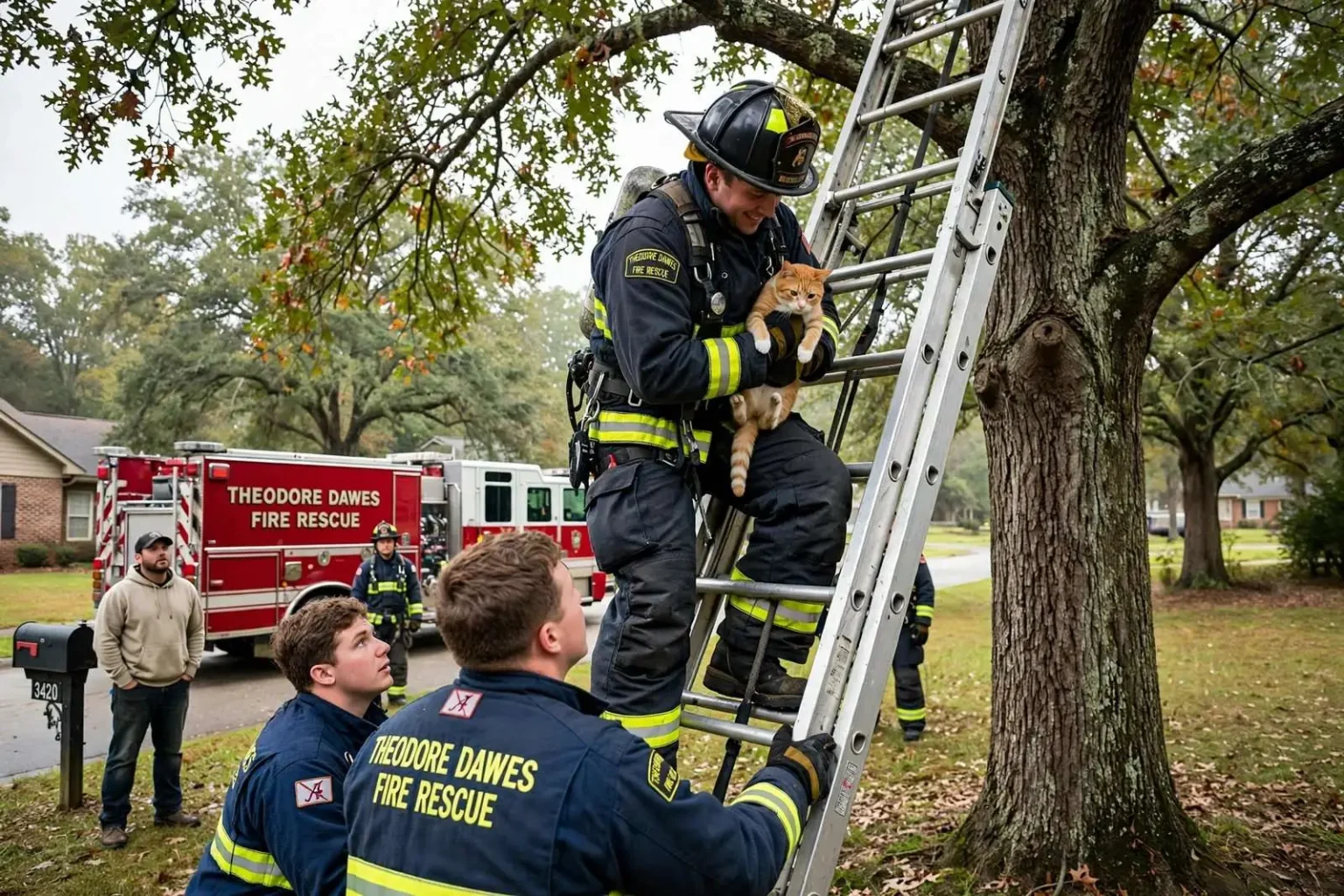
THEODORE, Ala. — A curious cat’s climb up a Theodore tree ended safely Thursday morning, thanks to firefighters with Theodore Dawes Fire Rescue. The department’s crews were called to a local home after the homeowner’s ladder proved too short to reach the stranded feline, and after attempts to coax the animal down with food also failed, the job fell to the professionals with the tall ladders.
The call came in as the kind of errand fire departments handle without sirens or urgency — no fire, no injury, no hazard to anyone but the cat’s dignity. Yet the situation was genuine enough for the homeowner: a family pet perched high in a tree, refusing every entreaty to come down, with an owner underneath unable to reach it. When the homeowner’s own ladder fell short of the cat’s perch, the next call was to the fire station.
Firefighters arrived and assessed the situation. Food placed at the base of the tree — the classic first move for anyone trying to lure a cat down — failed to do the trick, according to the department. With the animal showing no interest in descending on its own and the height beyond the reach of household equipment, the firefighters moved to plan B.
The Rescue
A firefighter climbed an extended ladder, scooped up the cat and made his way back down with the unharmed animal in hand — capping off an unusual but successful morning call for the department. The operation took the coordinated effort of a small crew: one member on the ladder, others steadying and spotting from the ground, all under the eye of the department’s officers.
Cats stuck in trees are rarely in true danger, but the rescues carry real risks for the people involved. Extended ladders must be placed carefully, often on soft ground or uneven terrain under the tree’s canopy, and a cat that panics at the approach can retreat higher or leap, injuring itself. A firefighter making the climb has to move slowly enough to keep the animal calm while managing his own footing at height — a skill set that has less to do with firefighting than with patience.
In this case, the combination worked exactly as intended. The firefighter reached the cat, secured it, and made the descent without incident. The homeowner got the family pet back unharmed, and the department got a successful outcome it was happy to share.
A Classic Call for Local Fire Crews
Cat-in-a-tree rescues may sound like a cliché, but they remain a regular part of life for fire departments across Mobile County, where residents often turn to their local fire service when pets get themselves into precarious spots. The county’s mix of wooded residential lots, towering oaks and pecan trees, and a large population of outdoor and semi-outdoor cats produces a steady trickle of such calls, particularly in the suburban and rural communities south and west of Mobile.
Fire departments generally respond when they can, and most treat the calls as community service rather than emergency response. A stuck cat does not outrank a house fire, but between alarms, the time and equipment are usually available — and departments know that a successful pet rescue earns a level of community goodwill that no amount of advertising can buy. Children who watch their local crew save the family cat remember it for years.
Theodore Dawes Fire Rescue serves the Theodore area and neighboring communities in southern Mobile County, responding to fires, medical calls, wrecks and the full range of emergencies that come with a growing suburban service area. The department, like other volunteer and combination departments across the county, is staffed by members who live in the communities they protect, which is why the cat call ranks as one of the more satisfying tasks on the board.
Why Cats Climb and Won’t Come Down
Any cat owner knows the pattern: a cat chases a squirrel, bird or butterfly up a tree, gets higher than it intended, and freezes. Veterinarians note that cats are superb climbers but awkward descenders — their curved claws point backward, ideal for pulling themselves up a trunk and poor for backing down. A cat that climbs too high often has to jump the last stretch, and a cat that is too high to jump waits for help instead.
Most stuck cats come down on their own within a day or so, driven by thirst or hunger, which is why experts often advise patience before any rescue attempt. But owners of indoor cats, young cats and older animals frequently cannot bear the wait, especially with rain or cold in the forecast, and a cat visible in a bare winter canopy has a way of mobilizing a household. When the family ladder comes up short, the fire department gets the call — as it did in Theodore on Thursday morning.
Food at the base of the trunk is the standard first attempt, and it fails often enough that firefighters expect it to. A frightened cat high in a tree is rarely interested in a bowl of cat food on the ground, and some experienced rescuers suggest that the smell can actually draw other animals — dogs, raccoons, opossums — that make the situation worse. When the lure fails, the ladder is next, and when the ladder is too short, it is time for the fire service.
The Social Media Album
Theodore Dawes Fire Rescue shared photos of the operation on social media, showing the firefighter’s climb, the rescue itself and the safe trip back down. Departments across Mobile County have learned that these photo albums travel far — neighbors tag each other, the story gets shared beyond the community, and the department’s name reaches households that may never have needed a fire truck but now know the crew that climbs trees for cats.
The photos also serve a practical purpose. Each lighthearted post humanizes the department, shows the community the range of work its firefighters do, and reminds residents that the number for the fire station is not reserved for catastrophe. Departments that share these moments routinely note that the goodwill pays dividends at budget time and recruiting time alike.
The department did not report any injuries — human or feline. The cat, presumably, returned to the business of napping, perhaps with a new wariness of trees; the firefighter returned to the station; and the ladder was racked back in its bay, ready for the next call that is more than it seems.
When to Call, and When Not To
Fire departments and animal control agencies offer a rough guide for the next stuck-cat situation. First, give the animal time — many cats descend overnight once the audience disperses and hunger takes over. Second, try the familiar: food, the cat’s own litter box placed at the tree’s base, or the sound of a can opener on a quiet evening. Third, attempt a rescue from height only with a stable ladder and a second person present, never alone and never beyond a safe reach.
When the cat is genuinely too high, has been stuck for days, or is visibly weak or injured, the fire department is the right call — along with the local animal services office. Departments like Theodore Dawes would rather field a dozen cat calls than hear that a resident fell from a ladder trying to do the job alone. Thursday’s rescue ended the way these calls are supposed to: a cat down, an owner relieved, and a crew back in service with a good story to tell.
For the Theodore homeowner, the morning’s drama ended with an unharmed pet and a new appreciation for the tall ladders at the neighborhood fire station. For the department, it was one more entry in the long, affectionate tradition of the rescue that never makes the headlines — and always makes the photo album.
Theodore and Its Fire Service
Theodore sits in southern Mobile County along U.S. Highway 90, between Mobile and the communities strung out toward the bay — a growing suburban area where residential subdivisions push against the same wooded lots that make the region so green and, apparently, so climbable. Its namesake fire department serves one of the county’s broader response zones, covering homes, schools, churches and the commercial strips along the highway.
Departments across southern Mobile County handle this full range daily. A single shift can run from a structure fire or a highway wreck to medical assists and, when the occasion demands, a cat in an oak tree. The variety is part of the job’s texture, and members of small departments often note that the odd calls are the ones the community remembers most fondly.
The county’s fire services operate as a patchwork of departments, some career, some volunteer, some a mix, each covering its own district with mutual aid agreements binding the map together. For residents, the practical takeaway is simple: the station down the road is staffed by neighbors with the equipment — aerial ladders, protective gear, training — that no homeowner can replicate in the backyard.
The Economics of a Small Rescue
A cat rescue costs a department little: a few gallons of diesel, an hour of a crew’s time between other duties, and some wear on an aerial ladder. Measured against the goodwill generated — and against the cost of a resident falling from a ladder trying it alone — the investment returns itself many times over. Fire chiefs are generally happy to make the trade.
The alternative outcomes are what justify the response. Every year, somewhere in the country, a pet owner falls from a ladder or a roof trying to reach a stranded animal, and those falls produce exactly the kind of injuries fire departments exist to prevent. Departments would much rather take the risk onto themselves, with trained climbers and proper equipment, than respond afterward to a rescue that became an accident.
Thursday’s call in Theodore fit the pattern. The homeowner had already tried the ladder and the food — the correct first steps — and simply ran out of height. The department completed what the family started, and the photos it shared will serve as the template for the next household facing the same situation: call early, keep the cat calm, and let the professionals bring everyone down safely.