Thomasville Teachers Mourn Teen Killed in Tragic Bashi Road Crash
Teachers and students at Thomasville High School remember 18-year-old Gavin Pugh, killed in a car crash on Bashi Road in Clarke County, Alabama.
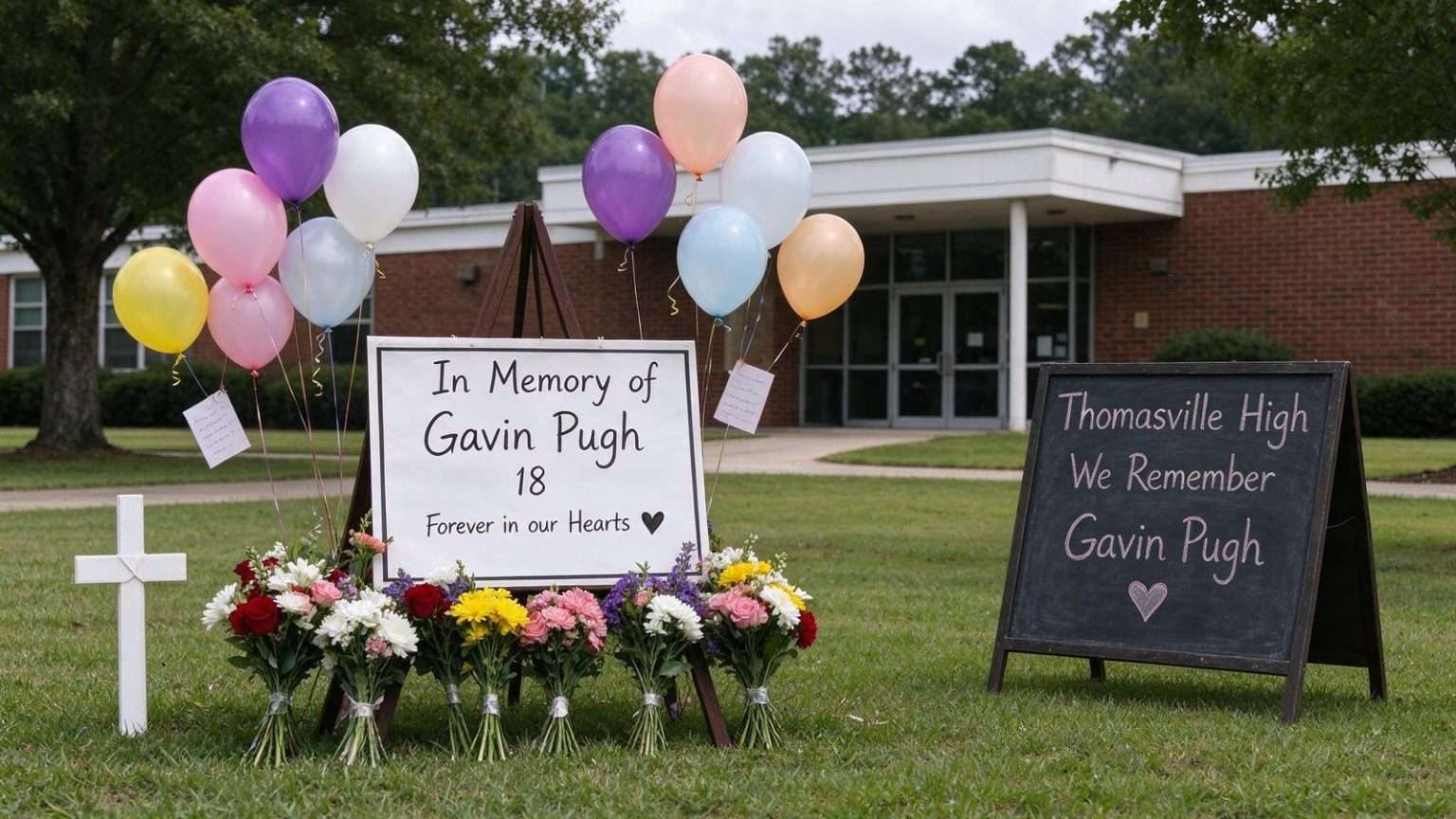
THOMASVILLE, Ala. — Faculty and students at Thomasville High School in Clarke County are grieving the loss of 18-year-old Gavin Pugh, who died in a car crash on Bashi Road. The death of the senior has cast a shadow over the school, where teachers knew him not as a name on a roster but as a daily presence in their classrooms.
A community in mourning
Principal Kyle Ferguson addressed the senior class in the school auditorium to share the devastating news. “They probably sat for nearly an hour and a half without speaking a word,” Ferguson said. “For teenagers and adolescents it’s kind of hard to wrap your mind around the finality of loss like that.”
The reaction Ferguson described is familiar to educators who have had to deliver such news. For students approaching graduation, the death of a classmate lands at a moment when the future feels most open — college plans, jobs and the last shared months of school all suddenly shadowed by an empty chair. Schools across rural Alabama typically respond to a student death by opening counseling rooms, bringing in extra support staff and giving students space to gather, grieve and talk, and Thomasville High School’s auditorium became exactly that kind of gathering place in the hours after the news broke.
For teachers who spent five days a week with Gavin in the classroom, the loss hit especially hard. “This is the first time I’ve lost a student while teaching that student. It’s something I hope I never go through again,” said teacher Kay Larrimore.
Gavin’s empty seat on Thursday was a painful reminder for classmates and educators alike. “Everybody liked Gavin, everybody,” Larrimore added.
Remembered as smart, funny and loving
Teacher Stepheni Wright remembered the young man fondly: “He just was an incredible young man and I’m so thankful for the opportunity for him to have been in my life. I want people to remember Gavin Pugh as a wonderful person.”
Friends and faculty described Gavin as smart, funny and loving — the kind of student whose absence is felt in the small routines of a school day. Students were already planning a balloon release to honor the 18-year-old, a gesture common in small Southern towns where a school often serves as the center of community life for families across the county.
The crash on Bashi Road
Gavin died in a car crash on Bashi Road, a rural highway that runs through northern Clarke County and is well known to local travelers for its stretches of forest and farmland. Rural two-lane roads like it carry much of the daily traffic in Alabama’s Black Belt and surrounding counties, where long drives between home, school and town are a routine part of life for students. County and state officials have long urged caution on such roads, where curves, narrow shoulders and wildlife crossings make conditions less forgiving than they might appear.
The loss of a young driver resonates across Clarke County, a largely rural county in southwest Alabama where Thomasville serves as the largest city and a hub for schools, shopping and medical care. When a crash takes a student’s life, the news travels quickly through close-knit communities — churches, ballfields and classrooms — where the victim’s family is often known personally to half the town.
How schools walk students through grief
The scene at Thomasville High School in the days after the crash reflected a pattern that educators across Alabama know well. Administrators generally try to deliver news of a student’s death directly and honestly, in a controlled setting such as an auditorium, before rumor can spread through hallways and social media. Counselors and youth pastors are typically made available, and teachers are encouraged to keep classroom routines steady, because structure can be a form of comfort when a school’s ordinary rhythm has been broken.
The silence Ferguson described from the senior class — an hour and a half without a word — captures how teenagers often process a death that feels impossible. Grief at that age arrives unevenly: some students weep immediately, others sit stunned, and others return to jokes within days as a way of coping. Educators say all of those responses are normal, and that the weeks after a loss matter as much as the first day, when memorial gestures such as balloon releases, memory tables and moments of silence keep the student’s place in the school visible.
A teacher’s first loss
Larrimore’s words — that she had never before lost a student she was teaching — speak to a dimension of the tragedy that often goes unmentioned. For the adults on a school campus, a student’s death is not a news item but a wound in the daily fabric of their work. The desks stay where they were; the roll still gets called. Teachers describe the empty seat as the hardest part, a silent daily reminder that no lesson plan prepared them for.
Veteran educators in small districts often teach the children of former students, which deepens the web of relationships around a loss like Gavin’s. In a school the size of Thomasville High, a senior class typically knows one another’s families, and a death touches teachers, coaches, cafeteria workers and bus drivers alike. The faculty’s grief, visible in interviews with those who taught him, mirrors what students expressed: that Gavin was genuinely liked, without qualification.
The balloon release and a town’s rituals of remembrance
The balloon release students planned for Gavin fits a long tradition of informal memorials across south Alabama, where communities mark sudden deaths with balloons, candles, flowers and handwritten signs at the site of the loss. Such gestures give young people an active role in mourning, which counselors often note is healthier than passive sadness — planning, organizing and gathering are ways of doing something when nothing can be undone.
In towns like Thomasville, school events in the weeks after a student’s death — ballgames, ceremonies, graduation itself — take on a double meaning as both the continuation of normal life and a series of moments when the missing classmate is felt. Classmates frequently wear his favorite colors, reserve his seat at assemblies or carry his memory into graduation exercises in the spring. Schools rarely announce those plans formally; they simply emerge from the class itself, as the balloon release did.
What remains
For now, Clarke County’s focus is on the family, the classmates and the teachers who will walk into that classroom each day and see the empty chair. Ferguson’s composure in front of the seniors, Larrimore’s candor about her own grief and Wright’s wish that people remember Gavin as a wonderful person together sketch the picture of a school doing what schools in small Alabama towns have always done in moments like this: holding together, remembering honestly and carrying a young man’s name forward with pride. As one of his teachers said, everybody liked Gavin — and in Thomasville, that simple truth is the starting point for saying goodbye.
Driving risks on rural Alabama roads
Crashes on rural roads remain a persistent danger for teenage drivers across Alabama. Young drivers have less experience judging curves, passing distances and night conditions, and the county roads around Thomasville — like Bashi Road — present exactly the kind of environment where inexperience can matter most. State and county law enforcement agencies regularly remind drivers, especially new ones, to slow down on curves, watch for livestock and slow-moving farm equipment, and expect narrow shoulders on stretches where a moment of inattention leaves little room for recovery. While the details of Gavin’s crash have not been the subject of public discussion by school officials, the grief that followed it has already prompted the kind of quiet conversations between parents and teenagers that rural communities know too well.
The role of faith and neighbors in a small-town loss
In Clarke County, the response to a student’s death typically extends well beyond the school grounds. Churches open their doors for prayer services and visitation, local businesses post signs of support for the family, and neighbors deliver food in the days surrounding the funeral. These rituals matter in a county where many families have lived for generations, and where the networks that bind people together — school, church, youth sports — overlap almost completely. For the Pugh family’s classmates and teachers, those community structures provide a frame for grief that a larger city often cannot.
School leaders, meanwhile, face the delicate task of keeping the campus functioning while honoring the loss. Administrators coordinate with counselors, communicate with parents and decide how memorials will be handled on school property, all while continuing the ordinary business of schedules, lessons and activities. It is demanding, unglamorous work, and Ferguson’s decision to address the senior class directly — rather than letting the news arrive secondhand — reflected the care with which Thomasville’s leadership treated its students in the hardest hour of their senior year.
Carrying the memory forward
The measure of a loss like this one will show up over months, not days. When the senior class reaches graduation, Gavin’s absence will be part of the ceremony whether anyone plans it or not — in the moment of silence, the flowers or simply the number of chairs on the floor. Until then, the balloon release stands as the first of what will likely be many gestures, each one an attempt by people who loved him to answer the question every sudden death leaves behind: how do we keep him with us? For the teachers who answered with words — “a wonderful person,” “incredible,” “everybody liked Gavin” — and for the students who answered with balloons, the memory work has already begun. Thomasville is a small enough place that Gavin Pugh will be remembered not as a headline but as a classmate, a student and a son, and in the end that local, personal remembering is the only memorial his school could ever have offered.