
Thomasville’s Ashley Ballard Completes Summer Cancer Research Program at USA
Thomasville native Ashley Ballard completed an eight-week undergraduate cancer research program at USA's Whiddon College of Medicine, studying colon cancer progression under Dr. Chandrani Sarkar.
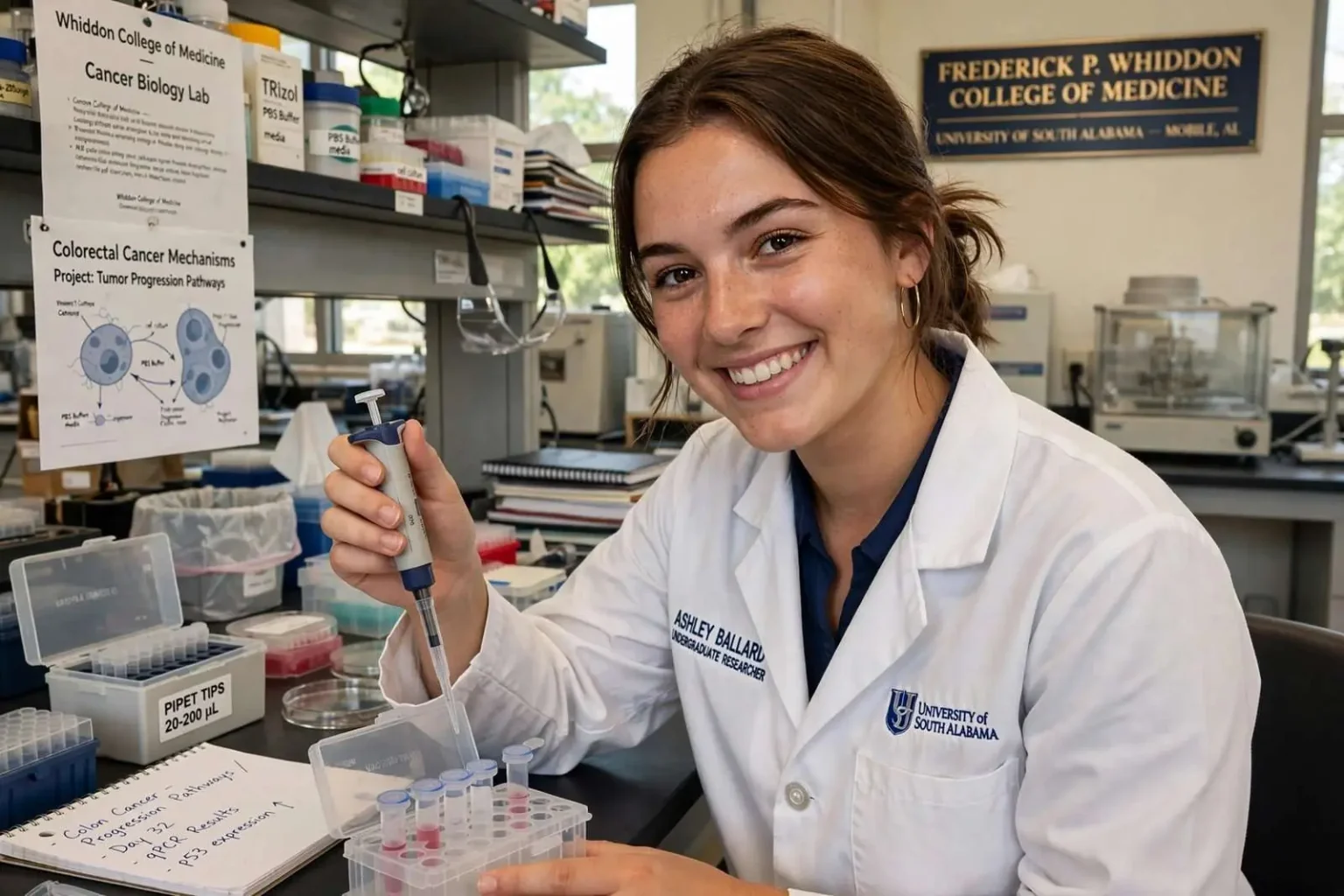
A Thomasville native has spent her summer in the lab, working alongside faculty researchers at the University of South Alabama’s Frederick P. Whiddon College of Medicine, in a program designed to turn undergraduate classroom training into real bench science before a student’s career even begins. Ashley Ballard recently completed an eight-week undergraduate summer research program that gives aspiring scientists hands-on laboratory experience under the guidance of a faculty mentor.
Eight weeks is a short span in research terms, but the summer program’s structure packs a graduate-style experience into it: students arrive in Mobile at the start of the summer, join a working laboratory, learn the techniques the lab actually uses, and carry a defined piece of a project from question to result. By the program’s end, participants have practiced the daily craft of science — pipetting, troubleshooting, reading literature, presenting findings — that no lecture course can teach.
Colon Cancer Research at Whiddon COM
Ballard was mentored by Dr. Chandrani Sarkar, Ph.D., and studied mechanisms that may contribute to the progression of colon cancer. Colorectal cancer research occupies an urgent corner of cancer biology. The disease is among the most common cancers diagnosed in the United States, and while screening has driven overall death rates down for decades, diagnoses in younger adults have been climbing — a trend that has pushed researchers to understand the molecular machinery of tumor progression in finer detail than ever.
Studies of progression mechanisms — the cellular and molecular changes that let a tumor grow, invade and resist treatment — are the long game of cancer medicine. Every targeted therapy and every biomarker test now in the clinic began as basic research of exactly the kind the Whiddon College of Medicine’s laboratories conduct, and summer students contribute to that pipeline while learning what research actually feels like. For an undergraduate, the mentorship is the heart of it: a faculty mentor who works beside a student daily, explains not just how a technique runs but why the question matters, and shows the difference between a classroom answer and a lab result. That daily contact is what separates a genuine research apprenticeship from a summer lecture series, and it is the element alumni of such programs consistently cite years later as formative.
The Program’s Purpose
The intensive summer program is designed to expose undergraduate students to biomedical research early in their academic careers, pairing them with faculty mentors at the medical school for hands-on lab work. Programs of this type exist across the country because the pipeline into biomedical science has a well-known leak: students who have never worked in a laboratory rarely imagine themselves as scientists, and the ones who try research early overwhelmingly stay in it. A summer in a real lab converts an abstract interest in science into a career direction — or, just as usefully, redirects a student before years are spent on a path that fits poorly.
Whiddon College of Medicine
The Frederick P. Whiddon College of Medicine is the University of South Alabama’s medical school in Mobile, the only MD-granting institution on the central Gulf Coast between New Orleans and Pensacola. Named for the university’s longtime president who built South Alabama from a small extension center into a full university, the college trains physicians who practice across the Gulf Coast region and runs research programs spanning cancer biology, cardiovascular science, neuroscience and infectious disease. Its research enterprise gives undergraduates — most of them from Alabama colleges — access to working laboratories that would otherwise require travel to major research universities.
That access matters for students from small towns. Thomasville, Ballard’s hometown, is the commercial center of Clarke County, a community of a few thousand residents in Alabama’s piney woods where the school system and the surrounding towns produce college-bound students far from any research university. A summer program in Mobile puts a student from Thomasville in a medical school laboratory within an hour’s drive of home, close enough that family can watch the work and the student can imagine building a scientific career without leaving the region behind entirely.
From Clarke Prep to the Lab Bench
Ballard is the daughter of Jennifer and Neil Ballard of Thomasville. She was valedictorian of her senior class at Clarke Prep and was named the 2024 Clarke County Distinguished Young Woman, a record that marks her as one of the most decorated students of her graduating class in the county. Clarke Prep, a private school in Thomasville, has a tradition of sending graduates to Alabama’s public universities, and the Distinguished Young Woman program — the scholarship competition formerly known as Junior Miss, headquartered in nearby Mobile — has long been a proving ground for the region’s high-achieving young women.
The combination of achievements speaks to what the summer program looks for: students who have excelled academically and shown the discipline that laboratory work demands. Research rewards exactly the habits that earned those honors — precision, persistence, and the willingness to be wrong repeatedly until the experiment works.
A Day in the Program
Summer research students typically live the schedule of their lab: days at the bench running experiments, reading papers and analyzing data, with seminar sessions and journal clubs layered on top. In a cancer biology lab, that can mean cell culture work maintaining tumor cell lines, western blots and PCR assays measuring gene and protein expression, microscopy, and the careful record-keeping that makes an experiment reproducible. The eight weeks end with a presentation, where students stand before peers and faculty and defend what they found — the same format they will face in graduate school interviews and, eventually, professional meetings.
The mentor relationship carries the program’s weight. A faculty mentor like Dr. Sarkar sets the student’s project at the right level — real enough to matter, bounded enough to finish — and meets with the student regularly to interpret results and plan next steps. Undergraduate researchers rarely change a field in eight weeks, but they learn how knowledge is actually made: the failed controls, the ambiguous blots, the slow accumulation of evidence. Students who finish the summer wanting more of that are exactly the ones the program was built to find.
What Comes Next
For a student with Ballard’s trajectory, a summer at Whiddon COM typically sharpens an already-focused path. The experience strengthens graduate and medical school applications in concrete ways — a faculty mentor who can write in detail about the student’s abilities, a research presentation on the record, and the technical vocabulary that separates applicants who have done science from applicants who have only studied it. Many program alumni go on to medical school, Ph.D. programs in the biomedical sciences, or combined M.D.-Ph.D. tracks, and a meaningful share return to practice or research in Alabama.
The homecoming angle is real for communities like Thomasville, which like much of rural Alabama faces a shortage of physicians and scientific professionals. Every student who leaves a small town, excels in biomedical training, and remembers where she came from is a candidate to bring those skills back — to the clinic, the classroom, or the lab. Clarke County has watched Ballard collect academic honors since her valedictorian year; the summer research milestone adds a professional credential to the list and a glimpse of where her career may be headed.
Why Summer Programs Matter to the Region
From the university’s side, programs like this one are both outreach and investment. They build relationships with small colleges and high schools across South Alabama, they feed the university’s own graduate programs with students who arrive already trained, and they strengthen the case for funding — agencies that support biomedical research look for evidence that laboratories are training the next generation, not just producing papers. A student from Thomasville presenting summer work at Whiddon COM is the program’s product and its advertisement at once.
Eight weeks of colon cancer research will not, on its own, change the course of the disease. But the pipeline it feeds — student to mentor, undergraduate lab to graduate program, training to practice — is how the region builds the scientific workforce its hospitals, universities and biotechnology future depend on. Ballard’s summer is one link in that chain, notable to her community and, in time, perhaps notable well beyond it.
For now, the record stands as follows: a Thomasville native, the daughter of Jennifer and Neil Ballard, valedictorian of Clarke Prep’s senior class and the 2024 Clarke County Distinguished Young Woman, completed an eight-week undergraduate summer research program at the University of South Alabama’s Frederick P. Whiddon College of Medicine, mentored by Dr. Chandrani Sarkar, studying mechanisms that may contribute to the progression of colon cancer. It is the kind of milestone that rarely makes more than local headlines — and exactly the kind that, twenty years from now, gets cited as the beginning.