
Thousands of Students Head Back to Class as Catholic Schools Open Across Mobile Archdiocese
Thousands of students return to class at the Archdiocese of Mobile's 18 Catholic schools as Archbishop Thomas Rodi celebrates the back-to-school Mass.
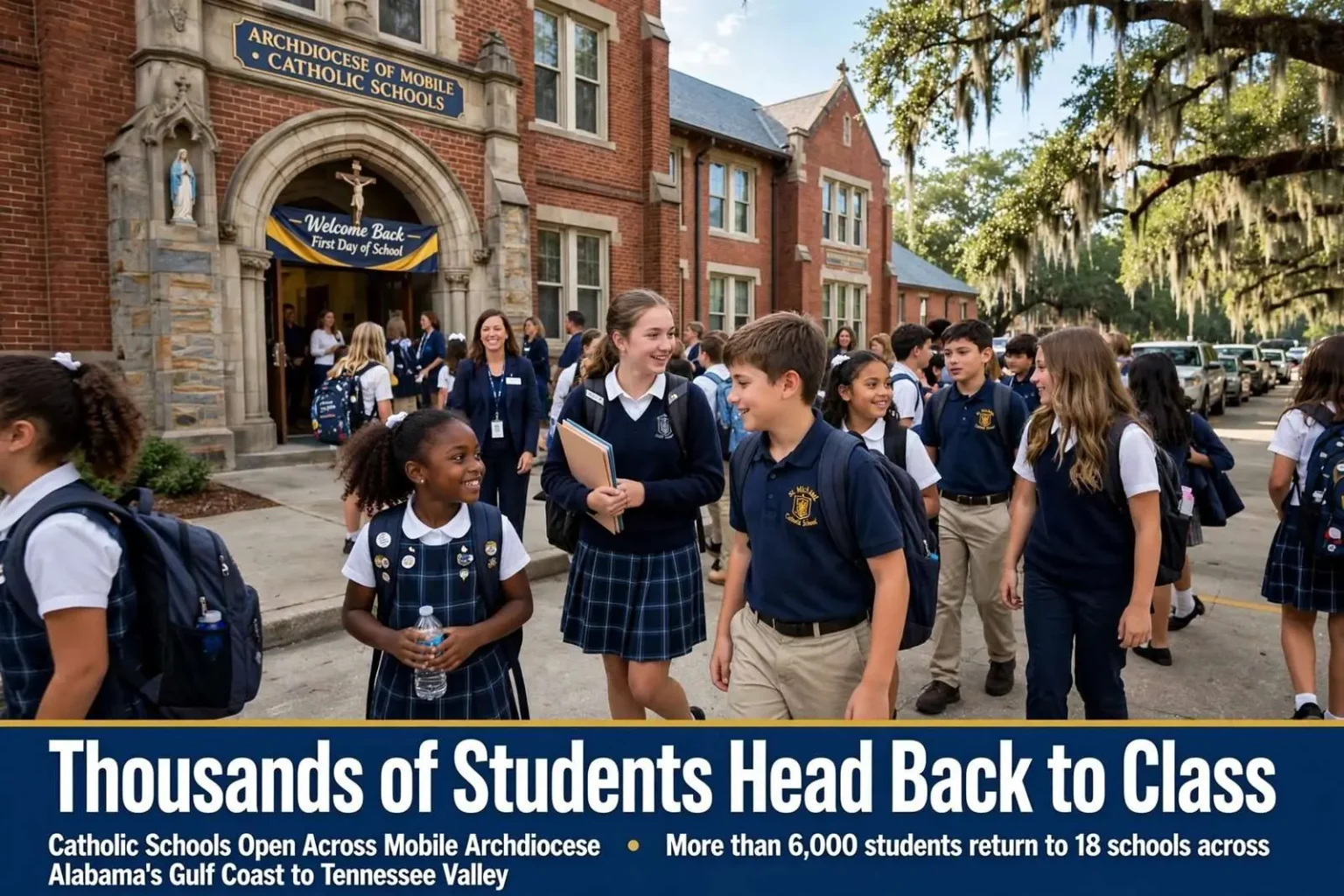
MOBILE — The first day of school has arrived for thousands of Catholic students across the Archdiocese of Mobile, as backpacks, uniforms, and car lines returned to campuses from the Gulf Coast to the Tennessee Valley. The archdiocese, which spans roughly half of Alabama, counted more than 6,000 students in 18 schools last year, and many of those students attend schools in Mobile and Baldwin counties — the population centers where Catholic education has its deepest roots in the state.
The opening days followed a familiar rhythm: teachers returning a week early to prepare classrooms, principals holding orientations for new families, and the first morning’s mix of nervous kindergartners and settled upperclassmen. Behind the scenes, the archdiocese’s education office had spent the summer filling positions, ordering materials, and finalizing calendars for a school system that operates as both a private network and a single, unified family of schools spread across dozens of counties and multiple time zones.
A Mass before the first bell
Teachers and staff gathered Tuesday for the annual back-to-school Mass, the tradition that formally opens the school year for the adults who run it before the students ever arrive. The Mass draws faculty, administrators, and staff from across the archdiocese for a service that is equal parts worship and pep rally — a chance to mark the year ahead, to acknowledge the weight of the work, and to send educators back to their classrooms with a shared sense of purpose.
Archbishop Thomas Rodi reflected at the Mass on the outsized role educators play in young lives, noting that teachers spend nearly as much time with students as their parents do — and in some cases even more. The observation lands differently for Catholic school teachers, whose days blend instruction with prayer, sacramental preparation, and the informal mentoring that happens in hallways and on playgrounds. A teacher in a parish school may coach, direct the Christmas pageant, and prepare a class for first Communion in the same month.
Rodi told the gathered educators that students may not remember every lesson years later, but they will always remember how their teachers made them feel about themselves. It was a message about the long shelf life of a teacher’s tone: the arithmetic fades, the vocabulary fades, but the child who was made to feel capable — or small — carries that forward. “There are teachers who made me feel good, gave me confidence, made me know that I was worthwhile,” the archbishop said, drawing on his own school years to make the point personal.
The system behind the first day
The Archdiocese of Mobile is one of the oldest Catholic jurisdictions in the United States, and its schools carry that history. Catholic education in Alabama began in the 19th century, much of it founded by religious orders of women who arrived to teach in Mobile’s parishes and built schools that outlasted the congregations that started them. Today’s network mixes long-standing urban parish schools, suburban campuses serving fast-growing communities, and small-town schools that anchor Catholic life in regions where they are the only private option for miles.
That span — from Mobile and Baldwin counties to the northern half of the state — means the first day of school arrives at different moments for different communities, but the mission statement is common: strong academics taught inside a framework of faith. School leaders across the archdiocese describe their task as forming students who can succeed at the next level and carry their values with them, and the system’s families, many of them not Catholic, choose it for exactly that combination.
Faith alongside academics
Catholic school officials point to their blend of strong academics and Christian values as the hallmark of the system, and the claim is more than a slogan. Religion classes and schoolwide liturgies sit on the schedule beside advanced coursework, athletics, and the arts, and the expectation that faith shapes conduct extends to how discipline, service, and even competition are handled. Students are organized around service projects that put the classroom’s lessons to work in the community — collecting food, visiting the elderly, supporting parish ministries — because school leaders see charity as a subject to be practiced, not only taught.
Rodi also had a message for parents heading into the new year: make sure a child’s achievement in school is never overshadowed by the need to put faith first. It was a gentle counterweight to the anxieties of the season — the grades, the test scores, the college applications — and an argument about priorities that Catholic educators make to families every year. The archbishop’s point was that a transcript is a temporary document and a formation is a permanent one, and that parents who treat faith as an add-on to achievement teach their children that it is optional.
For the parents dropping children off on the first day, the practical realities of Catholic schooling were in the air alongside the spiritual ones: tuition conversations, volunteer sign-ups, uniforms, and the volunteer hours that keep parish school budgets balanced. Catholic schools in Alabama, like those across the country, serve families who make significant financial sacrifices for enrollment, and the system’s leaders acknowledge that affordability is a constant concern — one met through parish subsidies, fundraising, and scholarship programs rather than the state funding that public schools receive.
What the year ahead holds
With more than 6,000 students across 18 schools, the archdiocese’s opening week is less a single event than a rolling arrival, as campuses across half of Alabama welcome their students on staggered calendars. In Mobile and Baldwin counties, where the largest concentrations of Catholic schools sit, the first days bring the familiar sights of the local version of the tradition: car lines stretching into the street, teachers greeting students by name, and principals standing at the front door as they will every morning for the next nine months.
The educators who gathered at Tuesday’s Mass will spend the year doing the work Rodi described — teaching content their students may forget, in a tone their students will remember. The archbishop’s charge to them was essentially that: the confidence a teacher builds, the worth a child feels in a classroom, outlasts every lesson plan. For a school system whose founding generations built the buildings and the religious orders staffed the classrooms, the work now belongs to lay teachers who carry the same task forward, in schools their students will remember not for the curriculum but for how they were treated.
The 18 schools of the archdiocese open the year with full classrooms, a new roster of families, and a mission unchanged by the calendar: faith first, achievement in its place, and teachers who know that how they make a child feel is the lesson that lasts.
Why families choose Catholic schools on the Gulf Coast
In Mobile and Baldwin counties, Catholic schools compete not only with public systems but with a crowded field of private and parochial options, and the families who choose them tend to cite the same reasons. Class sizes are smaller than the public average, expectations for behavior are explicit, and the religious dimension is integrated into the day rather than confined to a Sunday. For many families, the decision is generational — parents who attended a Catholic school in Mobile enroll their own children in the same building, and the school’s alumni association doubles as its enrollment pipeline.
The schools also serve a practical role in communities where Catholic identity is only part of the appeal. In some of Alabama’s smaller towns, the local Catholic school has functioned for decades as the private option for families of many denominations, and its enrollment tells that story: a student body that is substantially non-Catholic, drawn by academics and stability rather than liturgy. School leaders accommodate that reality while maintaining the religious program that defines the school, an approach that requires both hospitality and clarity about what the school is.
The people in the classrooms
The teachers and staff gathered at Tuesday’s Mass represent a workforce that has changed as much as the system around it. The religious sisters and brothers who once staffed Catholic schools in Alabama have largely been replaced by lay educators, many of them graduates of the very schools they now teach in, and the archdiocese competes for them against public districts that can offer higher salaries. What Catholic schools offer in exchange is culture: smaller communities, engaged parents, the freedom to pray, and a sense of mission that many educators describe as the reason they stay.
That mission was the subject of Rodi’s message, and veteran educators in the pews would have recognized it as the standard wisdom of their profession restated at the highest level. The teachers who matter most, the archbishop suggested, are remembered not for what they covered but for who they were in the room — the ones who made students feel good, gave them confidence, made them know they were worthwhile. A school year that begins with that reminder begins with its priorities in order, and the students of the archdiocese’s 18 schools returned to classrooms this week staffed by people who had just been told, formally and together, that how they treat children is the core of the job.