
Three-Car Crash Sends Vehicle Into Mary’s Southern Cooking on Spring Hill Avenue
A three-car crash in Mobile sent a vehicle into Mary's Southern Cooking on Spring Hill Avenue; at least one person was hospitalized.
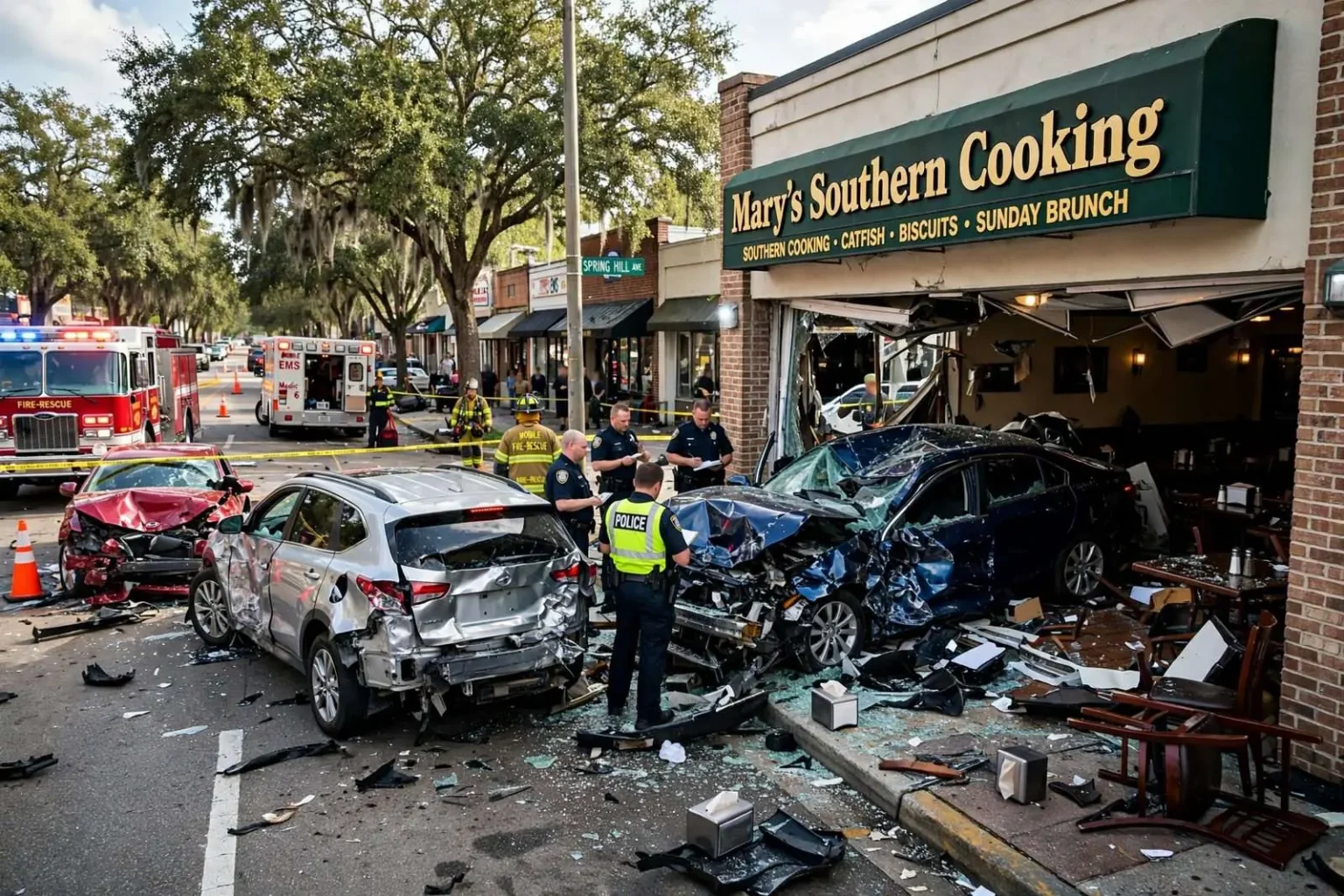
A three-vehicle crash in Mobile ended with one car slammed into the side of a popular neighborhood restaurant Sunday morning. Mobile police and fire-rescue crews rushed to Mary’s Southern Cooking on Spring Hill Avenue around 11:30 a.m. after the chain-reaction collision pushed one of the cars into the building, turning a routine Sunday rush into an emergency scene in the heart of the Spring Hill neighborhood.
At least one person was taken to a hospital; the extent of their injuries was not immediately known. First responders remained at the scene working to assess the damage and clear the wreckage, while investigators worked to determine what caused the three cars to collide in the first place.
Crashes that end with a vehicle inside a building are rarer than ordinary collisions, but Spring Hill Avenue is exactly the kind of road where they happen. The avenue runs through one of Mobile’s oldest neighborhoods, a busy urban corridor where traffic, driveways, intersecting side streets and commercial storefronts sit close to the roadway. When a collision unfolds near a business with a plate-glass front and a full dining room, the margin between a fender-bender and a catastrophe is a few feet of distance and a few seconds of time.
No additional details about those involved were released as of Sunday afternoon, and it was not clear whether any citations would be issued. Investigators’ work at the scene — measuring skid marks, documenting vehicle positions, collecting witness accounts — will determine not only what caused the crash but whether any driver faces charges.
What responders found
When Mobile Fire-Rescue units and police arrived around 11:30 a.m., they faced the compound problem that vehicle-into-building crashes create. The immediate priority is medical: anyone hurt in the collision itself, plus anyone inside the building who may have been struck by debris, glass or the vehicle. At least one person was transported to a hospital, and responders worked through the scene methodically to account for everyone involved.
The second priority is structural. A car striking a building can compromise walls, support framing, gas lines and electrical systems, and firefighters treat every such impact as a potential collapse or fire hazard until the structure is checked. Utility shutoffs, debris removal and a structural assessment are standard steps before anyone is allowed back inside — and before the business can begin to think about reopening.
The third task is traffic. A crash on Spring Hill Avenue in the late morning closes lanes that carry steady traffic through the neighborhood, and officers spent part of the day directing vehicles around the scene while the wreckage was cleared. The work of measuring, photographing and documenting the collision happens only after the injured are cared for and the building is stable, which is why such scenes stay active for hours.
How chain-reaction crashes happen
The term investigators use — chain-reaction collision — describes a sequence in which an initial impact sets the vehicles in motion in ways no driver can control. A car struck from behind or from the side is pushed into the path of a third, and momentum does the rest. The car that ends up in a building is sometimes not the car that made the first mistake, which complicates both the physics analysis and the question of who is legally at fault.
Common causes include speed too fast for the road, distraction, following too closely, and failures to yield at the intersections that punctuate Spring Hill Avenue. Sunday late morning adds its own conditions: brunch and church traffic filling the corridor, cars backing out of narrow parking areas in front of storefronts, and the heavier volume that weekend mornings bring to neighborhood business districts.
Reconstructing the sequence is a specialized job. Investigators measure final resting positions, examine damage patterns on each vehicle, and interview witnesses to establish the order of impacts. In cases with significant property damage or serious injury, the analysis can extend beyond the scene — vehicle data recorders, surveillance video from nearby businesses and follow-up interviews with the drivers involved.
Mary’s Southern Cooking and the Spring Hill community
Mary’s Southern Cooking is a fixture of the Spring Hill corridor, the kind of restaurant where the regulars are known by name and Sunday is among the busiest days of the week. Places like it anchor Mobile’s neighborhood commercial strips — modest buildings set close to the road, serving a customer base that walks and drives in from the streets around them. That proximity to traffic is part of their character and, as Sunday’s crash showed, part of their risk.
The restaurant was serving its Sunday crowd when the collision pushed a car into its side, and the incident rippled immediately through a community for whom the dining room is a gathering place. Neighborhood businesses absorb such blows differently than chain stores do: there is no corporate office to assign a cleanup crew, only the owner, the staff and the insurance process that follows.
Vehicle-into-building crashes damage more than walls. A restaurant closed for repairs loses its busiest revenue days, staff lose shifts, and the interruption can last weeks while structural work and inspections are completed. For a small neighborhood business, that interruption is measured not just in repair bills but in the customers who form habits and may not return until word spreads that the doors are open again.
Building crashes are a growing safety topic
Across the country, storefront owners and city planners have paid increasing attention to vehicle-into-building incidents, which number in the thousands nationally each year by insurance industry counts. The standard responses include parking barriers — heavy bollards set between the road and the building — redesigned parking layouts, and improved visibility at driveways and intersections.
Older commercial corridors like Spring Hill Avenue predate those design principles. Their buildings sit near the curb because they were built when traffic moved slower and parking was informal, and retrofitting protection means balancing safety improvements against the character and cost constraints of small neighborhood businesses. Sunday’s crash will renew those conversations in Spring Hill, as every such incident does.
For drivers, the lessons are plainer. Speed and attention are the variables that decide whether a mistake in a parking lot or a lane of traffic stays a minor incident or becomes a front-page one. The distance between the roadway and a dining room full of Sunday customers is small on a street like Spring Hill Avenue, and it disappears quickly at the wrong speed.
What happens after the scene clears
Once the wreckage is removed and the scene is released, the administrative phase begins. Police reports documenting the collision are completed for the drivers, their insurers and any potential legal proceedings. Investigators will review what they collected — statements, measurements, photographs — and decide whether any citations or charges are warranted, a determination that was still open as of Sunday afternoon.
The injured person’s condition will shape that calculus. Injury severity in a multi-vehicle crash influences both the depth of the investigation and the consequences drivers may face, from traffic citations for lane violations to more serious charges if impairment or recklessness is established. None of those findings had been announced by Sunday afternoon.
For the restaurant and its neighbors, the days ahead will be about repairs and reassurance — assessing the structural damage, working with insurers, and letting the regulars know when the kitchen will fire again. For the community along Spring Hill Avenue, the scene that unfolded outside Mary’s Southern Cooking was a reminder of how quickly an ordinary Sunday can change, and of the responders who turned a dining room’s worst morning into a story without a tragedy at its center.
Inside the emergency response
A crash of this kind mobilizes a layered response from the city’s emergency system. Mobile Fire-Rescue brings engine and rescue companies capable of stabilizing a damaged structure, treating the injured and controlling any hazard the impact creates, while police secure the scene, divert traffic and begin the investigation. The 11:30 a.m. call came at a hour when both departments are staffed for weekend volume, and the response unfolded in the coordinated pattern residents of Spring Hill have seen at serious scenes before.
Paramedics triaged those involved in the collision, prioritizing transport for anyone with injuries that could worsen, while firefighters checked the building’s interior for customers and staff who might have been hurt by glass, debris or the vehicle itself. The person transported to the hospital represented the visible injury count as of Sunday afternoon, but responders noted that evaluations at such scenes continue long after the initial rush, as symptoms sometimes emerge hours later.
The clearance work that followed — removing three damaged vehicles, boarding the impact point on the building, and sweeping glass and debris from the roadway and parking area — took the rest of the day. Investigators kept portions of the scene protected while the documentation work was done, a standard practice in crashes with serious damage that preserves the physical record for later analysis.
What witnesses can do
Investigators building the file on Sunday’s crash will rely heavily on witnesses — customers inside the restaurant, drivers who saw the collision develop, and residents along Spring Hill Avenue whose doorbell cameras or security systems may have captured the sequence. Anyone who saw the crash and has not spoken with police is encouraged to contact investigators, since independent accounts are often the detail that resolves conflicting versions of a chain-reaction collision.
Video from nearby businesses has become a decisive resource in Mobile crash investigations in recent years, as cameras that record parking areas and storefronts routinely capture both the collision and the moments before it. Footage showing speeds, braking and the order of impacts can confirm or rule out the leading explanations for how the crash began.
For those involved in the crash, the coming days will involve insurance claims, vehicle damage assessments and medical follow-up — the ordinary aftermath of a collision, complicated by a damaged building and the uncertainty of pending citations. Investigators have asked for patience as the review continues, and the findings, when they come, will be a matter of public record through the courts if charges result.