
Three Hurt in Barker Drive West Shooting, Mobile’s Fifth Injury Shooting of the Weekend
Gunfire hit a parked car on Barker Drive West, injuring three — Mobile's fifth shooting with injuries in a single violent weekend.
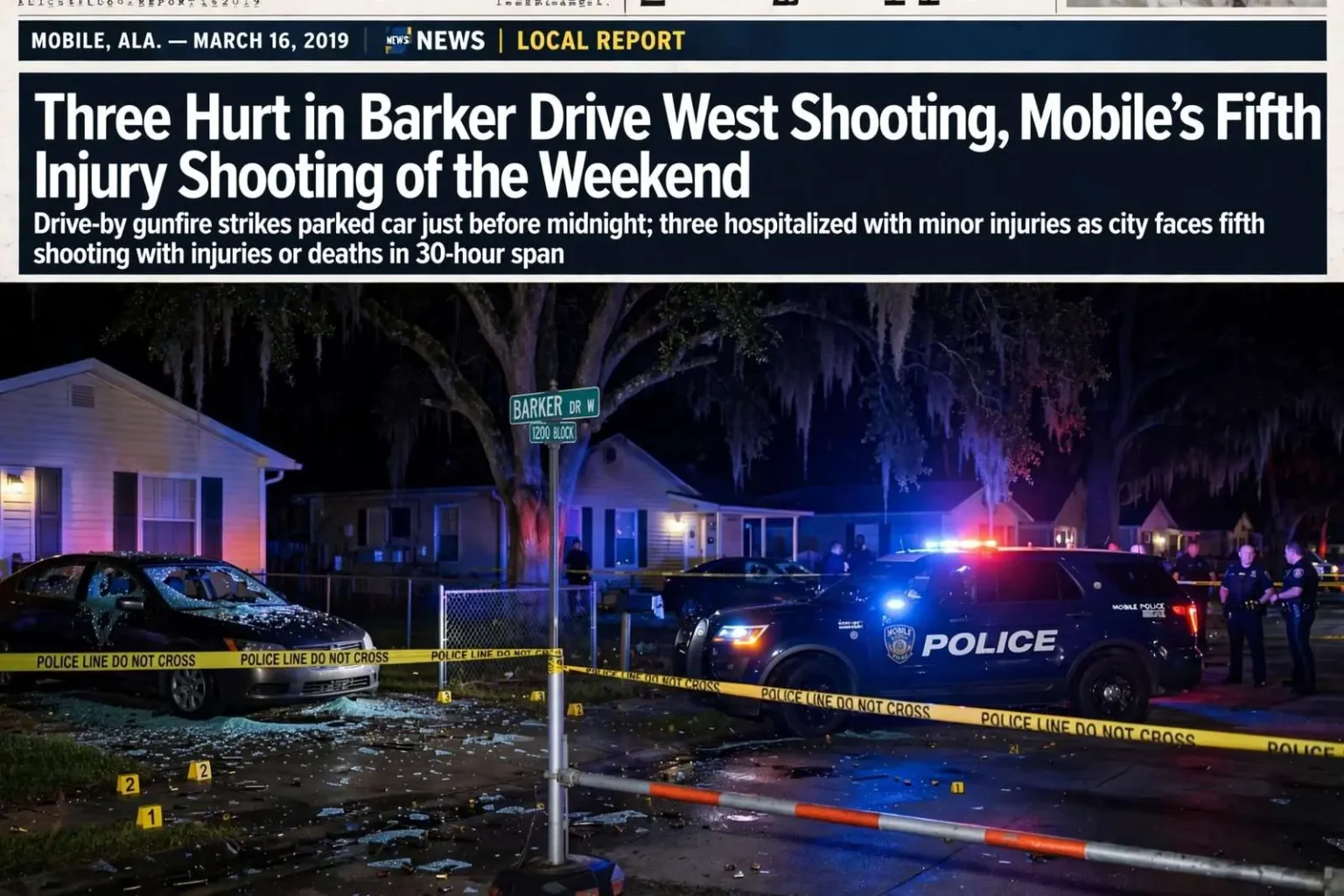
MOBILE, Ala. — Three people were hurt Saturday night when someone opened fire on their parked car on Barker Drive West, Mobile police said — the fifth shooting with injuries or deaths across the city in a single weekend of violence that stretched from Friday night’s double-fatal gunfire to an attack on a parked car just before midnight.
Around 11 p.m. on March 16, 2019, the victims were sitting in a vehicle parked in the driveway of a home in the 1200 block of Barker Drive West when another car drove past and fired shots into it, according to a police spokesman. The drive-by pattern — victims stationary, a passing vehicle, shots fired without warning — left the three with nowhere to take cover and no opportunity to identify anyone before the car disappeared. All three sustained minor injuries and were taken to a hospital for treatment.
The 1200 block of Barker Drive West sits in a residential neighborhood of modest homes in west-central Mobile, the kind of street where a car in a driveway is a routine sight and a Saturday-night shooting is not. The attack — on people doing nothing more visible than sitting in a parked car outside a home — illustrated the randomness that makes drive-by gunfire so destabilizing for a neighborhood: the victims were not necessarily the intended targets, the shooter was gone in seconds, and every household on the block was left to reckon with the fact that gunfire had crossed their street.
A Violent Stretch Across Mobile
The weekend’s violence began Friday night with a shooting on Dauphin Island Parkway that killed two people and wounded three others — the deadliest single incident of the span and the one that set the tone for the days that followed. Dauphin Island Parkway, the long commercial-and-residential corridor that runs south from the city toward the coast, has figured repeatedly in the city’s violence statistics, its length and traffic making it both a thoroughfare and, for police, a recurring crime scene. Five victims in one incident placed it among the city’s worst shootings of the year to that point.
Later that same Friday evening, officers responded after authorities said a 49-year-old man forced his way into a home on Lucille Street and was shot several times. That case — an intrusion ending in gunfire — presented investigators with a different set of questions than the parkway shooting: whether the intruder knew the occupants, what precipitated the break-in, and who fired. Authorities described the sequence but released few details about the circumstances or the man’s condition beyond the fact of his wounds.
Saturday afternoon brought a report of a man shot in the arm on Azalea Road, the busy west Mobile artery lined with retail strips and apartment complexes. The daylight wounding, on one of the city’s most traveled commercial corridors, pushed the weekend’s count higher while the city was still processing Friday night’s deaths. Then came an evening shooting that injured one person on Tuttle Avenue, and the Barker Drive West gunfire capped the string just before midnight — five incidents in roughly thirty hours, spanning the city from the Dauphin Island Parkway in the south to west Mobile’s commercial districts.
Five injury-or-death shootings in a weekend is an extraordinary concentration even by the standards of a city of Mobile’s size, and it placed immediate strain on the resources that respond to them. Each incident sets in motion a parallel process: patrol officers securing the scene and canvassing for witnesses, detectives taking the case, evidence technicians processing ballistics and shell casings, and hospital staff treating victims whose accounts may or may not reach investigators. When the incidents stack up hours apart, the canvassing windows close fast — witnesses scatter, memories blur, and the physical evidence of a Saturday-night drive-by competes with three other active scenes for the same technicians.
The cluster also strained the city’s emergency response in a more basic way. A shooting on the Dauphin Island Parkway pulls medics and patrol units south; a shooting on Azalea Road pulls them west; a third on Barker Drive West requires coverage for a neighborhood whose responders may already be committed elsewhere. Weekend night shifts in Mobile are staffed for the ordinary city, not five major scenes in thirty hours, and the overtime and mutual coverage that follow such weekends are part of the cost the violence bills to the city beyond the injuries themselves.
For the neighborhoods that hosted the five scenes, the weekend’s pattern carried its own burden. The victims’ names and conditions were released only in fragments, but the locations — a parkway, a residential street, two commercial corridors, a driveway — told residents that no part of the city’s geography was exempt. Community anti-violence groups in Mobile have long argued that clusters like this one produce a compounding fear: each incident makes residents more reluctant to be outside, to report what they saw, or to cooperate with detectives, which in turn makes the next case harder to solve.
The Investigation
Police have not announced arrests connected to any of the weekend’s incidents, and investigators continue to work each case. That absence of quick arrests after a weekend of this scale is common in Mobile and in cities like it: drive-by shootings leave few cooperative witnesses, home-invasion cases turn on relationships detectives must untangle before anyone talks, and the cases that break fastest are usually those where a victim can identify a shooter. The Barker Drive West case carried the added difficulty of a moving shooter, a dark street, and victims who saw a car pass and then, seconds later, glass and gunfire.
Homicide investigators working the Dauphin Island Parkway double killing faced the highest stakes of the weekend’s docket — two dead, three wounded, and a case that would proceed to the district attorney with the weight of the city’s weekend behind it. The police department’s practice in multi-victim cases is to treat the scene as a single event until evidence indicates otherwise, mapping shell casings, phone records, and witness accounts against the timeline of the night.
The weekend of March 16, 2019 entered Mobile’s recent history as one of its most violent short stretches — five scenes, two dead, seven wounded across the span, and a city asking the questions that follow every such weekend. Where the guns came from, who fired them, and whether any of it was connected are the questions detectives were left working, case by case, in the weeks after. For the three people who were sitting in a parked car on Barker Drive West when the shots came through, the questions were simpler and closer to home: they were, by the police account of their injuries, the luckiest victims of Mobile’s violent thirty hours — minor wounds, a hospital trip, and a story of survival that began with a car driving past their driveway at eleven o’clock on a Saturday night.
Police urged anyone with information about any of the weekend’s incidents to contact Mobile police or the department’s tip lines, renewing the standing appeal that accompanies every unsolved shooting in the city — and that, in cases like these, is often the only route between a neighborhood that knows and a case file that doesn’t.
The geography of the five scenes maps the reach of the weekend across the city. Dauphin Island Parkway anchors the southern edge of Mobile, running from the old city toward the bay communities; Lucille Street sits in a midtown residential grid; Azalea Road cuts through the commercial heart of west Mobile; Tuttle Avenue lies in the western neighborhoods; and Barker Drive West is a quiet residential street not far from the corridors the other incidents touched. No single district could claim the weekend, and no single precinct’s patrol could have prevented it — the incidents were scattered precisely the way a city’s spontaneous violence scatters, following disputes and opportunities rather than a plan.
March 2019 fell in a period when Mobile’s violent crime numbers were under sustained public scrutiny, with city officials and community organizations debating enforcement strategies, youth programs, and the street-level dynamics that produce weekend clusters like this one. The debate has tended to circle the same realities: Mobile’s shooting incidents concentrate in late-night and weekend hours, in a geography that shifts as enforcement pressure moves, and in disputes — personal, retaliatory, transactional — that begin far from the moment gunfire erupts. Five shootings in thirty hours gave every side of that debate its evidence.
For the families of the two killed on the parkway, the weekend’s statistics are beside the point; for the seven wounded across the other scenes, the recovery ahead ranges from minor to serious. What remains publicly unresolved — arrests, motives, connections between the incidents — will remain the work of detectives in the months after the tape comes down. The city, meanwhile, absorbed the weekend the way it absorbs its worst stretches: with the arithmetic of victims and scenes, the quiet of streets that hosted gunfire, and the standing appeal for the witnesses who can turn five open cases into five solved ones.


