Three Inmates Injured in Assault Involving 11 at Holman Prison
Three inmates were hurt, two of them stabbed, in an assault involving 11 prisoners at Holman Correctional Facility in Atmore, state corrections officials.
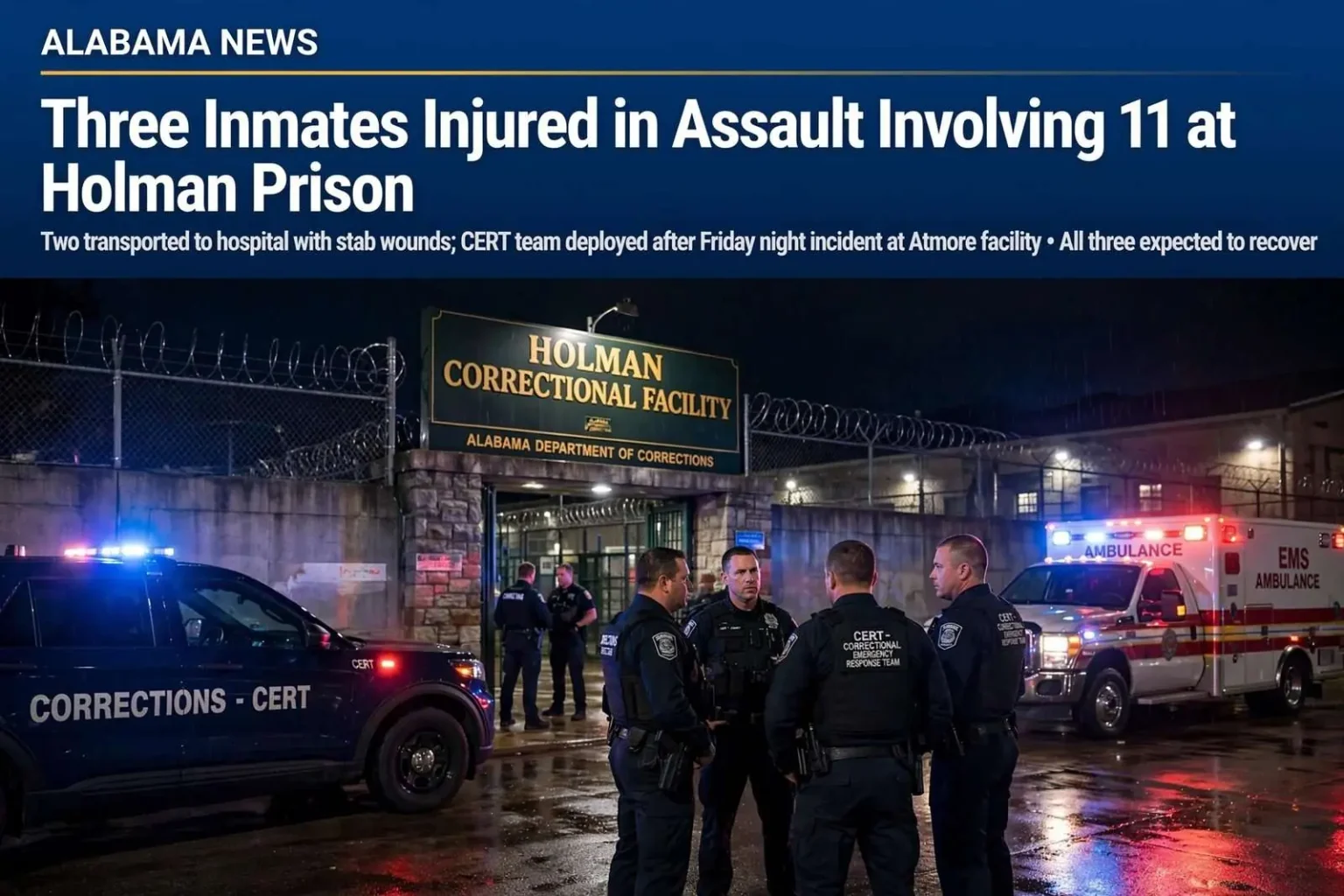
Three inmates at Holman Correctional Facility in Atmore were injured in an assault Friday night that involved 11 prisoners, according to the Alabama Department of Corrections. Two of the injured inmates were taken to a hospital and treated for stab wounds, while a third was treated at the prison infirmary, and all three were expected to recover.
The violence, one of a series of such incidents reported at Alabama’s maximum-security facilities in recent years, prompted a precautionary response from the department. A correctional emergency response team was deployed to assist Holman staff after the incident, a standard step when prison systems want added manpower to restore order, secure the affected area, and conduct a cell-by-cell accounting of the population.
Prison officials said the violence was confined to a single housing area and that no other inmates were involved. The containment limited the immediate danger to the broader prison, but the number of participants — 11 inmates in a single incident — underscored the scale of coordination that can occur inside a housing unit and the difficulty of preventing planned assaults among hundreds of confined men.
Eight inmates identified as suspects were moved to other facilities, officials said. No names were released, a common practice while investigations and potential criminal charges are pending. Transferring suspected participants out of the facility both protects them from retaliation and breaks up the group dynamics that investigators say often drive further violence in the days after an incident.
A Prison Under Long-Term Scrutiny
Holman, one of Alabama’s older maximum-security prisons, has been the subject of repeated concern over staffing levels and inmate-on-inmate violence in state facilities. The prison, located in Atmore in Escambia County near the Florida line, houses some of the state’s most dangerous inmates and has long operated with vacancy rates among the highest in the Alabama Department of Corrections system, a chronic understaffing problem that corrections officials and outside monitors have linked directly to violence behind the walls.
The department did not say what led to the fight, and no details about a motive were released. Investigations into prison assaults move slowly: evidence is gathered by institutional investigators, inmates are interviewed under difficult circumstances, and the resulting cases — where charges are pursued at all — go to local district attorneys or, in some cases, federal prosecutors. Families of both victims and suspects frequently learn little beyond what the department’s public statements provide.
The assault comes against a backdrop of systemic scrutiny of Alabama’s prisons. The U.S. Department of Justice has sued the state over conditions in its men’s prisons, alleging constitutional violations stemming from inmate-on-inmate violence, sexual abuse, and use of force, and federal litigation has documented stabbing rates far above national averages. State officials have responded with new prison construction plans and increased hiring efforts, but turnover among correctional officers has kept staffing below the levels the department itself considers safe.
Holman has figured prominently in that record. The facility has hosted multiple riots, killing incidents, and disturbances over the years, and it houses Alabama’s death row, adding a population with little to lose to the security calculus. Correctional officers who work there describe long mandatory overtime shifts, chronic vacancies, and housing units where the ratio of inmates to officers falls well below what policy recommends — conditions in which smuggling networks and inmate hierarchies operate with less interference.
How the System Responds to an Incident
The correctional emergency response team, or CERT, that deployed to Holman represents the department’s specialized reaction force — officers trained in riot control, cell extraction, and tactical movement inside correctional facilities. When a disturbance occurs, CERT members supplement the local staff, allowing exhausted officers to complete their shifts while the response team locks down the affected unit, searches for weapons, and restores normal operations. Their deployment Friday night was described as a precaution, indicating officials treated the assault as serious enough to warrant reinforcement beyond the prison’s own ranks.
The immediate medical response also followed the department’s standard protocols. Inmates with stab wounds face risks that begin with blood loss and continue with infection in a prison environment, and the decision to transport two of the three injured men to an outside hospital signals injuries beyond what an infirmary can manage. The third inmate’s treatment at the prison infirmary kept him within the walls, where medical staff can monitor him alongside security. All three were expected to recover, the department said — an outcome that separates this incident from the fatal assaults that have drawn federal attention to Alabama’s prisons.
Transfers of the eight suspects serve multiple purposes. Investigations are easier to conduct when suspected participants are separated and housed at different facilities, since coordinated accounts are harder to maintain. Victims are better protected when those accused of attacking them are gone. And housing units themselves benefit from the removal of the leadership of any dispute, allowing a return to routine that might otherwise take weeks.
The Limits of What Is Known
What the public learns about an incident like Friday’s assault is usually limited to a handful of facts: the number injured, the nature of the wounds, the response measures, and the transfers. The department did not release names, did not describe the weapon, did not say whether the assault was planned or spontaneous, and did not connect it to any larger conflict within the prison. That opacity is typical — prison operations are shielded by security concerns, ongoing investigations, and medical privacy rules — but it leaves families and the public to piece together conditions from statistics rather than narrative.
The statistical backdrop, however, is well documented. Alabama’s prison homicide and stabbing rates have ranked among the highest in the nation in federal court filings, and the state’s own corrections commissioners have acknowledged that staffing shortages are the system’s most pressing danger. At Holman and other facilities, officers supervise housing units at ratios that leave little margin for prevention — the difference between stopping an assault before it starts and responding after the wounds are inflicted.
Reform efforts continue on parallel tracks: state construction projects aim to replace aging facilities with modern designs requiring fewer officers, pay raises have attempted to slow attrition among corrections staff, and federal oversight remains in place through the ongoing litigation. Until those efforts change daily conditions, incidents like Friday night’s assault — 11 inmates, three wounded, eight transferred — remain a recurring measure of how much work is left.
For now, Holman resumes the routines of a maximum-security prison in rural Escambia County: lockdowns lifted as investigations wrap up, housing units returning to schedule, and a department statement that closes the public record until the next incident. The three injured inmates are expected to recover; the questions about why the assault happened, as so often in Alabama’s prison system, remain unanswered.
Atmore and Its Prison
The prison’s relationship with Atmore, its host city of roughly 8,000 people in Escambia County, is longstanding. Holman is one of the area’s largest employers, and generations of local families have counted corrections officers among them. The facility’s presence shapes the local economy and identity alike — a rural town whose largest institution is a maximum-security prison, complete with the noise of sirens and lock-downs that residents learn to ignore. When incidents occur, Atmore’s hospital and first responders are part of the response chain that carries injured inmates to care.
Holman’s history within the Alabama Department of Corrections stretches back to its opening in the late 1960s, and its age shows in the infrastructure challenges that plague it alongside the staffing ones. Aging plants and housing units cost more to maintain and are harder to supervise than modern designs, one of the arguments state officials have made for the construction program intended to eventually replace facilities like it. In the meantime, Holman continues to operate with the population it has always carried: the state’s most serious offenders, including death row inmates.
Friday night’s assault, viewed against that history, follows a pattern the department knows well — a planned or sudden eruption of violence in a single housing area, met with lockdown, medical response, tactical reinforcement, and transfers. What has varied over the years is the outcome: too often in Alabama’s recent record, injured inmates have died; this time, all three wounded men are expected to recover. That difference will spare the department a homicide investigation, but the underlying conditions that produced 11-man violence in a single unit remain in place, documented by federal lawyers and acknowledged by the state’s own officials.
The eight suspects transferred out of Holman will follow the department’s classification process at their new facilities, and the institutional investigation into the assault will proceed without public timelines. Whether charges result — in a system where inmate-on-inmate prosecutions are notoriously difficult to win because witnesses are reluctant — usually depends on injuries, cooperation, and evidence that can survive a courtroom. For the housing unit where it happened, the immediate future is quieter: new assignments, closer supervision, and the watchful routine of a facility that has seen this before and expects, realistically, to see it again.