
Three police chases across Mobile area end in crashes, one death
Three police chases across the Mobile and Baldwin County area over a weekend ended in crashes, with one suspect dead and two still sought.
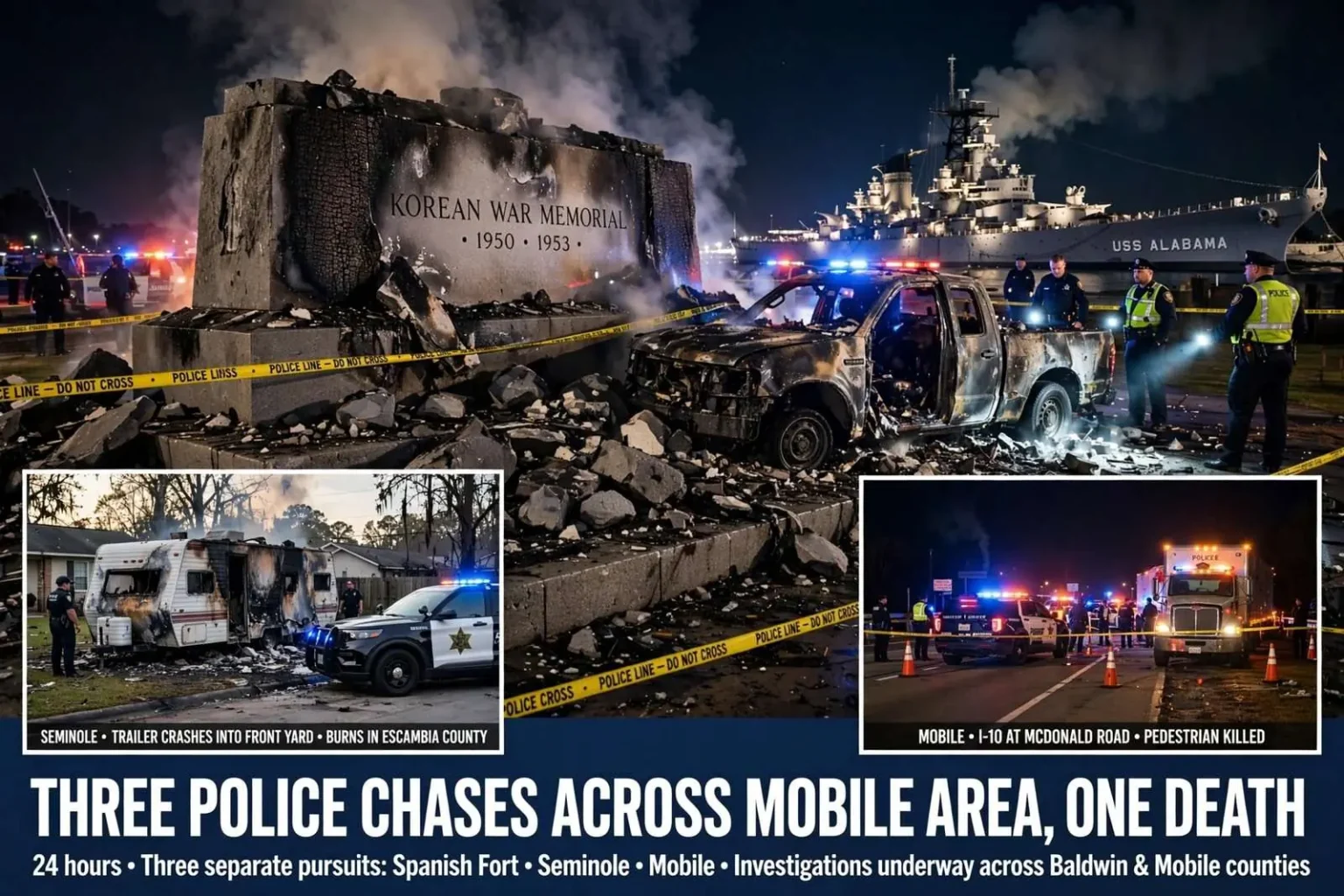
Authorities are investigating three separate police chases that unfolded within about 24 hours over the weekend, two of them ending in flames and one in death. The string of pursuits — in Spanish Fort, Seminole and Mobile — left a damaged war memorial burned, a travel trailer wreckage in a front yard and an 18-wheeler driver confronting a pedestrian fatality on Interstate 10, and it has renewed attention to how pursuits unfold across the crowded Mobile-area highway network.
The first chase began around 2:30 a.m. at Bass Pro Shops in Spanish Fort and ended in flames at the Korean War Memorial at Battleship Memorial Park. “Saddened me and angered me that somebody just running from the police would lose control of his truck and wreck a nice memorial like this,” said Walter Ballard, commander of the Gulf Coast Chapter of the Korean War Veterans Association. Police say the driver ran from the vehicle after it caught fire. Anyone with information is asked to call Spanish Fort Police at (251) 626-4914 or Mobile Police at (251) 208-1700.
The endpoint of that pursuit carries weight beyond the crash itself. Battleship Memorial Park sits on Mobile Bay beside the causeway, honoring Alabamians who served in every American conflict, and the Korean War Memorial there bears the names of the state’s dead from that war. For the veterans who maintain a connection to the park, watching a fleeing driver destroy part of it while running from police was a bitter collision of two things they hold dear: the memorial itself and the public safety it stands behind.
The park is one of the Mobile area’s most visited landmarks. The retired USS Alabama, a South Dakota-class battleship that earned nine battle stars in the Pacific during World War II, rests there alongside the submarine USS Drum and an aircraft and armor collection that draws school groups, veterans’ organizations and tourists year-round. The grounds also host memorials to specific conflicts, including the Korean War, which claimed the lives of hundreds of Alabamians between 1950 and 1953. Damage to any part of the park resonates with the veterans’ community across the Gulf Coast.
Spanish Fort, where the chase began, sits across the causeway from the park in Baldwin County, along the Interstate 10 corridor that funnels beach traffic between the Eastern Shore and Mobile. Retail centers along the corridor, including the shopping district near Bass Pro Shops, see heavy overnight traffic on weekends, and police there regularly pursue vehicles that cross the bay into Mobile County — which is why investigators from both Spanish Fort Police and Mobile Police are involved in the memorial case.
A second chase began around 6 p.m. in Seminole and also ended in flames in Escambia County, Florida. “The suspect trying to lose the deputy went off-road and again towing this travel trailer ends up in someone’s front yard,” said Baldwin County Sheriff’s Capt. Clint Cadenhead, describing dashcam video of the pursuit. The dashcam footage shows the danger towing adds to any pursuit: a trailer swings wide, resists sudden maneuvers and turns a marginal road into a hazard for everyone nearby.
The pursuit started in the same Baldwin County community where flooding from Hurricane Sally had dominated headlines weeks earlier, but on this evening the danger came at highway speed. Seminole sits along the southern edge of the county near the Florida line, and a driver heading east from there crosses into Escambia County within minutes — which is how a chase that began as a Baldwin County Sheriff’s traffic matter finished as a crash scene in Florida, with the burned-out trailer in a residential yard and deputies coordinating across the state line.
Multi-agency pursuits like that one are governed by a patchwork of local and state policy. Alabama deputies must weigh the seriousness of the offense against the risk a chase poses to the public, and Pursuit Intervention techniques vary from agency to agency. When a fleeing vehicle crosses into Florida, coordination shifts to the receiving jurisdiction, which takes over the scene once the vehicle is disabled. In this case, the driver’s decision to go off-road and drag a travel trailer through someone’s front yard ended the chase before that handoff could matter.
The third and deadliest chase began at 5:45 p.m. in Mobile and ended in death on Interstate 10. Deputies said they tried to stop a car that was speeding and had no headlights. The driver bailed out near the McDonald Road exit, ran across the interstate and was struck and killed by an 18-wheeler. The sequence — a car running dark at highway speed, a foot crossing across one of the Gulf Coast’s busiest freight corridors, and a truck that could not stop — compressed a chain of fatal decisions into seconds.
Dashcam and body-camera footage has become central to how these cases are understood. The Baldwin County Sheriff’s Office, like departments across the region, equips its patrol fleet with recording systems that capture pursuits from the deputy’s point of view, and clips released after major chases routinely show how quickly a routine stop turns into a rolling emergency. In the Seminole case, the footage of the off-road swerve and the trailer’s path into the yard gives investigators a precise record of the risk the fleeing driver created — and gives prosecutors the kind of objective evidence that older cases lacked.
The weekend’s geography tells its own story about pursuit risk in the Mobile area. The region’s road network concentrates traffic onto a handful of corridors — the I-10 Bayway and Bankhead Tunnel, the Causeway along the Delta, and the state highways feeding Baldwin County’s waterfront communities — which means a chase that starts at a retail parking lot can cross the bay, cross a state line or merge into interstate freight traffic within minutes. Fleeting drivers know the network; that knowledge is often why they run. Deputies and city officers must anticipate it in real time.
The McDonald Road exit sits on the eastern stretch of I-10 as it crosses Mobile County toward the Bankhead Tunnel and the Bayway. The interstate carries heavy truck traffic at all hours, moving freight between the Port of Mobile, the beach communities of Baldwin County and the interstate network beyond, and a pedestrian on its travel lanes faces traffic closing at 70 miles an hour. Drivers who witnessed the aftermath described lanes halted while troopers worked the scene, one more weekend delay on a corridor that has seen its share of fatal incidents.
Three chases, one weekend, and the questions that follow
Within about 24 hours, the three pursuits spanned two counties and a state line, involved the Baldwin County Sheriff’s Office, Spanish Fort Police, Mobile Police and the Alabama Law Enforcement Agency troopers who typically work interstate fatalities, and produced three separate investigations. Each agency will examine the decisions that opened the pursuit, the tactics used and the outcomes, and the findings will feed into the reviews that follow every serious chase in the region.
The human cost deserves its own accounting. The driver struck on I-10 became the weekend’s only fatality, and the 18-wheeler driver who hit him will carry that moment though he did nothing wrong. Veterans who look to the memorial at Battleship Park as a place of honor watched it burned by someone fleeing a traffic stop. The family whose front yard caught a burning travel trailer now has a crash scene where children play. Police pursuits compress all of that into a few miles of roadway, which is why every agency involved says the review of this weekend matters beyond the three cases themselves.
Pursuits for minor traffic violations have drawn growing scrutiny nationally, and the weekend offered a case study in why. The memorial fire in Spanish Fort, the trailer wreck in Escambia County and the death on I-10 were all set in motion by drivers who chose to flee — but each also exposed bystanders and landmarks to risk they had not chosen. Law enforcement executives across the Gulf Coast have wrestled with that balance for years, tightening pursuit policies to weigh the offense against the danger, while officers on the street still face split-second decisions when a driver runs.
For residents along the routes involved — the causeway beside the battleship, the roads around Seminole, the neighborhoods near McDonald Road — the weekend was a reminder of how quickly a police chase can arrive in an ordinary setting: a park lawn, a front yard, a highway lane. Investigators are asking anyone who witnessed any of the three incidents to come forward, beginning with the Spanish Fort and Mobile police numbers released in the memorial case. The three investigations remain active, and charges, if any, will follow the evidence each agency gathers.