Troopers Searching for Blue Minivan After Deadly I-65 Crash in Escambia County
Alabama troopers are searching for a blue minivan that left the scene of a deadly I-65 crash near Flomaton that killed a Texas man.
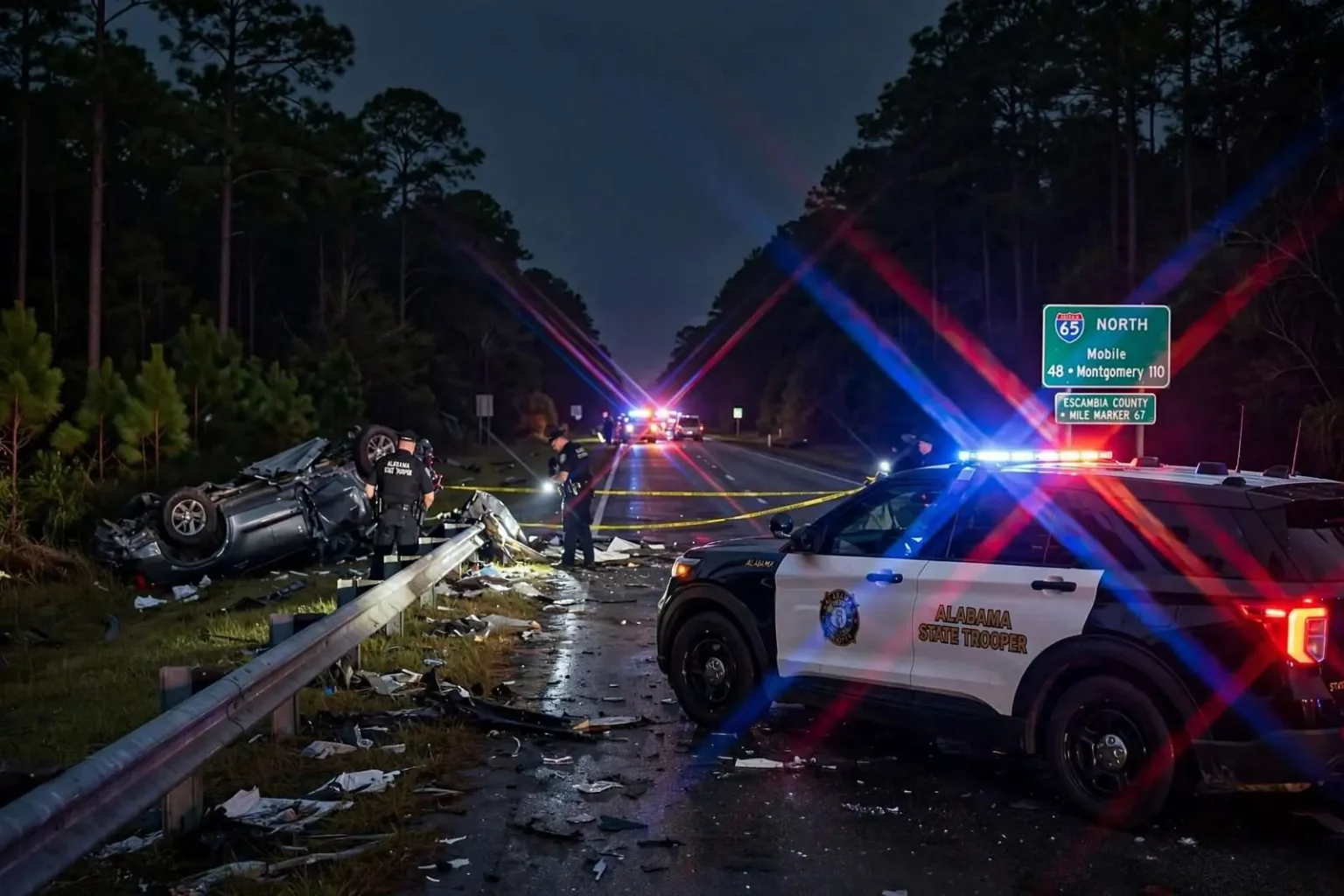
Alabama State Troopers are looking for a vehicle that left the scene of a fatal crash on Interstate 65 in Escambia County early Saturday. According to troopers, an SUV collided with another vehicle and overturned at about 12:10 a.m. near mile marker 67, roughly 16 miles west of Flomaton. The overnight wreck shut investigators’ attention onto a stretch of interstate that runs through some of the most rural territory in south Alabama.
A passenger in the SUV, 47-year-old Steven Stone Stewart of Nederland, Texas, was killed. The SUV’s driver, James Pittman, also of Nederland, was taken to a hospital in Atmore for treatment, troopers said. The two Texans had been traveling on I-65 when the collision occurred, and the crash’s severity left one man dead and the other hospitalized in the middle of the night.
Investigators Seek the Public’s Help Troopers say the second vehicle involved — believed to be a blue minivan — left the scene before officers arrived. The search for that vehicle and its driver is part of an ongoing investigation. Anyone with information about the crash or the minivan is asked to contact Alabama State Troopers at (251) 578-1315.
A deadly stretch of interstate
Interstate 65 is one of Alabama’s primary north-south corridors, carrying commuter, commercial and long-distance traffic from Mobile up through Montgomery and on toward Huntsville. The portion that crosses Escambia County near mile marker 67 is rural four-lane highway, far from the brighter interchanges around the major cities. Wrecks there can be especially dangerous, because traffic moves at interstate speeds and emergency response times are stretched by distance — the nearest hospital of any size sits in Atmore, miles to the west.
The 16-mile gap between the crash site and Flomaton places the wreck squarely in the county’s northern reaches, an area of pine forests, crossroads communities and long, dark stretches of road. Overnight crashes in such corridors carry added risks: reduced visibility, fatigue and, in this case, a second vehicle that left the scene before help arrived. Investigators working fatal wrecks reconstruct what happened from physical evidence left on the roadway, and every detail from the public can help fill the gaps.
How hit-and-run investigations work
When a vehicle leaves the scene of a fatal crash, the investigation shifts immediately to identifying that vehicle and finding its driver. Troopers collect debris, paint transfers, tire marks and camera footage from nearby businesses or homes, and they appeal to the public for tips from anyone who may have seen the vehicle before or after the collision. Descriptions such as the one released here — a believed blue minivan — come from witness accounts and physical evidence gathered in the hours after the wreck.
TheAlabama Law Enforcement Agency, which includes the Highway Patrol division staffed by state troopers, investigates fatal crashes on Alabama’s interstates and state highways. Troopers assigned to the post that covers southwest Alabama work crashes across a multi-county territory, which is why the public contact number routes to a trooper post rather than a local police department. Once the investigation identifies a suspect vehicle, prosecutors weigh charges that can include leaving the scene of an accident involving death, a felony under Alabama law that carries prison time far beyond the penalties for the underlying crash.
Leaving the scene of a fatal wreck is among the most serious traffic offenses on Alabama’s books. The law requires drivers involved in a crash resulting in injury or death to remain, render aid and provide information, and prosecutors treat a driver’s flight from a fatal scene as an aggravating factor. For investigators, an early arrest matters — witnesses’ memories fade, physical evidence weathers and vehicles can be repaired or moved as time passes.
What the public can do
Troopers are asking anyone who traveled I-65 near mile marker 67 around the time of the 12:10 a.m. crash to think back to what they saw. Even drivers who did not witness the collision itself may have passed a blue minivan in the minutes afterward, seen damage on a vehicle fitting that description or noticed a driver acting erratically at a gas station or rest area. Dash cameras, security footage and simple recollections about traffic on the interstate that night can all become leads.
The contact line for the case is the Alabama State Troopers post at (251) 578-1315. Callers can provide tips directly to the investigators working the case, and even partial information — a direction of travel, a partial license plate, a location where a damaged minivan was spotted — can advance the investigation. Authorities routinely stress that in hit-and-run cases, the fastest tips come from ordinary motorists who were on the road and remember something that seemed unimportant at the time.
Escambia County residents who live along the interstate corridor should also look at their own property for clues. Homes and businesses near the interstate sometimes capture passing traffic on doorbell or security cameras, and investigators routinely canvass for such footage after fatal wrecks. A single clip showing the minivan’s direction of travel or condition after the crash could confirm details that physical evidence alone cannot.
The human toll
Behind the investigation is a loss that reached from south Alabama to Nederland, Texas, a city near Beaumont in the state’s Gulf Coast refinery region. Stewart, 47, was killed in the crash, and Pittman was taken to the hospital in Atmore for treatment. Atmore’s hospital serves as the first stop for crash victims across a wide swath of rural Escambia and Monroe counties, stabilizing patients before transfer to larger facilities in Mobile or Pensacola when needed.
Fatal overnight wrecks on rural interstates echo through the small communities nearby, where volunteer responders and local residents are often among the first on scene. For the troopers working the case, the job now is to account for every vehicle involved and give Stewart’s family a complete account of what happened. The search for the blue minivan is the open question at the center of that effort.
Staying safe on rural interstates
The crash is also a reminder of the conditions that make late-night interstate travel dangerous. Darkness, fatigue and high closing speeds combine on rural corridors like I-65 between Mobile and Montgomery, and drivers who share the road with them need margin — extra following distance, slower speeds in poor visibility and full attention on the traffic ahead. Safety advocates note that many multi-vehicle collisions begin with a single driver’s mistake compounded by others’ inability to react in time.
For motorists who come upon a crash scene, the guidance from authorities is consistent: call 911 immediately, stay in a safe location and never pursue a fleeing vehicle. Chasing a hit-and-run driver creates additional dangers and is a job for law enforcement. Witnesses are far more useful to troopers as observers, providing descriptions, directions of travel and times that investigators can piece together into a timeline.
The investigation into Saturday’s fatal crash remains active, and troopers have not announced any arrest in connection with the minivan that left the scene. Anyone with information is urged to call (251) 578-1315, the tip line for the troopers handling the case. As with all fatal crash investigations, details will be released as they are confirmed by the Alabama Law Enforcement Agency.
Reconstructing the night
Fatal crash reconstruction is meticulous work. Troopers documenting an overturned SUV measure skid and yaw marks, plot the final resting positions of the vehicles, photograph debris fields and examine damage patterns to estimate speeds and the sequence of impacts. In a case involving two vehicles, establishing how the SUV and the minivan came together — and in what order — determines both the narrative of the crash and any charges that may follow for the driver who left.
The timing of the wreck, shortly after midnight on a Saturday, will shape the canvass as well. Traffic on a rural interstate at that hour is thin, which limits witnesses but also means any sighting of a blue minivan in the area stands out more sharply in a driver’s memory. Investigators will try to establish where the minivan came from, where it exited and which direction it headed after the collision, working outward from the crash scene through the communities that ring the interstate.
Escambia County’s placement on the Alabama-Florida line adds another dimension. The county borders the Florida Panhandle, and I-65 runs toward Interstate 10, which crosses the state line near Flomaton and links Mobile with Pensacola and Tallahassee. A vehicle leaving the scene could just as easily have crossed into Florida as turned toward an Alabama town, which is why tips from motorists in both states are valuable to the troopers working the case.
Authorities have not released a description of the minivan’s driver or said whether anyone in the second vehicle was injured. Those details may emerge as the investigation progresses, and updates typically come through the Alabama Law Enforcement Agency as charges are filed or additional information is confirmed. Until then, the case remains open, and the minivan remains the focus of the search.
For now, the message from troopers is simple: if you know something about the blue minivan, or you were on I-65 near mile marker 67 early Saturday, call (251) 578-1315. The investigation into the death of Steven Stone Stewart continues, and the account of what happened that night will not be complete until the vehicle that drove away is found.