Twenty Years Without Answers: Daughters Still Search for Mobile Mother Lisa Ann Pierce
Lisa Ann Pierce vanished from a Mobile street corner on Nov. 6, 2000. Twenty years later, her daughters and a detective still seek answers in the cold case.
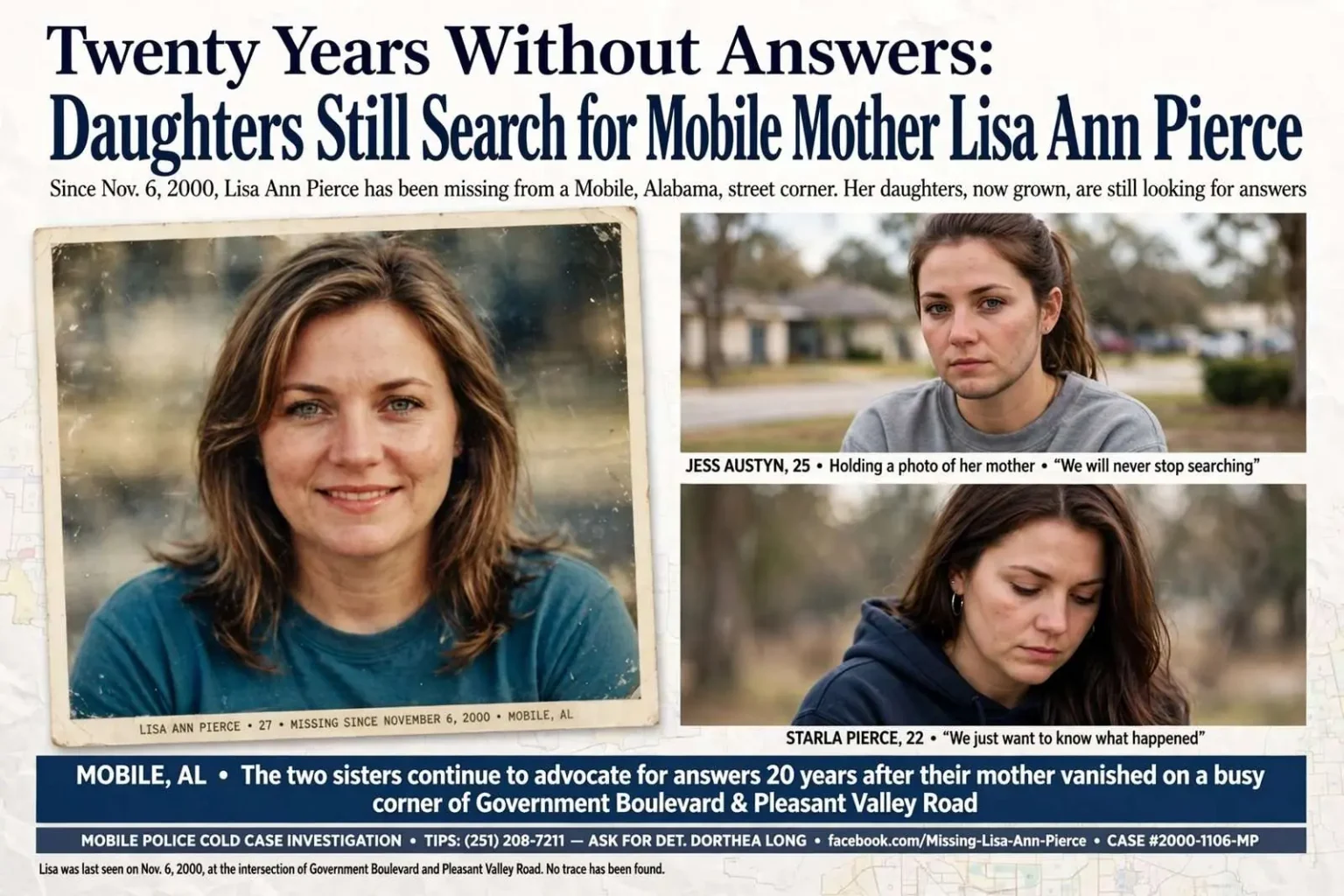
Two decades have passed since Lisa Ann Pierce vanished from a Mobile street corner, but her daughters refuse to let her name fade from memory. The case, now one of Mobile’s longest-running missing persons investigations, has outlasted changes in police leadership, advances in forensic science, and the passage of an entire generation — yet the search continues, driven by two women who barely had time to know their mother.
Pierce, 27, was last seen on Nov. 6, 2000, at the intersection of Government Boulevard and Pleasant Valley Road. The crossing sits in a busy corridor of west Mobile, where Government Boulevard carries commuters and shoppers past a mix of businesses and neighborhoods. She was reported missing by her common-law husband, and in the twenty years since, no trace of her has resolved the question of what happened that night.
Her daughters, Jess Austyn and Starla Pierce, were 5 and 2 at the time — old enough to remember a mother they describe as bubbly and loving, but too young to care for themselves. The girls grew up in the shadow of an unanswered disappearance, carrying fragments of memory and a lifetime of questions about the woman at the center of them.
Pierce placed both girls for adoption, a decision her daughters say came from love, not abandonment. The sisters have spoken about that choice with a clear-eyed appreciation: their mother, facing circumstances that made raising two young children impossible, chose a path she believed gave them their best chance. It is one more reason, they say, that her story deserves to be told accurately.
“Everything I heard of her is that she was a light of a person, and that light deserves to still be here,” Austyn said. “That world is darker without her.”
Few Clues, One Firm Belief
There are few tangible clues. Police believe a crime was committed and that Pierce may one day be found through DNA. That confidence — that the case will eventually yield to science even if no witness ever comes forward — has become the anchor of the investigation as it has passed through the hands of different detectives over the years.
Detective Dorthea Long, who took over the case several years ago, said leads have come in over the years — “She’s over here,” “She’s over there” — but none have panned out. The pattern is a familiar one in long-running missing persons cases: sightings reported secondhand, rumors passed along social media, and tips that dissolve under checking. Long has continued to run each one down despite the decades of accumulated dead ends.
Austyn maintains a Facebook page, “Missing-Lisa Ann Pierce,” hoping the right person will see it and come forward. The page has become the case’s public face, keeping her mother’s photograph and story circulating among Mobile users year after year — a digital version of the missing-person flyer, updated and shared by an audience that grows each time the case draws renewed attention.
“You need to come forward. If not, you are going to be found. It’s a matter of time. I am not going to stop until you are caught, and that’s the end of that,” Austyn said. The message is directed squarely at whoever is responsible, and it reflects the sisters’ posture after twenty years: patience has run out, and the demand for answers is not softening.
The sisters acknowledge the odds their mother is alive are slim, but they say they cannot rest until they know what happened. It is the specific pain of the missing persons case — neither grief nor hope, but an unresolved suspension of both. Families of the missing describe the state as a kind of limbo: no funeral to attend, no closure to mark, only an open question that follows them through weddings, holidays, and the ordinary milestones their mother never saw.
A Case That Spans a Generation
Pierce’s disappearance straddles two eras of investigation — before and after DNA became a routine tool for cold cases. In 2000, forensic DNA analysis existed but was far less sensitive than today’s methods, and it required biological samples of a size and quality that older techniques often could not supply. Evidence collected in the early 2000s sat in storage as the science advanced around it, waiting for techniques that could succeed where the original testing could not.
Long said she believes the case may one day be resolved through forensic advances, even if no witness ever steps forward. The past two decades have transformed what is possible in exactly this kind of case. Analytical methods now succeed with touch DNA samples far smaller than once imaginable, genealogy databases have identified suspects in decades-old cases across the country, and combined DNA index systems have matched offenders whose samples were never on file when the crimes occurred.
That evolution is why cold case units nationwide have revisited their archives, and why Mobile investigators hold out the same hope for Pierce’s case. Every advance that has resolved a twenty-year-old disappearance elsewhere — retested evidence, a new database match, a family tree built from degraded genetic material — represents a path that could someday apply here.
The passage of time cuts both ways. Memories fade and witnesses move or pass away, eroding the human trail. But relationships change too: loyalties shift, accomplices age into conscience, and people who stayed silent in 2000 find, twenty years later, that they are ready to talk. Detectives who work cold cases say those delayed breakthroughs are among the most common ways old cases finally break.
Never Going to Stop
“We will never give up,” Pierce said. “If we don’t find her before we die, that will be the only time we gave up. We are never going to stop searching.”
The commitment has defined the sisters’ adult lives. Children who lose a parent to violence or disappearance often spend their youth piecing together who that parent was, and the Pierce daughters have done it publicly — through the Facebook page, through interviews, through the insistence that their mother’s name appear in coverage of Mobile’s unsolved cases. Keeping the name visible is not sentimentality; investigators and advocates say public attention is one of the few levers families can pull to keep a cold case alive.
Mobile Police continue to accept tips on the case, as they have for two decades. Anyone with information about the disappearance of Lisa Ann Pierce is asked to call Mobile Police at 208-7211 and ask for Detective Long.
The Geography of a Disappearance
The corner where Pierce was last seen tells its own story about the case. Government Boulevard is one of west Mobile’s principal east-west arteries, a commercial corridor lined with storefronts, restaurants, and apartment communities feeding into some of the city’s busiest intersections. Pleasant Valley Road threads through the residential neighborhoods to its south, making the crossing a natural junction of foot and vehicle traffic — the kind of place where a person can be seen by dozens of passersby, and yet seen by no one who could say what happened.
In the days and weeks after Nov. 6, 2000, investigators would have canvassed that corridor business by business, asking clerks and regulars whether they remembered a 27-year-old woman passing through. Twenty years later, that landscape has changed — businesses have turned over, buildings have been replaced, and the community of potential witnesses has scattered. It is one more reason investigators have shifted their expectations toward physical evidence rather than recollection.
Mobile Police have handled the case through that entire transformation. The department, headquartered downtown, investigates the city’s missing persons and cold cases through its investigations division, with detectives inheriting files that stretch back decades. Cases like Pierce’s occupy a difficult category: strong reason to believe a crime occurred, but no scene, no body, and no arrest to build a prosecution around.
What Families of the Missing Carry
The daughters’ search reflects an experience shared by families across Alabama and the nation. Missing person cases number in the tens of thousands nationally at any given time, and for every one that makes headlines, hundreds sit in files with a family somewhere keeping the flame. Advocates for families of the missing describe the role relatives eventually assume — part archivist, part publicist, part investigator — keeping documents organized, pages updated, and tips flowing toward the detectives still assigned.
For children of the missing, the burden arrives early. Austyn was 5 and Starla was 2 when their mother disappeared, meaning their entire conscious lives have unfolded under the weight of the question. Placed for adoption and raised apart from the mystery’s daily grind, they nevertheless grew into its most public advocates — the two voices now insisting that the world remember a woman they barely got to know.
Their description of their mother as bubbly and loving is, in a sense, the case’s most important evidence. It is the human portrait that turns a file number into a person, and it is what keeps casual readers sharing the story and distant witnesses reconsidering old memories. Every cold case detective will say the same thing: somebody knows. The twenty-year mission of the Pierce sisters is built on making that somebody finally speak.
How You Can Help
Twenty years of detective work, forensic progress, and family advocacy have not yet answered the central question of what happened to Lisa Ann Pierce on a November night in 2000. But none of the participants in the search — not the daughters, not the detective who now carries the file — treat the case as closed. The belief that a resolution is possible, whether through a tip or a test tube, continues to drive the work.
For residents of Mobile, the case is also a reminder of how the city’s unsolved mysteries live on quietly alongside its growth. The intersection of Government Boulevard and Pleasant Valley Road hums today with traffic that passes, unremarked, over the last known footsteps of a 27-year-old mother. Her daughters are asking the community to remember that the ordinary corner holds an extraordinary question.
The avenues for helping remain the same as they have been for two decades: share the Facebook page that keeps her photograph circulating, mention the case to anyone who lived near the corridor in 2000, and call in what you know. Investigators stress that no detail is too small — a sighting, a rumor, a name remembered from years back can be the thread that finally unravels the case.
Anyone with information about the disappearance of Lisa Ann Pierce is asked to call Mobile Police at 208-7211 and ask for Detective Long. Tips may be made at any hour, and detectives urge anyone who has stayed silent to consider what two decades of waiting has cost the daughters now searching for their mother — and what one phone call could finally give them.