Two bodies found in Texas floodwaters; three from Flomaton still missing
Two bodies were found in Texas floodwaters as the search continued for three Flomaton, Alabama, residents missing after the Llano River swamped their RV.
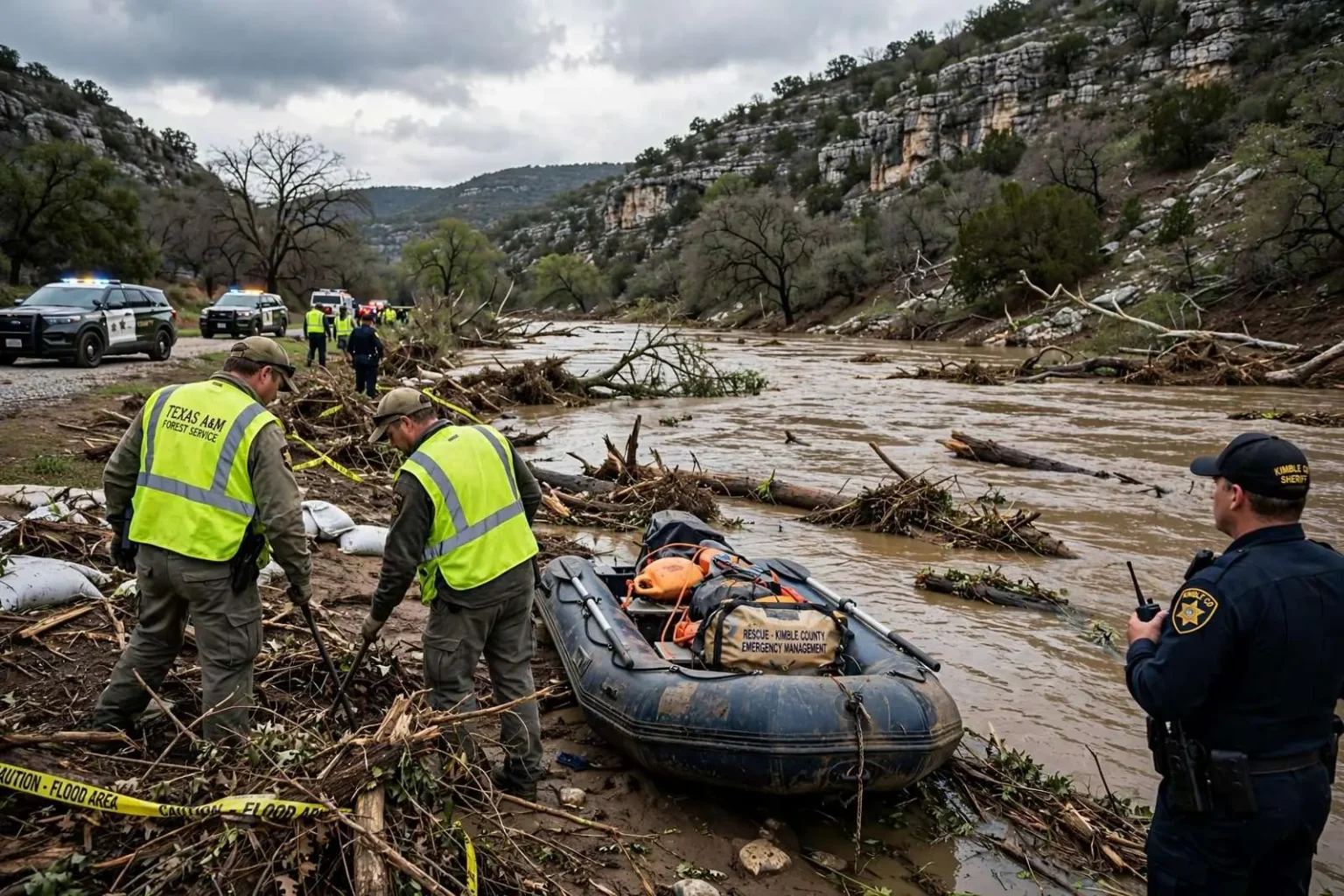
Two bodies were found Thursday downstream from a flooded RV park in Junction, Texas, where three people from Flomaton, Alabama, are missing after the Llano River swept through the site earlier in the week. The discovery grimly confirmed what searchers had feared since Monday morning, even as crews continued combing the river for the missing travelers from south Alabama.
The Texas A&M Forest Service said the bodies were discovered along the river’s edge, about nine miles downstream from the RV park where the victims had been staying. The victims have not been publicly identified, and authorities cautioned that identification work continues as the search operation presses on both upstream and down through the flood-scoured riverbed.
Joey Huss, Charlotte Moye and Mike McGee, all of Flomaton, have been missing since Monday morning, when water from the Llano River flooded the RV park where they were staying. A Texas man is also missing from the same flood event, bringing the confirmed total of unaccounted victims to four. The three Alabamians had been traveling together and were among a larger group from Flomaton caught in the flood.
In the hours after the river swelled, first responders helped evacuate 45 people and rescue 19 more, officials said, including three others from Flomaton who escaped the rising water. Those rescues — conducted in current-swept camps and along cut-off roadways as the flood peaked — pulled dozens of campers and travelers out of the path of the river before the worst of the water moved through.
A Hill Country Flash Flood
Junction sits at the junction of Interstate 10 and U.S. 377 in Kimble County, in the Texas Hill Country region that hydrologists know as one of the most flash-flood-prone areas in the United States. The Llano River and its tributaries drain steep terrain with thin soils and rocky ground, so heavy rain that would soak slowly into earth elsewhere instead runs off almost immediately, sending walls of water down narrow river valleys with little warning. Campgrounds and RV parks that sit on shaded riverbanks — the very feature that makes them popular — are the first places that water reaches.
The pattern that caught the Flomaton travelers is a familiar one in the region. Rain falling miles upstream can raise a river dramatically at a downstream campground before a cloud has even passed overhead, and rivers that are ankle-deep at dusk can become torrents by dawn. The Llano River, which drains a wide swath of the Hill Country before joining the Colorado River, has a long history of sudden rises, and local officials have spent decades preaching river-camp awareness to visitors who arrive expecting gentle water.
The search operation that followed involved emergency crews from about eight local, state and federal agencies, a mobilization that reflected both the scale of the disaster and the difficulty of the terrain. Searching a flooded river system means working the water itself with boats and sonar, walking the banks and sandbars where floodwaters deposit debris, and checking thickets of flood-tossed brush that can hide a person a yard from a searcher’s path. The Texas A&M Forest Service’s involvement pointed to the use of specialized personnel trained in disaster search operations.
Days of systematic searching downstream from the RV park — working through rapids, logjams, and the braided channels that the Llano carves through the Kimble County countryside — preceded Thursday’s discovery of the two bodies along the river’s edge. The locations, miles from where the campers were last seen, illustrated how far floodwaters can carry victims and how vast the search area becomes once a river recedes.
A Community in Flomaton Awaits Word
The impact of the disaster reached deep into Flomaton, the small Escambia County, Alabama, town just south of I-65 near the state line, where the missing travelers were known as friends and neighbors. Family members of the missing traveled from Alabama to assist with the search, joining the effort in Junction and standing by for word as crews worked the river. In a town Flomaton’s size, three missing residents is not a news item but a collective crisis, and the case became a shared vigil for the entire community.
The travelers who survived owed their lives to the speed of the first responders and, in some cases, to luck of timing. The 45 people evacuated and 19 rescued in the initial hours represented a large share of the campers on site when the river rose, and officials noted that the three other Flomaton residents rescued alongside them escaped the flood’s grip. For those the water caught before help arrived, the window between safety and disaster was measured in minutes as the Llano River overtopped its banks.
RV travel has surged in recent years, and the riverbank parks of the Texas Hill Country are among its most popular destinations, drawing travelers from across the country on routes between Texas’s big cities and its western parks. Interstate 10 puts Junction within easy reach of cross-country travelers, which means the camps there fill with visitors who may know little about local river behavior. Emergency managers in the region have long warned that this combination — transient campers, popular riverbanks, and flash-flood hydrology — makes the Hill Country uniquely dangerous when heavy rain threatens.
The coordinated response drew praise even as it continued, with agencies from Kimble County’s own sheriff and emergency management offices to state and federal partners sharing boats, aircraft, and search teams. Coordinating eight or more agencies is itself a significant undertaking, requiring unified command, shared communications, and careful division of the river into searchable segments — the kind of disaster infrastructure that federal and state systems exist to provide when a small county is suddenly overwhelmed.
How to Help the Families
Anyone wishing to donate to the families or first responders may contact the Kimble County Chamber of Commerce, which has served as the coordination point for assistance flowing into the community. Chamber officials have emphasized that donations help cover the practical needs that follow a disaster like this: travel and lodging costs for families who have come from as far as Alabama, meals and support for search teams working long days on the river, and recovery costs for survivors who lost vehicles, campers, and belongings in the flood.
The challenges ahead for the search are sobering. Rivers that have flooded carry victims far downstream and sometimes into the larger waterways below, and recovery operations can take days or weeks even when searchers know roughly where to look. The two bodies found Thursday narrowed the search but did not end it, with Huss, Moye and McGee and the missing Texas man still unaccounted for as crews continued their systematic sweep of the Llano.
For the families keeping vigil in Junction, the operation’s progress is watched hour by hour, sustained by the knowledge that searchers are giving the effort everything the terrain allows. For the community back in Flomaton, the distance between the two towns — nearly 800 miles of Gulf Coast highway — has been bridged by phone calls, prayer groups, and family members who drove west as soon as the news broke, ready to help however they could.
The disaster stands as a grim chapter in the long history of Hill Country floods, and a reminder of the region’s fundamental hazard: the same rivers that make the land beautiful make it treacherous when rain falls in the hills upstream. For two Alabama families and one Texas family, that hazard turned personal in a single morning, and the search for answers — and for their loved ones — continues along the river’s edge.
The Search Method Itself
Recovery work on a flood-swollen river follows a disciplined sequence. Teams first search the water itself, using boats, drones, and sonar in the deeper pools, then move to the banks as levels drop, walking every sandbar, gravel bar, and snag where flood debris accumulates. The nine-mile stretch below the RV park had been divided into segments assigned to different crews, with each section searched and re-searched as conditions allowed — an exhausting, methodical process in terrain littered with downed trees and tangled brush.
The Texas A&M Forest Service, better known for wildfire response, maintains specialized incident management and search teams that deploy to disasters across the state, and its role in the Junction operation gave the effort experienced coordination muscle. Local firefighters and deputies who knew the river’s bends worked alongside them, contributing the kind of local knowledge that maps cannot supply — where the channels shift, where bodies of water pool, where a person carried by current is most likely to come to rest.
Weather and river conditions set the tempo. After a flood crests, water levels can fall quickly in the Hill Country’s rocky channels, opening new ground to searchers each day — but they also redistribute what the flood left behind, moving debris fields downstream and requiring teams to revisit areas already covered. Every day of searching, officials stressed, added coverage and reduced uncertainty for the families waiting on the banks.
As the operation moved into its final phases, the focus turned from rescue to recovery for the two victims found Thursday, while rescue efforts continued in parallel for the four still missing. The distinction matters little to the families, who have asked for nothing more than that the search not stop until everyone is found. The crews on the Llano River have kept that promise so far, working the riverbank mile by mile until the flood has given up everything it took.