
Two Dead in Early-Morning Crash on I-10 Eastbound in Mobile County
Two people died in a predawn crash on I-10 eastbound in Mobile County; ALEA identified the victims as Douglas Henderson Jr. and Christopher James Lambeth.
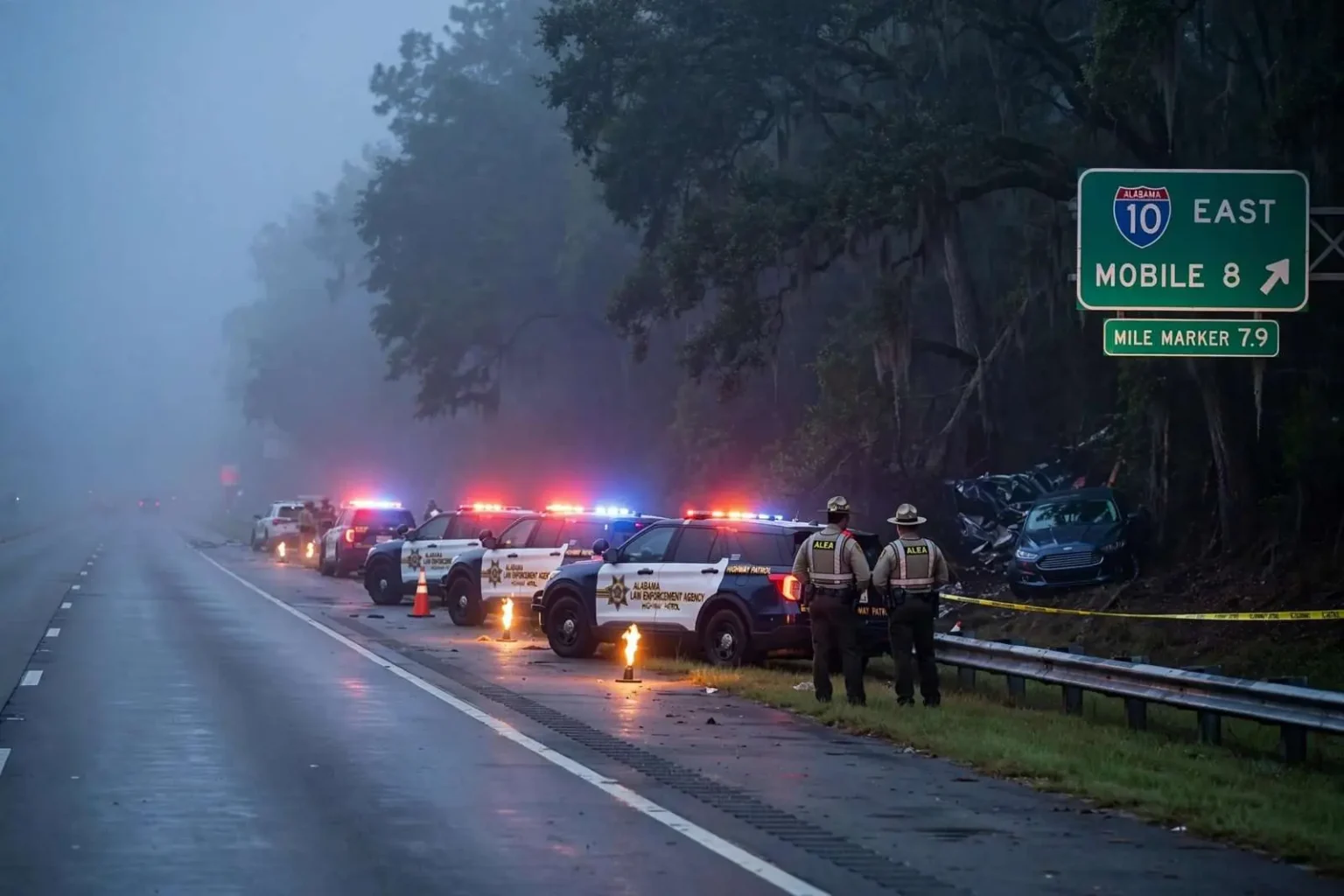
MOBILE COUNTY, Ala. — Two people were killed in a predawn crash Sunday on Interstate 10 eastbound in Mobile County, according to the Alabama Law Enforcement Agency. ALEA identified the victims as 31-year-old Douglas Henderson Jr. and 31-year-old Christopher James Lambeth, both of whom died in the wreck near the 7.9 mile marker. Troopers with the agency’s Highway Patrol Division responded to the scene at approximately 4:45 a.m., at a hour when traffic on the interstate is typically light but visibility is limited and the risk of single-vehicle run-off-road crashes is elevated.
Investigators said Henderson was driving a 2014 Ford Fusion eastbound on Interstate 10 when the sedan left the right side of the roadway and struck a tree. Lambeth was a passenger in the vehicle at the time of impact. Both Henderson and Lambeth were pronounced dead as a result of injuries sustained in the collision. ALEA has not said whether either occupant was restrained, and authorities have not released additional details about what caused the car to depart the roadway.
The crash remained under investigation by ALEA’s Highway Patrol Division, which handles the majority of serious injury and fatality collisions on state and interstate highways across Alabama. Investigators typically examine roadway conditions, vehicle mechanics, driver behavior and any potential impairment factors in determining a final cause. Findings in such cases often take weeks to compile, and formal reports are generally released after the investigative review is complete.
A stretch of I-10 with a demanding safety profile
The segment of Interstate 10 near the 7.9 mile marker sits on the eastern side of Mobile County, along the corridor that carries through traffic between downtown Mobile and the Alabama state line toward Pensacola. The route is one of the Gulf Coast’s most heavily used freight and commuter arteries, connecting Mobile’s port operations to the broader Southeast. Early morning hours bring a mix of long-haul truckers, shift workers and early travelers, though volume at 4:45 a.m. is far below the midday peaks that regularly slow the interstate through the city.
Run-off-road crashes like the one described by troopers are a persistent concern on high-speed interstates. A vehicle traveling at highway speed that departs the pavement faces hazards that include embankments, culvert ends, signage supports and trees near the right of way. For that reason, transportation officials across the nation emphasize seatbelt use, alert driving and appropriate speeds during overnight and early morning hours, when fatigue and reduced visibility combine to raise risk. Alcohol impairment is also a well-documented factor in fatal late-night and early-morning crashes nationwide, though ALEA did not state any suspected contributing factors in this case.
How ALEA investigates fatal wrecks
The Alabama Law Enforcement Agency was created in 2015 by an act of the Alabama Legislature, consolidating the former Department of Public Safety and several other enforcement functions into a single cabinet-level agency. Its Highway Patrol Division operates posts across the state, including one serving the Mobile area, and is the lead agency for crash reconstruction on interstates and state routes. When a crash involves fatalities, troopers document the scene, photograph evidence, measure skid marks and roadway geometry, and interview witnesses before the roadway can fully return to normal use.
Fatal crashes in Mobile County are counted among the area’s most serious traffic safety statistics, and the county consistently ranks among the highest in Alabama for total roadway fatalities because of its large population, its port-driven truck traffic and the network of interstates that pass through it. Interstate 10, Interstate 65 and the Cochrane-Africatown USA Bridge corridor all carry substantial daily traffic through the county, creating sustained exposure for the drivers who use them.
What the loss means locally
A predawn wreck that claims two lives reverberates beyond the scene itself. Families in the Mobile area are left to arrange services and answer questions that investigators may not be able to resolve quickly, and first responders who work the scene carry the burden of what they encounter. Local law enforcement agencies and ALEA routinely use such cases to remind drivers of the steps that most reliably reduce risk: wearing seatbelts, keeping speeds reasonable for conditions, avoiding distractions, and pulling over when drowsiness sets in on long drives.
For residents who regularly drive the I-10 corridor, the crash is a reminder that even familiar stretches of highway can turn deadly in a matter of seconds. Anyone with information about the incident is typically encouraged to contact ALEA’s Highway Patrol Division, as witness observations can aid investigators working to finalize their reconstruction. The investigation into Sunday’s crash remained active, and authorities said additional information would be released if and when it becomes available.
The circumstances of the crash — a single vehicle leaving the roadway and striking a fixed object — are among the most common patterns in fatal interstate collisions. Federal highway safety data consistently show that roadway departure crashes account for roughly half of all traffic deaths in the United States, a figure that has driven decades of investment in shoulder widening, rumble strips, breakaway sign posts and guardrail installation. Even so, trees located within the highway right of way remain a significant hazard, particularly in rural or semi-rural stretches like portions of eastern Mobile County where dense vegetation borders the interstate.
Speed is another central variable. At interstate speeds, a driver who nods off for even a few seconds can travel the length of a football field before reacting, and by the time a departure is noticed it is often too late to recover the vehicle. That is why agencies such as ALEA and the Alabama Department of Transportation have installed milled shoulder rumble strips along many highway segments: the vibration and noise they generate when a tire drifts off the pavement serve as a last-line warning for fatigued or distracted drivers. DOTD and ALDOT officials have also promoted median cable barriers and improved delineation in corridors with elevated run-off-road crash rates.
Weather may or may not have played a role in Sunday’s crash, and investigators have not said. What is known is that predawn conditions in coastal Alabama often include heavy dew, fog pockets and reduced contrast between the roadway and its surroundings, all of which can degrade a driver’s ability to judge lane position. Drivers heading eastbound in the early morning also face the sun rising nearly directly ahead of them as dawn breaks, a factor that regularly produces sudden slowdowns and edge-line drift on east-west routes like I-10.
Resources for families after a fatal crash
When a crash in Alabama results in a death, the investigation moves along a defined path. Troopers complete their on-scene work and forward their findings for review, and families generally receive updates through the investigating post. Death certificates are issued by the county, and in Mobile County that process runs through the county’s coroner function, which works with hospital and law enforcement partners to confirm identities and causes of death. Families of crash victims in Alabama also have access to victim advocates through district attorney offices, who can help explain the process and connect relatives with counseling resources.
Insurance and liability questions often follow, though those matters are resolved separately from the criminal investigative timeline. In single-vehicle crashes, attention typically turns to the vehicle’s mechanical condition and to any roadway defects that may have contributed, questions that require the full reconstruction report to answer. Attorneys who handle such cases generally advise families not to rush to conclusions before investigators have documented all relevant evidence.
Anyone who witnessed Sunday’s crash, or who may have dash-camera footage from the area around the 7.9 mile marker of eastbound Interstate 10 in the hours before 4:45 a.m., is typically asked to contact ALEA. Tips can be submitted through the agency’s Highway Patrol posts, and investigators emphasize that even small details — a description of a car’s movement, its lights, or its speed — can help confirm or rule out theories about what caused a vehicle to leave the roadway. The agency has not indicated how long the investigation into the deaths of Henderson and Lambeth is expected to take.
Mobile County emergency crews have responded to a steady string of serious interstate crashes in recent years, and local officials continue to press for safety improvements along the corridor. Public education campaigns in the region stress the “move over” law, seatbelt compliance and the dangers of impaired and drowsy driving, particularly around holiday weekends when travel volumes spike. Fire departments and EMS units that serve the unincorporated stretches of the county practice for the challenge of reaching crash victims quickly along limited-access highway segments, where the nearest rescue squad may be several miles from the nearest interchange. For now, Sunday’s crash stands as the area’s latest fatal roadway departure, and investigators are working to determine exactly what put the 2014 Ford Fusion off the eastbound lanes before dawn. Until that review is finished, both the identities of the victims and the sequence of events leading to the collision remain as recorded by troopers at the scene.