Two Gulf Shores City Schools Teachers Named Among 16 Alabama Teacher of the Year Finalists
Gulf Shores Middle and High School teachers Angela Kirby and Kristen Madsen are finalists for 2025-2026 Alabama Teacher of the Year.
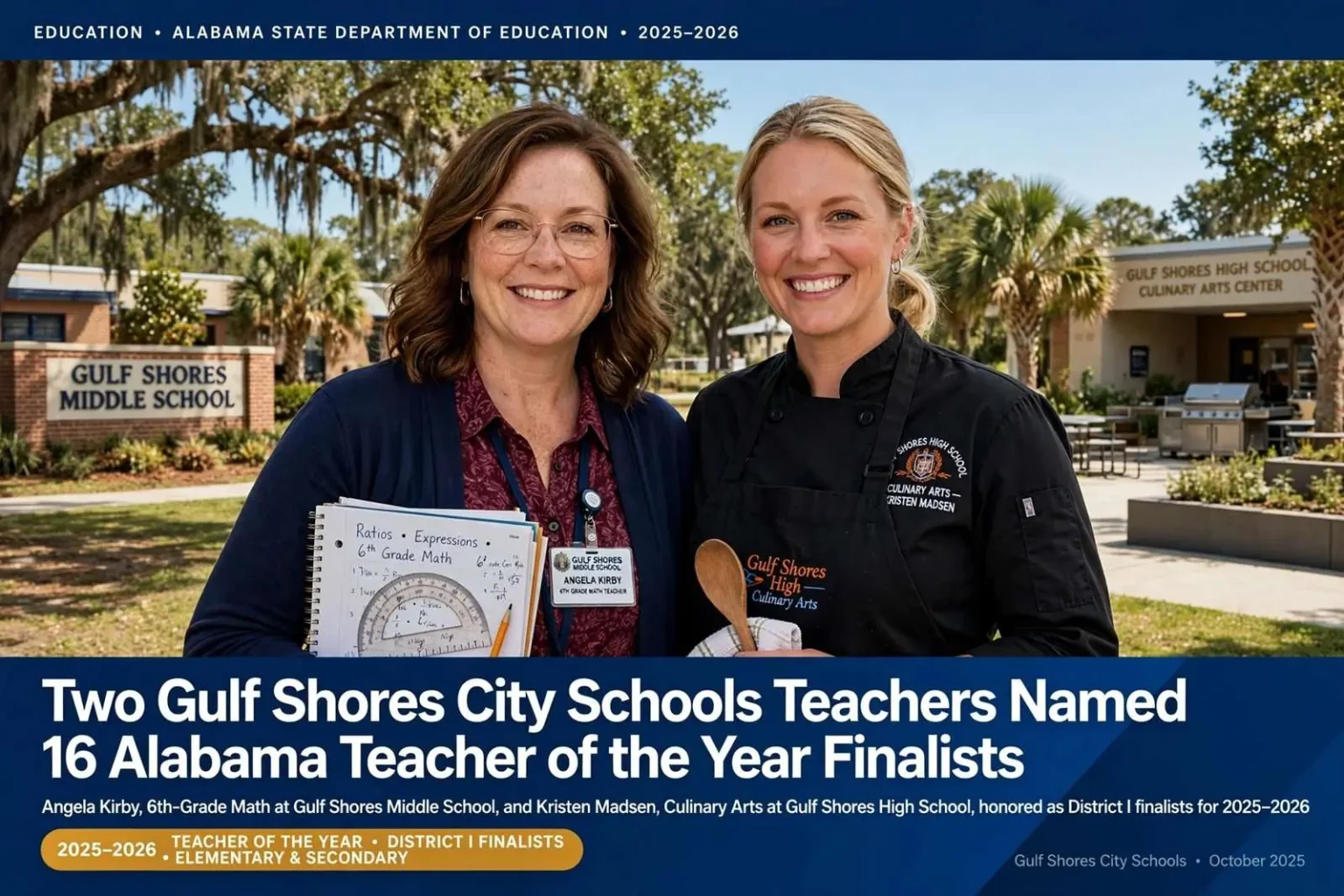
Two educators from Gulf Shores City Schools have landed spots among the 16 finalists for 2025-2026 Alabama Teacher of the Year, the Alabama State Department of Education announced. The announcement puts the small coastal city system on the state’s biggest stage for classroom teaching, with two of its teachers now in contention for honors that carry recognition across Alabama’s public schools.
Angela Kirby, a sixth-grade math teacher at Gulf Shores Middle School, and Kristen Madsen, who teaches culinary arts at Gulf Shores High School, each earned recognition as District Teachers of the Year on their way to the state round. The honor means Gulf Shores claimed both the elementary and secondary District I slots — a sweep Superintendent Matt Akin called proof of the district’s culture of innovation, collaboration and high expectations.
A sweep of a district’s two categories is unusual for a system of Gulf Shores’ size, and it means both of the district’s nominees advanced past the district round — a outcome that requires not just strong classrooms but strong applications documenting them. Akin, who has led the district since its formation, has made teacher recognition and retention central themes of his administration, and the double finalist announcement gives that message a concrete proof point.
For the teachers themselves, the recognition follows years of classroom work in a district that was only recently formed. Gulf Shores City Schools became one of Alabama’s newest independent systems when the city split from Baldwin County’s school system, and in the years since it has invested in career and technical programs, digital learning and classroom innovation. The two finalists represent both ends of that investment: a traditional core-subject classroom at the middle school and a hands-on culinary arts program at the high school.
A District Spanning South Alabama
District I reaches across much of southern Alabama, taking in Baldwin, Butler, Coffee, Conecuh, Covington, Crenshaw, Escambia and parts of Mobile County. The competition’s district structure divides the state geographically, with each district producing elementary and secondary honorees who advance to the state round. Winning a district title means standing out among teachers from both large suburban systems and small rural ones, in communities as different as Mobile’s suburbs and the pine-belt towns of south Alabama.
Gulf Shores is one of 16 school systems in the district, alongside systems in Andalusia, Brewton, Enterprise, Opp, Elba and Orange Beach, among others. The state’s eight districts together produced 156 individual schools represented in the program. The 16 finalists emerged from 155 educators recommended by superintendents, principals and colleagues through the state’s application process.
The math of the program makes the finalist round genuinely selective. Each district begins with nominations from the local level, where teachers are chosen by their colleagues and administrators, and the applications that advance are scored against their peers across the district. From 155 district-level educators across the state, only 16 reach the finalist stage — roughly one in ten. The finalists are then interviewed and evaluated further as the department selects the state’s elementary and secondary Teachers of the Year, one of whom becomes Alabama’s nominee in the national program.
The Teacher of the Year program is among the oldest and most visible honors in American public education, and Alabama’s version follows the national model: winners serve as spokespeople for the profession, travel to professional events, and represent the state’s classrooms for a year. For school systems, a finalist or winner is a recruitment asset and a morale signal — evidence, administrators say, that a district’s culture produces and sustains excellent teaching.
The Teachers React
Kirby said she was honored, humbled and grateful for colleagues she described as innovative and devoted to students. Madsen said the recognition took time to feel real and called it rewarding to see her work with students acknowledged so meaningfully.
Both teachers’ subjects illustrate the range of what Alabama’s program honors. Kirby’s sixth-grade math classroom sits at a pivotal point in a student’s mathematical development, the year when number sense gives way to ratios, expressions and the foundations of algebra. Madsen’s culinary arts program, meanwhile, is part of the career and technical education pathway that Alabama has expanded statewide, giving high school students industry-relevant skills, food-service experience and a connection to the Gulf Coast’s restaurant and hospitality economy.
A quirk of classification worked in Kirby’s favor: while Gulf Shores treats sixth grade as middle school, the state counts it as elementary, placing her math classroom in the District I elementary category. The classification quirk is a common one across Alabama, where grade configurations vary widely between systems, and it meant the district’s middle-school nominee competed in the elementary bracket. It is the first year either teacher has reached this stage of the program.
For Gulf Shores City Schools, the announcement arrives as the young district continues to build its identity. Splitting from a county system is a demanding process — new administration, new facilities decisions, new curriculum choices — and districts that manage it well tend to point to classroom culture as the thread that held everything together. Akin’s emphasis on innovation and collaboration has been the district’s public theme, and having two teachers reach the state finalist round in the same year is the kind of external validation that districts in transition value most.
The dual recognition also highlights the range of teaching the district offers. Gulf Shores Middle School serves the city’s upper elementary and middle grades, where Kirby’s math students build the foundations that high school coursework depends on. Gulf Shores High School, on the campus that anchors the city’s education corridor, runs career and technical programs that connect students to the coastal economy, and the culinary arts classroom has been among the signature offerings — a working kitchen where students learn food preparation, safety and service skills that translate directly into jobs in one of Alabama’s most tourism-dependent cities.
What happens next in the program follows a defined path. The 16 finalists go through the state department’s evaluation process, including application review and interviews, before the elementary and secondary winners are named. Winners are honored at the state level and advance into the national Teacher of the Year program, where each state’s nominee competes for the national honor. Whatever the outcome, the finalist stage places Kirby and Madsen among the most recognized classroom teachers in Alabama for the coming year.
For now, the district is celebrating the sweep. Colleagues at both schools marked the announcement, and the district’s message to the community paired the individual honors with the broader point Akin has made all along: that a culture of high expectations, shared by teachers and students alike, is what turns individual excellence into a district-wide pattern. Two finalists from one small city system make that argument as well as any statistic could.
A young district’s fast rise
The split that created Gulf Shores City Schools followed a years-long effort by the city to take control of its own classrooms. City residents approved the break from the Baldwin County system, and the new district opened as an independent system, taking over the city’s schools with its own board, administration and budget supported by city funding. The transition was closely watched across Alabama, where several communities have debated similar splits, and Gulf Shores’ early years have been scrutinized as a test case for whether a small city system can outperform its predecessor.
The district’s leaders chose to answer that question with investment: expanded career and technical offerings, updated technology, competitive pay aimed at retaining strong teachers, and partnerships that connect classrooms to the coastal economy. Enrollment has grown along with the city’s population, and the system has emphasized small-school advantages — the ability of teachers and administrators to know every student — alongside the resources of a well-funded city district.
In that context, a double finalist year reads as more than luck. The Teacher of the Year application process demands documentation of instructional practice, student outcomes and professional leadership, and advancing two nominees through the district round requires depth across the faculty rather than a single standout classroom. District officials noted that colleagues nominated both teachers — the process begins with peer recognition — which they take as evidence that the culture extends beyond individual award winners.
What the finalists represent
Kirby and Madsen also represent the two poles of Alabama’s modern teaching landscape. The state has pushed to strengthen middle-grades mathematics, where national assessments consistently show Alabama students needing support, and teachers like Kirby are on the front line of that effort. At the same time, the state’s expansion of career and technical education has elevated programs like Madsen’s from elective status to recognized pathways with industry credentials, dual-enrollment connections and direct lines into the workforce.
The culinary arts program’s connection to Gulf Shores’ economy is immediate. The city’s restaurant and hospitality industry is among the largest employers on the coast, and graduates of the program step into a labor market that values their training. Teachers in career-tech classrooms are evaluated on both instruction and industry relevance, a dual burden that the state’s recognition program now treats as equal in dignity to traditional academic subjects — something Madsen’s finalist selection formally acknowledges.
The state department will announce the elementary and secondary Teachers of the Year as the process concludes, and either Gulf Shores finalist would be the first from the young district to hold the title. Until then, both teachers return to the classrooms that earned them the recognition, where the day-to-day work that produced this honor — lesson plans, kitchen shifts, and the daily business of teaching — continues as it does every year.