Two Sea Turtles Injured by Fishing Gear Released Back Into the Gulf at Gulf Shores
Skipper, a loggerhead, and Pudge, an endangered Kemp's ridley, were released back into the Gulf near Gulf Shores after months of treatment for injuries caused by fishing gear.
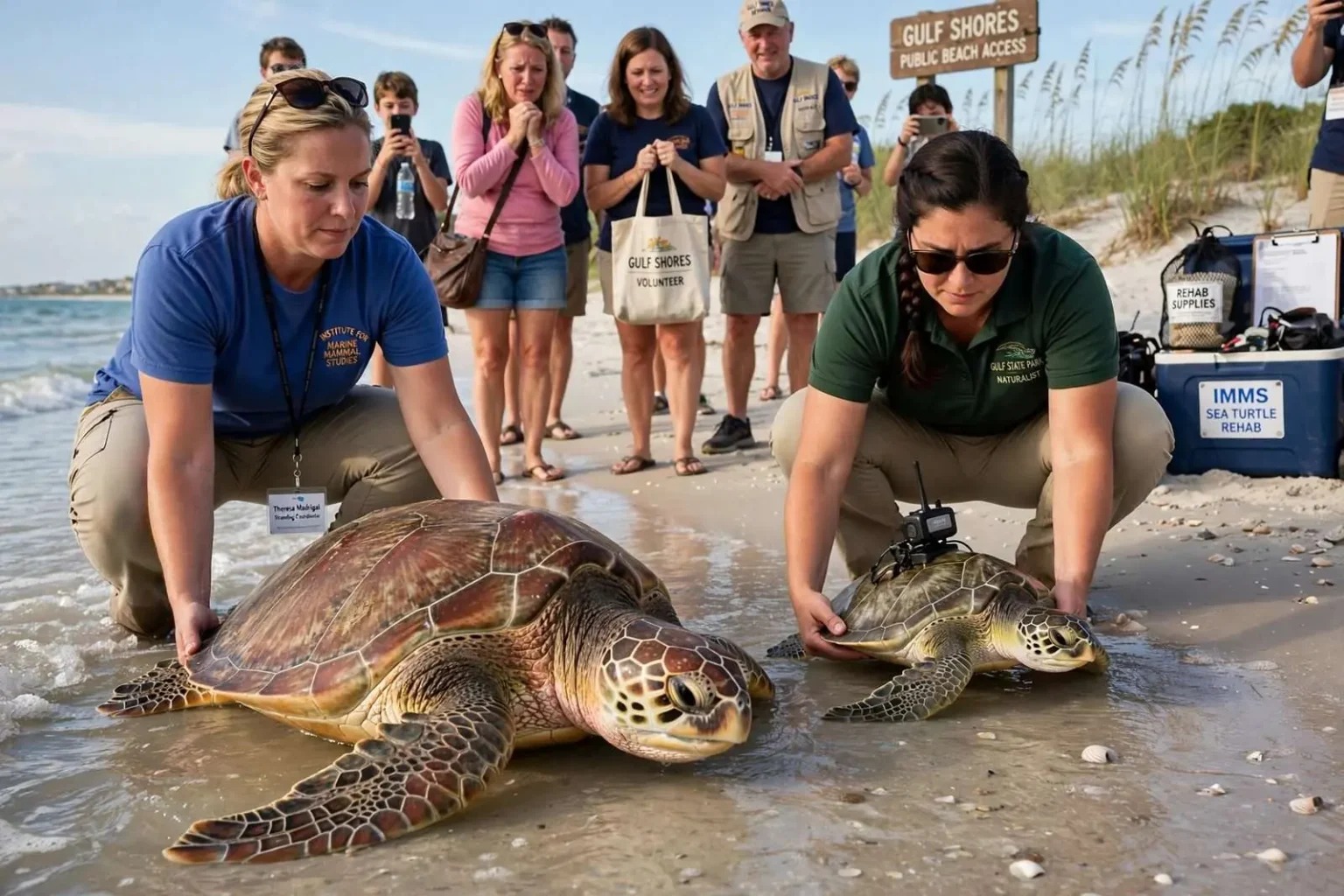
GULF SHORES, Ala. — Two sea turtles that had been tangled in fishing gear are swimming free in the Gulf of Mexico again after months of treatment and rehabilitation, a reminder of both the dangers discarded fishing equipment poses to marine wildlife and the resources dedicated to saving injured animals along the Alabama coast. The releases, staged on the beach at Gulf Shores before a small crowd of onlookers, marked the end of rescue stories that began with hooks and fishing line in the water and ended with healthy turtles paddling out through the surf. For the rehabilitation teams involved, days like this are the point of the months of tank time, medical treatment and feeding that come between a stranding call and a release.
The first turtle released, a young loggerhead named Skipper, was hooked in May. Rescuers found fishing line and lead weights wrapped tightly around one of his flippers. “It was about 10 pounds of extra weight that was hanging off this turtle’s flipper, and it was starting to embed in that flipper tissue,” said Theresa Madrigal, the Stranding Coordinator at the Institute for Marine Mammal Studies. A sea turtle dragging that kind of weight cannot swim effectively, feed normally or reach the surface to breathe without effort, and the line’s slow cutting into living tissue meant the injury would only worsen had the turtle not been found.
Madrigal said the case underscores a broader problem facing wildlife along the Gulf Coast. “It’s really important to dispose of your gear properly. Not just sea turtles are affected by this, but all wildlife,” she said. Discarded fishing line is among the most persistent hazards in coastal waters because it does not degrade quickly, and a single abandoned line can injure animals long after the angler who lost it has gone home. Birds, dolphins, and fish become entangled alongside turtles, which is why stranding coordinators treat every recovered line as one less hazard in the water.
An Endangered Species Gets a Second Chance
The second turtle released was Pudge, an endangered young Kemp’s ridley who was hooked through her left front flipper back in March. Both turtles received treatment at the Institute for Marine Mammal Studies in Mississippi before being cleared to return to the wild. Rehabilitation for a hooked turtle typically involves removing the hook, treating the wound, monitoring for infection, and confirming that the animal can swim, dive and feed normally — a process measured in months for animals whose injuries involve joints or tissue damage. Clearance for release only comes when veterinarians are satisfied the turtle can survive on its own.
For the team involved in these rescues, every successful release carries extra weight given how few Kemp’s ridleys remain. Hillary Bryan, a naturalist with Gulf State Park, said the numbers illustrate the stakes. “It’s what makes it worth it,” Bryan said. “We’ve had 59 hookings this year and only 14 successes. There are not very many left of the species, and if we don’t do anything, they will no longer be here.” The gap between 59 hookings and 14 successes is a measure of how often a rescue begins too late or the injuries prove too severe — and why each of the 14 matters to the people who do this work.
The Kemp’s ridley is considered the most endangered sea turtle species in the world, and Gulf Coast waters are an important habitat for the species. The smallest of the world’s sea turtles, Kemp’s ridleys nest almost exclusively on a single stretch of Mexican coastline, and the juveniles that feed in Gulf waters — including along the Alabama coast — represent a meaningful share of the species’ remaining population. Because the species concentrates its nesting in one place, setbacks to the population compound quickly, and conservationists treat every juvenile that reaches adulthood as a piece of the species’ future.
Every successful rehabilitation and release is treated as a meaningful contribution to the species’ survival. Loggerheads, like the one released alongside Pudge, are listed as threatened under the Endangered Species Act, and Alabama’s beaches see loggerhead nesting each summer, with volunteers marking and monitoring nests from May into the fall. The state’s coastal communities have built an identity around protecting those animals — beach lighting ordinances, nest patrols, and volunteer networks that walk the sand at dawn — because what happens on Alabama beaches shapes what happens to the species across the Gulf.
A Moment That Resonated With Beachgoers
The releases drew onlookers to the beach, including sisters Sherry and Carolyn Davies, who described the experience as emotional. “It was so awesome because we track the turtles before, and we walk the beach, and we try to pick up the trash and stuff,” Sherry Davies said after watching the release. For regulars who walk Alabama’s beaches collecting litter and watching for turtle activity, a release is the payoff of habits that can feel small — a bag of trash here, a marked nest there — until a rescued animal swims past the crowd and out into the Gulf.
“This is the first one we’ve seen, but it definitely won’t be the last,” Carolyn Davies added. “I almost cried!” The sisters’ reaction captured the reason rehabilitation centers stage these releases in public rather than quietly at dawn: an audience that watches a turtle return to the water comes away with a connection to the problem that no warning sign on a pier can match. Coastal educators have long found that a single release turns more casual visitors into careful ones than any amount of printed material.
Tracking Pudge’s Next Journey
Pudge’s release came with an added feature: researchers attached a small satellite transmitter to her shell before she returned to the water, allowing her movements to be monitored remotely. “Every time that turtle comes up to breathe at the surface, it’s going to send a transmission to the satellite. And then we’re able to track its movements,” Madrigal explained. Because sea turtles must surface to breathe, each breath becomes a data point — a position fix that plots Pudge’s path across the Gulf one surfacing at a time.
That transmitter will now give researchers a window into where Pudge travels next, adding to the broader body of knowledge scientists use to understand and protect sea turtle populations along the Gulf Coast. Tracking data from released turtles has shaped what scientists know about juvenile habitat use, migration corridors and the waters where turtles face the greatest risks from fishing activity. Every transmission Pudge sends adds a line to that map, and her movements in the months ahead may inform decisions far from the beach where she was released.
Officials continue to urge anglers and beachgoers to dispose of fishing line, hooks and other gear properly to prevent future injuries to sea turtles and other wildlife. The practical steps are simple: reel in and remove loose line rather than cutting it free, use the monofilament recycling bins posted at coastal boat ramps and piers, and never leave tackle behind on the beach. Anyone who finds a hooked or entangled turtle is urged to keep their distance and call a stranding response hotline so trained responders can handle the animal — an untrained rescue can make injuries worse.
For Skipper and Pudge, the months of treatment ended where they began — in the Gulf — but with working flippers and clear paths ahead. For the stranding coordinators, naturalists and volunteers who made both releases possible, the days ahead bring more hooking calls, more tank time, and the hope that careful disposal of a few yards of fishing line will mean fewer of both. The turtles are back in the water; the rest is up to the people who share the coast with them.
The two releases also spotlight the network that makes them possible. Stranding response along the Alabama coast depends on coordination between state biologists, park staff, volunteer beach monitors and out-of-state rehabilitation facilities such as the Mississippi-based institute that treated both turtles. A single rescue typically involves several of those links — the beachgoer who makes the call, the responder who secures the animal, the veterinarians who treat it and the staff who decide when it is ready to go home. When one of those links works, a turtle that would have died in the surf gets a second chance.
Summer is the season when those systems face their heaviest demand. Warm water brings more people fishing, swimming and boating, and the same months bring nesting females ashore and hatchlings into the surf, which means more turtles in the near-shore waters where hooks and lines are set. Coastal officials use the start of each season to remind visitors that a turtle spotted on the beach — nesting, stranded or injured — should be reported rather than handled, and that lights on the beach at night can disorient hatchlings trying to find the water.
For now, two turtles that might otherwise have died are swimming somewhere in the Gulf, one of them reporting her position each time she surfaces. The count of hookings against successes this year stands at 59 to 14, and the people who do this work will keep trying to move that second number — one rescue call, one recycled spool of line, one careful angler at a time.