
Two teens in custody after man fatally shot while riding motorcycle in Wilcox County
Two teens are in custody after Tim Fletcher was fatally shot while riding his motorcycle on Highway 162 in Wilcox County, the sheriff said.
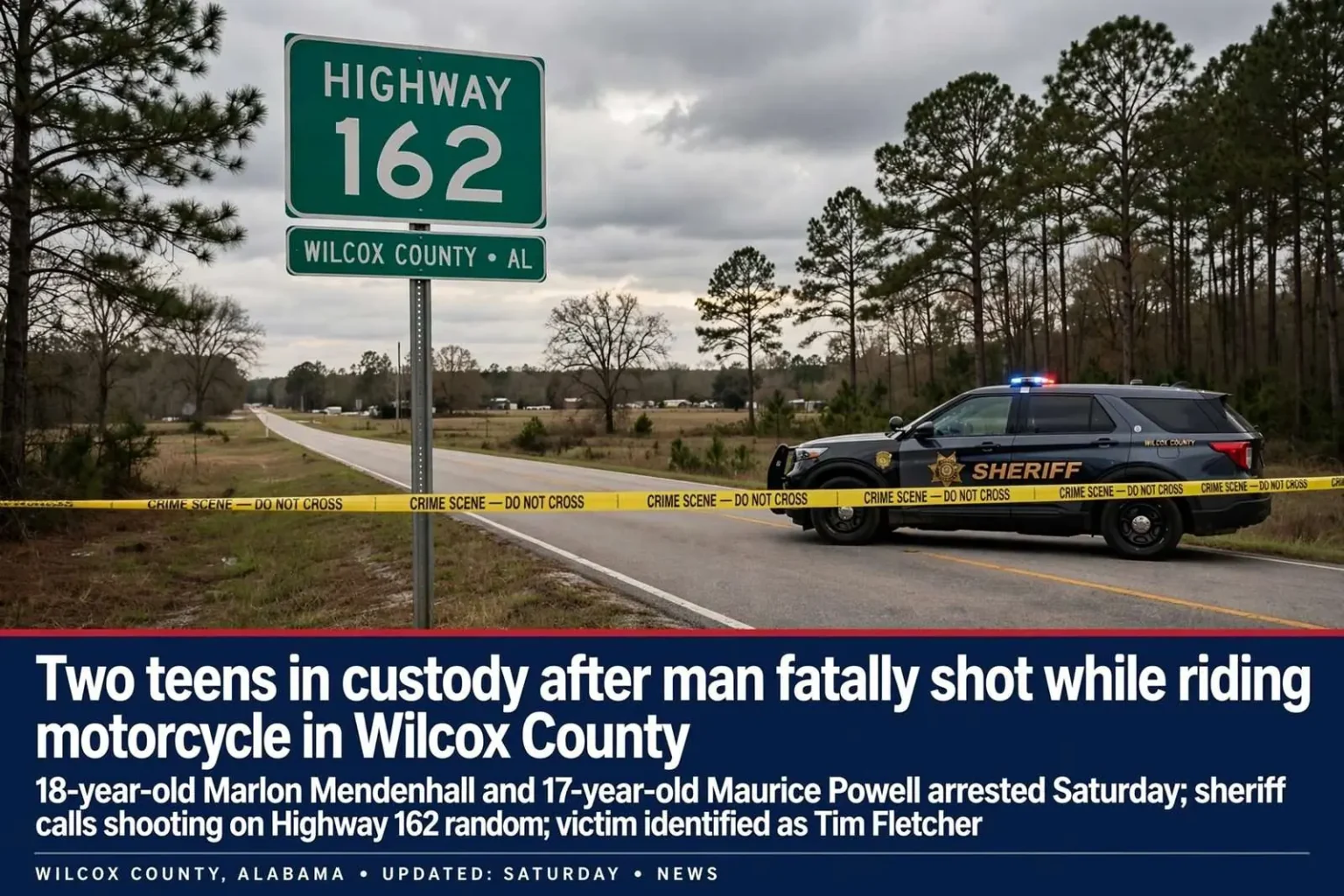
Two teenagers are in custody after a man was fatally shot while riding his motorcycle in Wilcox County, authorities said. Wilcox County Sheriff Earnest Evans said the victim, Tim Fletcher, was on his motorcycle on Highway 162 when he was shot during a Friday afternoon shooting. Investigators believe the attack was random. Sheriff Evans identified the two suspects as 18-year-old Marlon Mendenhall and 17-year-old Maurice Powell. Both were taken into custody Saturday, the sheriff’s office said.
The sequence of events, as announced by the sheriff’s office, moved quickly from the shooting to the arrests. Fletcher was struck while riding along Highway 162 on Friday afternoon, and investigators worked the case through the night and the following day. By Saturday, both suspects identified by the sheriff, one 18 and the other 17, were in custody. The speed of the arrests in a rural county with a small law enforcement agency reflects both the urgency of the case and the willingness of area residents to come forward when authorities asked.
Because investigators characterized the shooting as random, the case carries a particular weight for the community. Random attacks are the ones residents feel least able to protect against, and they generate anxiety far beyond their number. The sheriff’s announcement that two suspects were identified and captured within roughly a day addresses that anxiety directly, and it also closes the immediate question of whether a shooter remained at large in the area.
Wilcox County and Highway 162
Wilcox County sits in Alabama’s Black Belt, a band of south-central counties known for dark, fertile soil, rolling pine land, and some of the most rural landscapes in the state. Camden, the county seat, sits on the Alabama River, and the county as a whole is home to roughly ten thousand people spread across wide stretches of farmland, timber country, and small communities. Law enforcement in a county like this means covering hundreds of square miles of road network with a limited number of deputies and investigators.
Highway 162 is one of the county’s rural routes, running through sparsely populated country where traffic is light and the sight lines are long. Roads like it are popular with motorcyclists for exactly those reasons, and on a pleasant Friday afternoon a rider passing through has little company. That same emptiness works against victims and investigators after a crime: there may be no other cars around, no businesses with cameras, and few people within earshot when something happens.
The rural character also shapes how the news travels. In a county of this size, a fatal shooting is not an item that passes unnoticed; word moves through churches, stores, and phone calls within hours, and almost everyone knows someone connected to the case. That closeness is a double-edged sword for investigators, bringing both pressure and the community cooperation that makes fast arrests possible.
The investigation and the arrests
Sheriff Evans’s identification of the two suspects and the announcement of their capture came within about a day of the shooting. In rural Alabama, that pace typically depends on tips. Investigators canvass the area around the scene, talk to residents who live along the route, and ask for the public’s help, and in small counties someone almost always saw something: a vehicle that did not belong, two people walking where they should not have been, a detail that fits nowhere else until a shooting makes its meaning clear.
The two suspects, identified as Marlon Mendenhall, 18, and Maurice Powell, 17, were taken into custody on Saturday. With one suspect a juvenile, the case moves under rules that treat defendants under 18 differently from adults, though Alabama law allows juvenile charges in serious felonies to be transferred to adult court under certain conditions. Those decisions rest with prosecutors and judges as the case develops, and the sheriff’s office had not announced charges in detail at the time of the arrest announcement.
What investigators believe, according to the sheriff, is that the attack was random, meaning Fletcher was not known to the suspects and was not singled out for any personal reason. If that holds, it makes the crime harder to predict and harder to explain, but not harder to prosecute; the evidence in a highway shooting, from shell casings to vehicle and witness descriptions, tells its own story regardless of motive.
Riding the Black Belt roads
Motorcyclists across Alabama know the appeal of roads like Highway 162. The state’s rural routes offer the kind of riding that draws people to motorcycles in the first place: curves, open country, little traffic, and towns close enough together to make a loop of an afternoon. Riders traveling between the Black Belt and the river counties pass through Wilcox County regularly, and weekend afternoons bring a steady trickle of bikes along the area’s highways.
The fatal shooting of a rider on one of those roads is a shock to that community of riders as well. Motorcycle fatalities on Alabama roads most often involve crashes rather than violence, and the death of a rider who was shot while traveling an ordinary rural route stands outside every familiar category. For riders who use these roads, the case will be remembered not as a warning about riding, which no one could have heeded, but as an act with no connection to anything the victim did.
Fletcher, identified by the sheriff as the victim, was riding in daylight on a public highway when he was shot. Nothing in the circumstances as described suggests anything about his conduct or his route placed him at risk. That is what investigators mean when they call an attack random, and it is why the community’s response to such cases is so uniformly one of alarm and demand for answers.
Rural law enforcement at work
Wilcox County’s sheriff’s office operates the way most Black Belt agencies do, with a small staff covering a large territory and support from neighboring agencies and state partners when serious cases arise. Homicide investigations in counties like this one typically draw on the Alabama Law Enforcement Agency, crime lab services from the state, and cooperation from district attorneys and investigators in surrounding counties, all coordinated by the local sheriff.
Sheriff Evans’s office moved from a Friday afternoon shooting to two suspects in custody by Saturday, which in practical terms means the office spent those hours collecting evidence, interviewing witnesses, and running down leads without pause. Cases do not close themselves, and in a rural county the investigators working a killing are often the same deputies who patrolled the roads the day before, working with limited sleep and full caseloads.
The arrests also reflect the role of the community in rural justice. Deputies know the county’s residents, and residents know each other, so information flows quickly in both directions when authorities ask for help. A case that might take weeks to break in a large city can move in a day or two in a place where two teenagers cannot move through the countryside without being noticed by someone who knows their names.
What comes next in the case
With both suspects in custody, the case now moves into the court process. Formal charges, bond decisions, and initial appearances come first, and for the 17-year-old suspect, the question of whether the case will be handled in juvenile court or transferred to adult jurisdiction will be resolved through hearings under Alabama law. Prosecutors in the Wilcox County circuit will evaluate the evidence gathered by investigators and present it as the case moves forward.
The investigation itself may also continue after arrests. Investigators will work to establish a complete account of the Friday afternoon on Highway 162, including how the shooting happened, what weapons and vehicles were involved, and how the two suspects came to be on that road. Those answers matter to the prosecution, and they matter to the community, which in cases of random violence is left to reconcile an act that had no apparent logic.
For now, the facts established by the sheriff’s office are these: a man riding his motorcycle on a Wilcox County highway was shot and killed on a Friday afternoon; investigators believe the attack was random; and two teenagers, one 18 and one 17, were in custody by Saturday. In a small county where everyone is a neighbor of someone, those facts are enough to bind the community’s attention until the courts finish the work the sheriff’s office began.
Remembering the victim and the county’s response
Behind the case numbers is a man riding his motorcycle on a Friday afternoon with no reason to expect anything but a ride. Tim Fletcher was identified by Sheriff Evans as the victim, and in a county the size of Wilcox, his death is felt through the personal connections that tie the community together. Vigils, funeral services, and the quiet support of neighbors will follow in the days ahead, as they do in every rural Alabama county that loses one of its own to violence.
The county’s attention now turns to the courts, where the process set in motion by the arrests will play out. Residents who want to follow the case can expect developments to move through the county’s system at the pace the law requires, and the sheriff’s office, having delivered the arrests, will continue to support the prosecution with the evidence its investigators gathered in those first critical hours after the shooting.