University of Mobile Launches Nationwide Prayer Movement, Asks Supporters to Sign ‘Prayer Contracts’
University of Mobile President Mark Foley is asking Americans to sign prayer contracts as part of a new nationwide daily prayer campaign launching in.
University of Mobile President Mark Foley says a year-long look back at his 12 years leading the Southern Baptist-affiliated school convinced him he had accomplished the goals he originally set out to reach. Rather than simply setting new institutional targets, Foley said he landed on something broader: an effort aimed at shaping the spiritual culture of the country, not just his campus.
That reflection, Foley says, forced a question familiar to leaders of every established institution: what comes after the original mission is fulfilled? His answer was not another building campaign or enrollment target but an attempt to project the university’s convictions far beyond the borders of its campus — a direction few college presidents would choose.
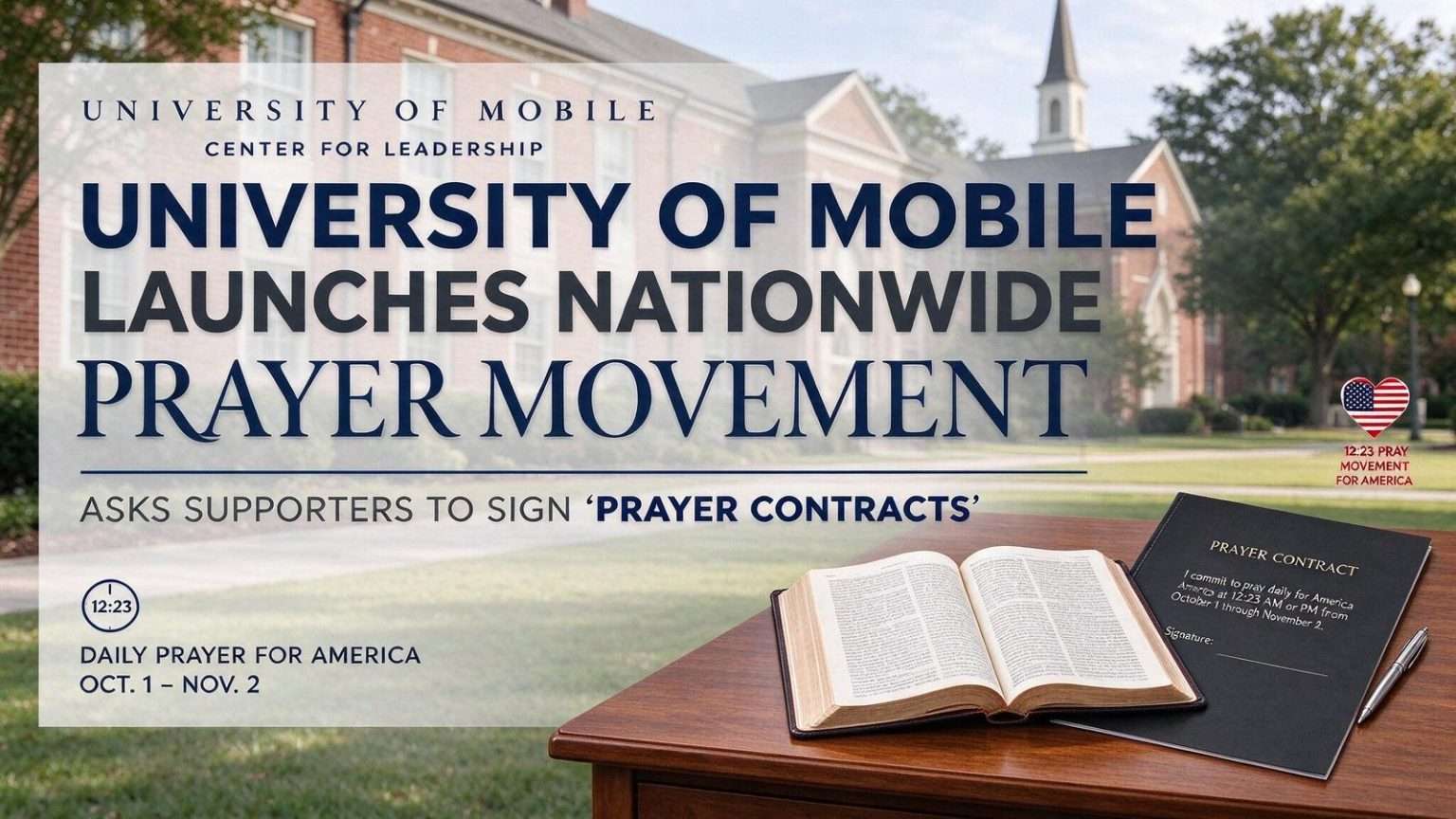
That idea has become the University of Mobile Center for Leadership’s first major initiative, called the “twelve23 Pray Movement for America.” The campaign asks people across the country to pause and pray for the nation each day at 12:23, either morning or evening, over a roughly five-week stretch running from Oct. 1 through Nov. 2.
The name is drawn directly from the daily time — 12:23 — chosen as the movement’s recurring anchor, a hour easily remembered and easily observed whether a participant is at a desk, in a classroom, on a job site or at home. The window spans the heart of the fall election season, ending the day after Election Day, a timing that gives the campaign a deliberate civic dimension.
Signing On to Pray
University organizers are not simply encouraging prayer — they are asking participants to formally commit to it. Supporters are invited to sign what Foley’s team is calling a prayer contract, a written pledge to make daily prayer for the country a consistent priority through the length of the campaign.
The contract approach borrows a page from accountability practices long used in spiritual disciplines and habit formation. A private intention, organizers note, is easy to let slide; a signed commitment turns a vague hope into a daily obligation. Participants who sign on are asked to treat the 12:23 pause as an appointment — brief, but non-negotiable — for the full five weeks.
“This is a rally cry for Christians and professionals,” Foley said, describing the effort as intended to reach beyond students and faculty to a broader national audience. The framing is significant: rather than addressing only the campus community, the movement explicitly courts working adults, church members and community leaders who have no formal tie to the university.
Foley said his personal hope is that the movement encourages the country to become, in his words, “a place that honors God.”
Why a University Would Lead a National Prayer Campaign
Asked why a university, rather than a church or denomination, would take the lead on an initiative like this, Foley pointed to what he sees as a gap. “Denominations aren’t doing it,” he said.
His argument reflects an observation common among religious leaders: as denominational structures have contracted and congregational attendance patterns have shifted, large coordinated spiritual campaigns have had fewer institutional sponsors. Universities like Mobile — small, mission-driven and nationally networked through their alumni — sit in a position to convene broad audiences without the organizational machinery a denomination requires.
The University of Mobile, affiliated with the Southern Baptist Convention, has built its identity around faith-integrated education on its West Mobile campus. Under Foley’s leadership, the school has emphasized Christian character alongside academics, and the Center for Leadership was created to extend that mission into professional and public life. The twelve23 campaign is that extension made explicit — an attempt to influence culture the same way the university tries to influence its graduates.
The timing also connects the campaign to civic life. Running Oct. 1 through Nov. 2, the daily prayer discipline brackets an election season, inviting participants to pray for the nation, its leaders and its future during the weeks when political attention peaks. Organizers stop short of framing the movement politically, describing it instead as a call for spiritual renewal that transcends party lines.
A New Direction for the Center for Leadership
The twelve23 campaign marks a new direction for the University of Mobile Center for Leadership, extending the private Christian university’s reach beyond its West Mobile campus and into a nationwide call to prayer timed to the fall election season. For a university of its size, launching a national initiative is an ambitious bet on reach and networks rather than institutional scale.
The Center for Leadership has positioned the prayer movement as the first of what it hopes will be several initiatives engaging professionals and communities beyond campus. University leaders describe the center as a bridge between the school’s spiritual mission and the broader culture — a vehicle for ideas that a classroom alone cannot carry.
For participants, the ask is deliberately modest: five minutes a day, at 12:23, for five weeks, anchored by a signed commitment. Organizers argue that modest ask, multiplied across a national audience, is precisely the point — a culture shift built not on a single event but on a repeated, shared discipline observed simultaneously by people across the country.
Whether the movement takes hold beyond the university’s own community will depend on the networks that carry it — churches, professional groups, alumni and families who sign the prayer contract and keep the daily appointment. For Foley, the campaign represents the answer to his year-long question: the goals of his first dozen years accomplished, and a new, larger mission now underway.
The campaign’s daily discipline model draws on a long tradition in American religious life. From noon-day prayer meetings of past generations to modern digital prayer chains, the idea of a fixed, shared time for collective prayer has repeatedly proven its staying power. What distinguishes twelve23 is its simplicity: no venue, no program, no registration fee — just a clock, a calendar and a willingness to stop and pray.
Organizers say the 12:23 choice also gives participants a conversation starter. A set time mentioned by name invites questions from coworkers and friends, turning each daily pause into a low-pressure opportunity to explain the movement — word-of-mouth spreading that no advertising budget could replicate. Supporters are encouraged to share the campaign with their churches, workplaces and social circles, multiplying signatories through personal networks.
The Prayer Contract Concept
The prayer contract at the center of the campaign deserves particular attention, because it reflects Foley’s belief that commitment changes behavior. Participants sign a written pledge agreeing to pray daily at 12:23 through Oct. 1 to Nov. 2. The contract language, organizers say, is intentionally framed as a personal covenant rather than a fundraising or membership commitment — there is no cost to participate and no obligation beyond the five-week window.
Accountability structures like this are common in other domains: fitness challenges, reading plans and stewardship campaigns all use written commitment to convert intention into action. University organizers adapted the practice to spiritual discipline, arguing that a signed pledge — even one made privately — measurably increases follow-through.
The contract also gives the movement a concrete artifact to distribute. Rather than asking people to “keep the campaign in mind,” organizers hand them something to sign, keep and revisit. For a campaign with no central gathering place, the contract becomes the campaign’s tangible presence in a participant’s daily routine.
For the University of Mobile, the mechanics matter less than the outcome the movement seeks. Foley has described his hope in national terms — a country that honors God — and the campaign’s five-week arc is presented as a starting point rather than a conclusion. If the daily habit takes root in enough households, organizers say, the election-season window may simply become the first chapter of a longer practice.
The University Behind the Movement
The University of Mobile sits on a wooded campus in West Mobile, a private institution that has grown over decades into one of southwest Alabama’s most visible Christian colleges. Its Southern Baptist affiliation shapes campus life in ways residents of the region will recognize: chapel gatherings, faith-integrated coursework and an explicit mission to prepare students academically and spiritually.
Foley’s 12-year tenure has coincided with the university’s effort to define itself nationally as well as locally. The school draws students from across Alabama and beyond, and its graduate and professional programs reach working adults who never set foot on the residential campus. That distributed audience is exactly the audience the twelve23 campaign addresses — people who know the university’s name but experience it from a distance.
The Center for Leadership, the campaign’s sponsor, was founded on the premise that leadership formation is inseparable from character formation. Its programs bring together students, professionals and community leaders around questions of ethics, service and conviction. The prayer movement is its most public initiative to date, and its first attempt to engage an audience measured in states rather than zip codes.
What Comes Next
As the Oct. 1 start date approaches, the university is asking supporters to sign the prayer contract and spread the word through their congregations, workplaces and families. The campaign’s structure — daily, individual, nationwide — means its success will be difficult to measure in conventional terms. There are no attendance counts or venue capacities to report, only the number of signed contracts and the stories participants choose to share.
Organizers appear comfortable with that ambiguity. The movement’s measure, they suggest, is not metrics but formation: whether thousands of Americans adopt a five-week habit of praying for their country at 12:23 each morning or evening, and whether the habit outlasts the calendar window that inspired it.
For Mobile, the campaign is also a moment of visibility. A university president who spent a year taking stock of his tenure has chosen to spend the next chapter on a national spiritual initiative — an ambition that, like the university itself, starts on a West Mobile campus and reaches far past the city limits. Whether the movement endures beyond Nov. 2, participants and observers will judge in time.