University of South Alabama Mobile
USA could lose $2 million if pandemic cuts Hancock Whitney Stadium capacity
The University of South Alabama faced a roughly $2 million revenue loss if the pandemic forced Hancock Whitney Stadium capacity down to 25 percent.
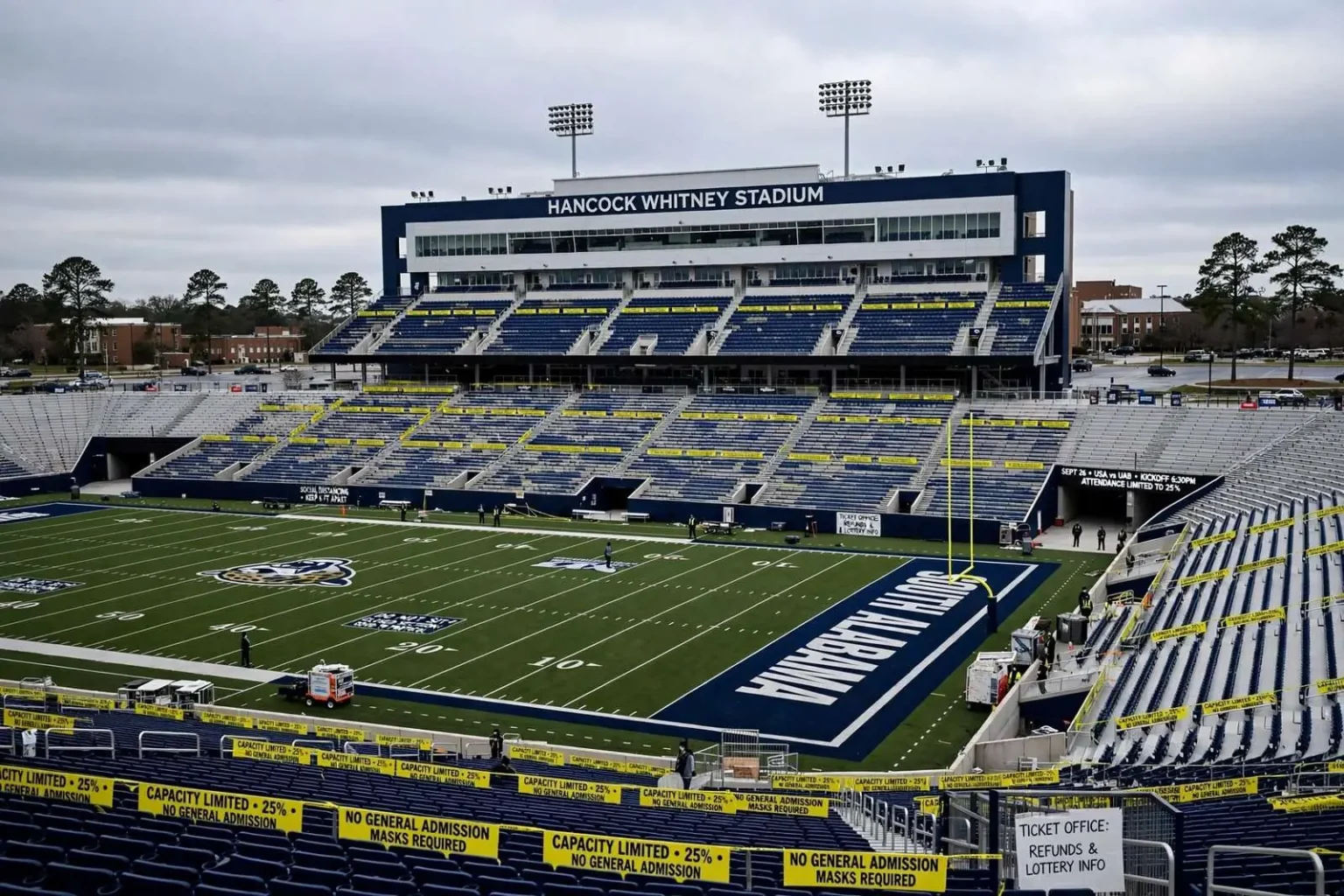
The University of South Alabama was bracing for a steep financial hit as the pandemic forced the school to weigh slashing attendance at its new on-campus stadium. Hancock Whitney Stadium can hold more than 25,000 fans, but USA expected fewer than 10,000 to be allowed inside for football games that fall as coronavirus cases surged across Alabama and the Gulf Coast.
Athletic Director Joel Erdmann said the university could lose around $2 million in revenue this season. “The ticket revenue, the walk-up sales revenue, and the parking revenue really starts to decrease,” Erdmann said.
The shortfall landed in the worst possible year for it. The 2020 season was to be the debut for Hancock Whitney Stadium, the on-campus facility that replaced Ladd-Peebles Stadium as the Jaguars’ home and represented years of fundraising and planning. A stadium opens with its fullest capacity and its most generous donors in place; a pandemic fall emptied the seats at the precise moment the program had counted on filling them.
USA’s football team was set to break in its new turf on Sept. 26 against UAB. The matchup — a Sun Belt program against a nationally ranked Conference USA rival from Birmingham — was the marquee date on the home schedule, the game built for the largest crowd the new stadium would ever have held. Instead, it became the emblem of what the pandemic was taking away.
The university considered cutting capacity to as low as 25 percent, a figure that would put only a fraction of the seating bowl on sale and relegate thousands of season-ticket holders to a lottery for the right to attend.
The Games That Would Have Sold Out
Some of South’s biggest games were canceled or limited in attendance. “The game against Grambling would have been a sellout. The game against UAB would have been a sellout. The same against Troy would have been a sellout,” Erdmann said.
Each of those matchups drew its charge from different quarters. Grambling State, one of the storied programs of historically black college football, would have brought thousands of traveling fans and the pageantry that accompanies HBCU game days. UAB, the Blazers from Birmingham, supplied the in-state rivalry edge that fills seats on both sides of the stadium. Troy, the Sun Belt rival an hour and a half up the road, is the game Mobile-area fans circle first — the nearest thing USA has to a rivalry date with something more than standings at stake.
Losing sellouts at the rate of one per game is how an athletic department arrives at a $2 million projection. College athletics budgets are built on the assumption that a stadium’s capacity converts to ticket, parking and concession revenue, and no line item absorbs a 60 percent attendance cut without pain. For USA’s program, still building its football fan base in the Sun Belt, the timing could hardly have been worse.
The Ripple Through the Neighborhood
Restaurants and hotels near the campus had counted on the new stadium to draw fans and tailgaters this fall. With big crowds unlikely, business owners were concerned. “It’s going to limit exposure. It’s going to limit pedestrian and vehicle traffic,” Erdmann said.
On-campus stadiums change the geography of a game day. Fans park in campus lots and surrounding neighborhoods, tailgate for hours, and spend before and after the game at the businesses within a mile or two of the gates. Mobile’s westernside corridors — the restaurants and hotels along Airport Boulevard and the streets near the campus — had positioned themselves for exactly that traffic, and the pandemic’s capacity limits cut the flow off at the source.
Erdmann looked past the season even while totaling its losses. “The end of that tunnel, we will get to the other side of this. When we do get to the other side of this, then the capabilities of Hancock Whitney Stadium will be on full display to everyone,” he said.
A Stadium a Decade in the Making
The new facility represented the culmination of a long-standing goal for the university: football played on campus. Since the program’s launch in 2009 under head coach Joey Jones, the Jaguars had played at Ladd-Peebles Stadium, the aging municipal venue miles from campus in midtown Mobile. Games there required fans to leave the university’s orbit — no easy walk from the residence halls, no tailgating on the quad, no campus bookstore on the way to the gate.
Hancock Whitney Stadium changed that equation. Built on the university’s campus with naming support from the Gulf Coast-based bank, the roughly 25,000-seat venue placed football at the center of campus life. Students could walk to games. Alumni traveling for a weekend could stay near the stadium rather than across the city. The facility’s opening was scheduled to coincide with the program’s most anticipated home slate in years — a schedule that in a normal fall would have featured the sellouts Erdmann described.
The Sept. 26 opener against UAB was chosen for the spotlight for good reason. The Blazers, revived after their program was briefly discontinued in 2014, had climbed into the national rankings and brought the kind of visiting following that guarantees a charged atmosphere. A pandemic-limited crowd, with attendance possibly held to a quarter of capacity, would transform the occasion from the loudest day in program history into something closer to a television studio taping.
How College Football’s Pandemic Fall Unfolded
USA’s planning reflected the uncertainty that gripped every athletic department in the country that summer. Conferences postponed and rescheduled their calendars week to week; protocols on testing, masks and stadium capacity shifted by the day. Capacity limits of 25 percent or fewer were the commonest approach in the Southeast, guided by state health orders and campus policies, and they imposed a cruel arithmetic on athletic departments whose revenue depends on butts in seats.
For a Group of Five program like South Alabama, the losses hit differently than they do in the SEC. Bigger programs cushion attendance shortfalls with media-rights distributions that dwarf ticket revenue; Group of Five budgets lean heavily on tickets, parking and local sponsorship. A $2 million hit at USA’s scale is the kind of figure that forces spending reviews across every sport the department operates.
The cancellation or limitation of the season’s most attractive games compounded the problem in a subtler way. Sellout games are also recruiting showcases — the days when recruits visit campus and see the program at full volume. A debut season without crowds weakened the recruiting pitch just as the program sought to establish itself in its new home.
What Comes After the Tunnel
Erdmann’s closing image — the capabilities of Hancock Whitney Stadium on full display once the pandemic passes — was more than consolation. The stadium’s long-term case rests on exactly what the 2020 fall could not demonstrate: a packed bowl, a tailgating culture on campus, and the recurring weekend traffic that transforms an athletic venue into an economic engine for its neighborhood.
When full crowds returned, the stadium would deliver what its planners promised: a game-day experience anchored to the campus rather than a municipal facility across town, with every sellout’s revenue flowing to the university and the surrounding businesses. The 2020 season’s losses were real — about $2 million by the athletic director’s estimate, two canceled sellouts, a debut muted by empty seats. But the asset itself remained, waiting.
For Mobile, the moment was a pause rather than a verdict. The stadium’s capabilities, as Erdmann put it, would be on full display in due time — for now, the university, its neighborhood businesses and its fans waited out a season measured in percentages of seats instead of scores.
The Money Behind a Season
College athletic budgets reveal their structure most clearly in a crisis. Ticket sales, walk-up purchases and parking are the three revenue lines Erdmann singled out, and each scales directly with attendance. When capacity drops from 25,000 to under 10,000, all three fall together — there is no partial adjustment. Concessions fall with them, as do the per-game payouts from premium seating and the merchandise sold at the gates.
The $2 million projection covered a single season, but its effects reach further. Athletic departments typically balance their books across a fiscal year, and a hole in the football budget has to be closed from reserves, cuts, or fundraising — none of which improves when donors’ businesses are weathering the same pandemic. Universities across the Sun Belt faced the same math in the summer of 2020, and several responded by trimming sports or borrowing against future years. USA’s leadership was working to avoid that outcome even as the season’s revenue picture worsened.
The stadium’s financing made the stakes sharper. On-campus venues are typically funded through a blend of donor campaigns, bond issues and athletic revenue streams, and early years of operation are when the projections have to prove themselves. A debut season at 25 percent capacity was the opposite of the proof point the fundraising case required.
Game Days as Local Economy
The commercial stakes around the stadium are easy to underestimate. A home game at a 25,000-seat venue means tens of thousands of people converging on a defined area for four to six hours — parking attendants, tailgaters buying ice and charcoal, families eating before kickoff, travelers booking hotel rooms for the weekend. Studies of college towns routinely attribute millions in seasonal economic activity to home games, and Mobile had only begun to capture that activity with the stadium’s opening.
When attendance falls to a quarter of capacity, three-quarters of that activity disappears. A restaurant that staffed for game-day Saturdays faces an ordinary Saturday instead. Hotels that priced for football weekends hold their inventory. Erdmann’s phrase — limiting exposure, limiting pedestrian and vehicle traffic — described the problem from the university’s seat: the stadium was designed as a generator of movement and spending, and the pandemic switched it off for its inaugural season.
The hope embedded in the athletic director’s comments was that the disruption was a one-year cost against a decades-long asset. Stadiums outlast their opening crises; the question for USA was whether the program could hold its audience through a season of limited seats and limited spectacles, and whether the sellout games lost to the pandemic could be rescheduled once crowds returned.
Waiting for Full Capacity
By late summer 2020, the university’s contingency planning had settled into a familiar pattern for the era: proceed with the season in modified form, limit attendance to whatever health conditions allowed, and communicate constantly with ticket holders whose seats were suddenly scarce. Season-ticket holders who had paid full price for the stadium’s first year faced partial access, and the athletic department’s service staff absorbed the burden of managing expectations, refunds and seat reassignments.
The Sept. 26 date against UAB still stood as the opener on the new turf, but the occasion carried the ambiguity of everything in that fall — a game that might be moved, played before a fraction of its audience, or reshaped entirely by the week’s protocols. What was certain was the financial shape of the season: fewer tickets, less parking, fewer walk-up sales, and roughly $2 million the program had planned on and would not collect.
South Alabama’s experience in 2020 became part of the stadium’s story rather than its ending. The debut season’s empty seats made the first full crowd, whenever it came, a delayed celebration — the moment when the capabilities of Hancock Whitney Stadium, in Erdmann’s words, would finally be on full display to everyone.