University of South Alabama Spanish Fort
USA Graduate Ari Theodore Tours the Country Bringing Theater to Small-Town Schools
University of South Alabama graduate Ari Theodore tours the country with Missoula Children's Theatre, guiding K-12 students through a full stage production in just five days.
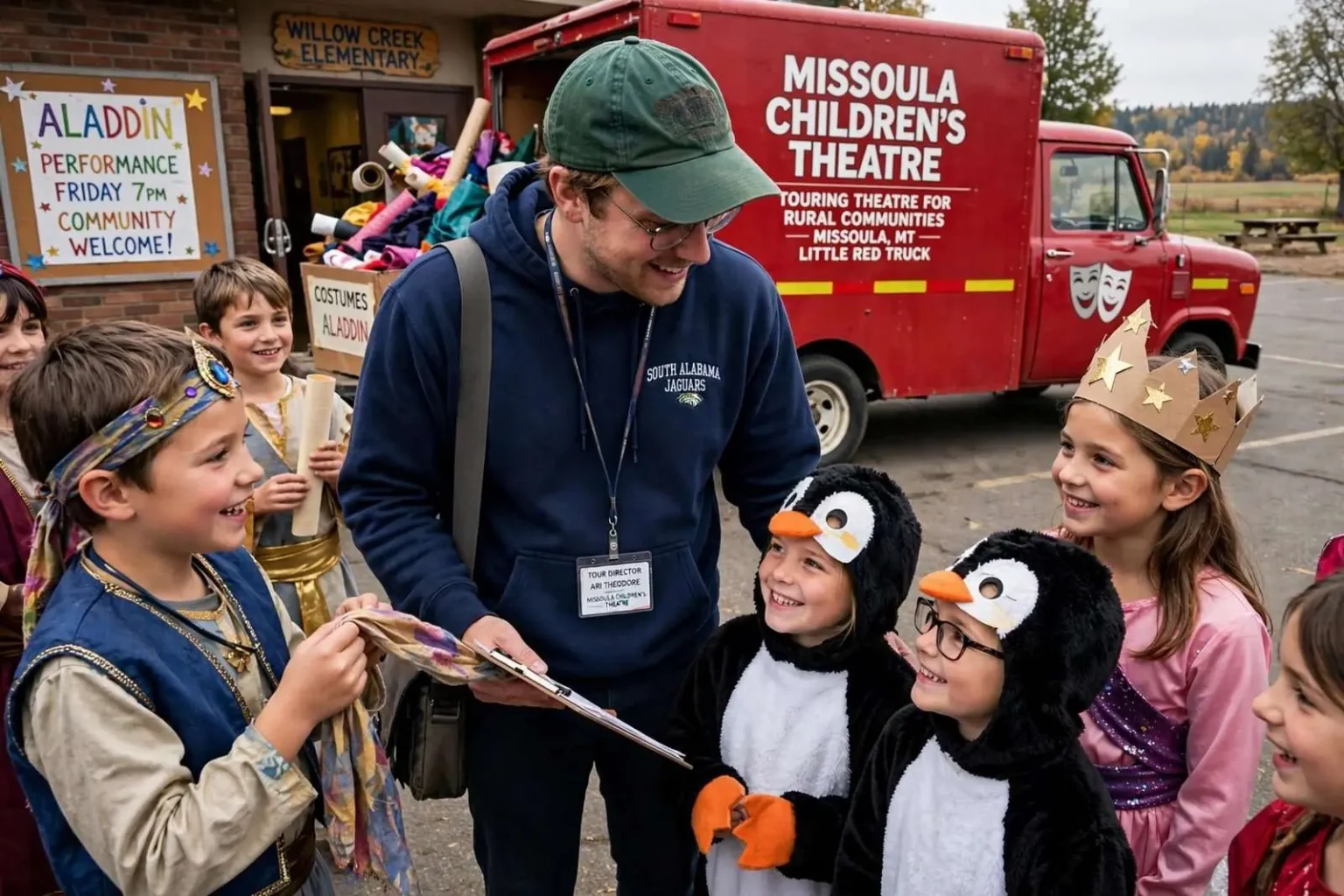
One week he is directing a cast of students in South Dakota. The next, he is hundreds of miles away doing it all again in another small town. For University of South Alabama graduate Ari Theodore, that whirlwind pace is the job. Theodore, who majored in English and drama at South, now spends his workweeks crisscrossing the country in one of Missoula Children’s Theatre’s iconic Little Red Trucks, guiding K-12 students through the entire process of putting on a play, from auditions to opening night, introducing many of them to the stage for the first time.
The Little Red Trucks have become a fixture of American small-town life, rolling into communities from the Gulf Coast to the northern plains with a portable set, costumes and two touring actor-directors in the cab. Missoula Children’s Theatre, based in Missoula, Montana, has run the touring program for decades, and each truck functions as a self-contained theater company. For the towns on the schedule, a week with the red truck may be the only professional theater presence the community sees all year.
A full production in just five days
The schedule follows the same fast-moving rhythm nearly every week. “We drive in on Sunday, hold auditions on Monday and start rehearsals that same day,” Theodore said. “By Friday or Saturday, they’re performing a full show.”
In that span, Theodore and his partner cast students across all grade levels, teach them their roles, run rehearsals, help with costumes and assemble a portable set that travels with them in the truck. The two also perform in the show themselves, alongside the young cast, alternating each week between an onstage role and backstage responsibilities. The alternating arrangement means one tour partner is always anchoring the performance while the other handles the dozens of small crises that a cast of schoolchildren can generate backstage, from a missing costume piece to a case of pre-show nerves.
The production Theodore is currently leading is “Aladdin” — not the Disney film, but Missoula Children’s Theatre’s own original adaptation of the classic story. The company writes its own scripts and music for the tour productions, adapting well-known tales into hour-long shows sized for young casts and community audiences. Original adaptations let the company control casting sizes and comic beats, and they mean the students are performing material their audiences have not already memorized from a screen.
The five-day turnaround is demanding for the visiting directors, but it is also the design. A compressed schedule keeps the momentum high for students, who arrive at Monday auditions as strangers to the process and by week’s end are performing for parents and neighbors in full costume. Communities that host the tours handle the local logistics, from audition space to a performance venue, and everything else arrives in the truck.
Where education meets the stage
For Theodore, the appeal of the job lies at the intersection of his two biggest interests: theater and teaching. He eventually plans to pursue a graduate degree in English with the goal of becoming a college professor. Leading a cast of children through a folk tale each week may not be a direct route to a faculty position, but he has found meaningful overlap between the two pursuits.
“I believe this job is, first and foremost, education,” he said. “I get to work with children five or six days a week while still doing something I really love.”
The educational framing is not incidental. Arts educators have long pointed to the particular skills that theater demands of young people: memorization, public speaking, cooperation, and the discipline of showing up on time and knowing one’s lines. In small towns where after-school options can be thin, a week of rehearsals also gives students a structured activity with a visible goal, and one that ends with applause rather than a grade.
Theodore learned about the opportunity at the Southeastern Theatre Conference Convention, an annual event that draws faculty and students from South and other universities for professional development, workshops and job fairs. SETC, as the conference is known, is one of the largest theater gatherings in the country, and it has become a standard hiring ground for touring companies, summer stock programs and academic theater jobs across the Southeast. For students at schools like South, it is often the first place a classroom skill meets an actual employer.
Landing the position required a competitive process that included both virtual and in-person auditions along with multiple interviews before he was offered the job. Touring companies screen carefully for candidates who can handle the dual demands of the work, since each tour partner must be at once a performer, a director, a teacher and a driver logging hundreds of highway miles between towns. The combination narrows the field quickly, which is why the interview process runs several rounds.
Bringing theater to communities that rarely see it
One of the most rewarding parts of the work, Theodore said, is watching students discover the joy of performing in towns where theater opportunities are scarce. “Missoula Children’s Theatre tries to go to communities that don’t have a large theater presence,” he said. “It gives kids who may never have done a show before, and may never do another one, the opportunity to perform.”
That reach is the touring model’s central promise. Many rural school districts across the plains and the mountain west have no drama program at all, and the nearest community theater may be hours away. When the truck arrives, dozens of children who have never set foot on a stage find themselves rehearsing with a professional director, and their week culminates in a ticketed performance before their own community.
A recent memory in South Dakota stands out. The youngest cast members in “Aladdin,” playing a group of penguins, stole the show with a featured song. After the performance, they rushed backstage to celebrate. “They were all giving each other high-fives and telling each other how awesome it was,” Theodore said. “It’s a very heartwarming job and a very rewarding one.”
Moments like that one are what tour directors tend to carry between towns. A single week is long enough for a cast of children to bond around a production, and the youngest performers often approach the material with a total commitment that older students have learned to temper. Directors who spend months on a single production rarely get to see that cycle repeat; touring directors watch it begin and end every seven days.
The job also builds a particular kind of professional versatility. In the course of an ordinary week, a tour director might teach a group of first graders a chorus, coach a high school senior through a comic monologue, repair a costume, troubleshoot a sound system and drive three hundred miles. Few entry-level positions in American theater ask as much of a young professional so quickly, which is why alumni of touring programs frequently move on to roles in education, arts administration and professional theater.
Roots at South
Theodore’s connection to theater at South runs deeper than his coursework. As part of his senior thesis, his original play “Finnegan’s Got a Secret” was staged at Laidlaw Performing Arts Center on campus. He hopes to keep writing plays throughout his career, even as he pursues a future in higher education. Staging an original script as a thesis project is a substantial commitment for an undergraduate, requiring not just the writing but the rehearsal process and production work that turn a manuscript into a performed show.
Laidlaw serves as the university’s main performance venue for music and theater, and a full staging there gives a student playwright the experience of hearing an audience respond to material no one has ever performed before. Playwrights often describe that first full production as the moment a script becomes real, since dialogue that reads well on the page can behave very differently when spoken aloud on a stage.
A native of Spanish Fort, Alabama, Theodore continued a family tradition by attending South — both of his brothers and his parents are also graduates of the University. Spanish Fort sits on the Eastern Shore of Mobile Bay, just across the bay from the university’s campus, making the choice a natural one for a local family with deep ties to the school. Families with that kind of multi-generational connection to a university are common along the Gulf Coast, where public universities serve as the default step between high school and career for students who want a strong program without leaving the region.
His father, Philip Theodore, spent years as a history instructor and served as director of the University’s Student Recreation Center. Growing up around a parent on the university’s staff gave the younger Theodore an early view of academic life, and his plan to pursue a graduate degree and a professorship follows a path he has watched from childhood. Faculty children who go on to academic careers often describe the classroom as a familiar place, and the tour job’s teaching component has already given him daily practice explaining things clearly to a demanding audience.
Looking back on his time at South, Theodore credits the faculty in both the English and drama departments with shaping his path forward. “They were all such amazingly talented people,” he said. “They had a huge influence on how I viewed both disciplines and helped me realize my passion for teaching.”
The double major he pursued reflects how the two departments reinforce one another for students who work across them. English study builds the analysis of text, character and language, while drama training applies those same instincts to bodies, stages and audiences. Students who move between the two, as Theodore did, often arrive at teaching as the natural synthesis — a career built on explaining both what a text means and how to bring it to life.
What the touring life teaches
The touring schedule also offers a view of the country that few jobs provide. Little Red Truck tours fan out across dozens of states each season, and the two-person teams become temporary residents of a new community every week. They learn which schools have active parent networks, which towns rally around a performance and which gymnasium acoustics will fight the actors all night. That accumulating local knowledge is part of what the company’s longtime hosts value, and part of what makes the position attractive to young theater professionals deciding where their careers should lead.
For the students he directs, the week is frequently their first experience of the full arc of a production. Children who audition on Monday nervous about singing a single line are, by Friday, waiting in the wings for an entrance cue they know cold. Watching that transformation repeat in town after town has reinforced for Theodore the conviction that the work is educational at its core, whatever the venue looks like.
The route from a thesis production at Laidlaw to a tour truck in South Dakota is not a standard one, but it is a logical extension of the same interests. Theodore’s plan to continue toward graduate study and a professorship remains in place, and the tour year figures to strengthen it. Graduate programs in English value teaching experience, and few applicants arrive with two semesters of daily practice directing an unscripted classroom of sixty children.
For now, the truck keeps moving. Each Sunday brings a new town, each Monday a new set of audition nerves in a school cafeteria, and each Friday or Saturday a fresh cast taking its bows in front of families who have never seen their children on a stage. It is, as Theodore describes it, a very heartwarming job and a very rewarding one — and for a young artist and teacher from the Eastern Shore, it is also a year of professional education no classroom could quite replicate.