
Veteran Job Fair in Mobile to Feature More Than 80 Employers This Week
A veteran job fair in Mobile will feature more than 80 employers from maritime, hospitality, and retail industries.
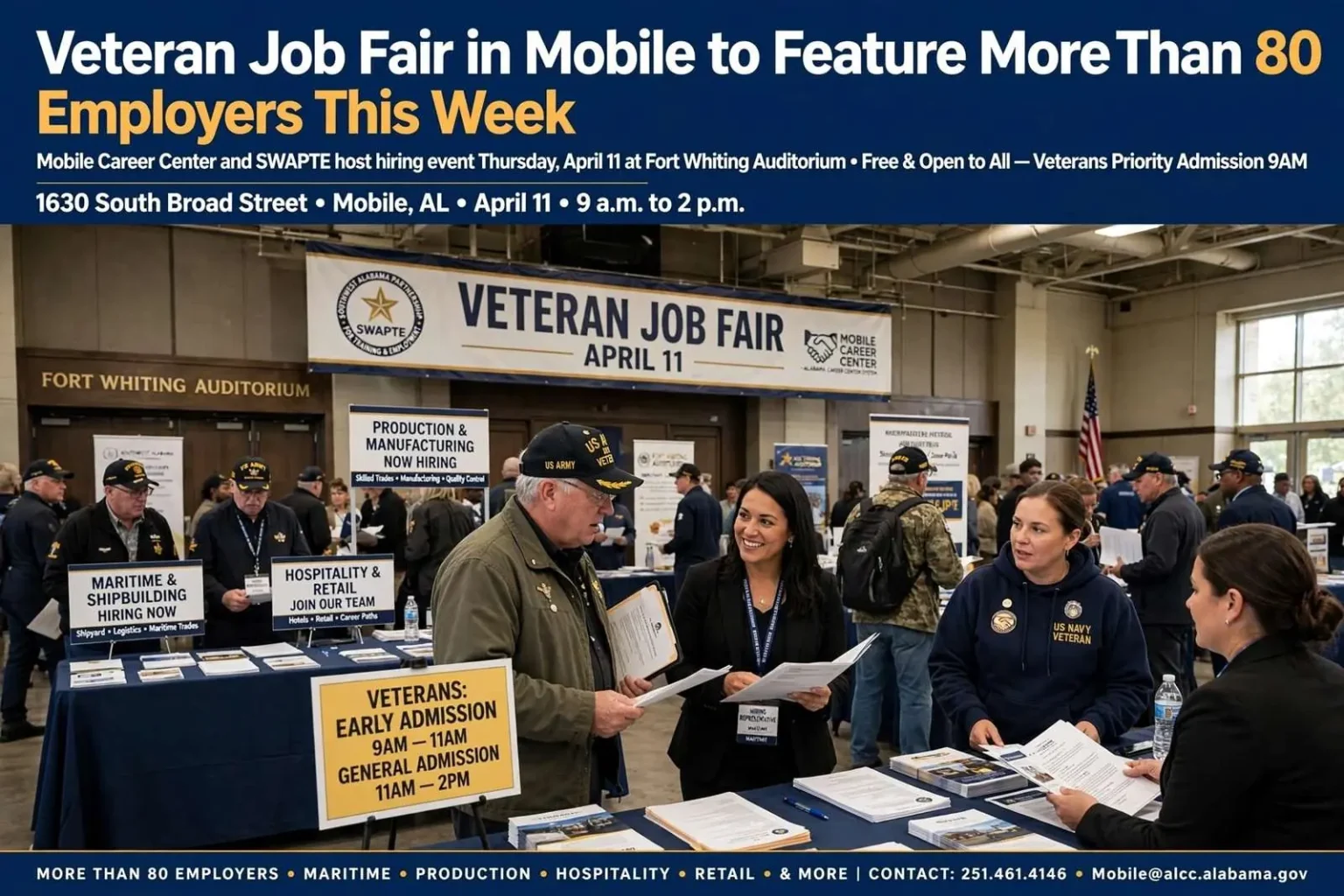
A Veteran Job Fair scheduled for Thursday in Mobile will connect military veterans with more than 80 employers across a range of industries, giving South Alabama’s veteran community a concentrated opportunity to meet hiring managers face to face. The event, hosted by the Mobile Career Center and the Southwest Alabama Partnership for Training and Employment (SWAPTE), will take place Thursday, April 11 from 9 a.m. to 2 p.m. at Fort Whiting Auditorium, located at 1630 South Broad Street in Mobile.
Employers representing maritime, production, hospitality, and retail industries, among others, will be on hand to meet with job seekers. The mix reflects the breadth of the Gulf Coast’s hiring economy — from the shipbuilding and maritime businesses that anchor Mobile’s waterfront to the production facilities, hotels, and retailers that employ thousands across the metro area. The fair is free and open to all jobseekers, with veterans receiving priority service.
“We are proud to host this event for the men and women who serve our country through the military,” said Mobile Career Center Manager Derrick Turner. “I’d encourage anyone who is looking for a job to come out.”
Veterans will receive early admission at 9 a.m., with general admission opening at 11 a.m. The two-hour head start gives former service members first access to every booth before the crowd arrives, an intentional design that treats priority service as something more than a slogan. For more information, job seekers can contact the Mobile Career Center at 251.461.4146 or by email at [email protected].
More than 80 doors open at once
The scale of the event is its central advantage for job seekers. An individual job search — application, wait, interview, wait — can stretch for months with no face-to-face contact, while a single afternoon at a fair with more than 80 employers compresses that process into dozens of conversations. Attendees can speak directly with hiring representatives, learn which companies are actively filling roles, and make the kind of in-person impression that a submitted resume rarely achieves.
The industry spread matters as much as the headcount. Maritime and production employers bring the skilled-trades and manufacturing opportunities that have long powered Mobile’s economy, from the riverfront industries to the growing industrial corridors around the port. Hospitality and retail employers, meanwhile, offer entry points, management tracks, and the flexible schedules that suit workers transitioning out of service. “Among others” in the lineup suggests the range extends beyond those four pillars, giving attendees from virtually any background a reason to walk the floor.
For employers, the fair concentrates a workforce segment known for discipline, reliability, and training that translates. Veterans arrive with years of hands-on experience — logistics, equipment operation, leadership, maintenance, administration — and hiring managers across the Gulf Coast have repeatedly found that military backgrounds map onto the region’s industrial and service economy more directly than most civilian resumes do.
Fort Whiting: a fitting venue
Fort Whiting Auditorium on South Broad Street is one of Mobile’s most recognizable event spaces, a large facility with the floor capacity to accommodate dozens of employer booths and the steady foot traffic of a full-day fair. Its location on Broad Street places it within easy reach of downtown and the neighborhoods of central Mobile, and its history as a gathering place for civic events makes it a natural host for an audience that includes the region’s veteran community.
The 9 a.m. to 2 p.m. window is designed for accessibility as well. Working job seekers can attend before or after a shift, and the five-hour span prevents the crush of a single-hour event. Veterans — who enter two hours early — can make their rounds at a measured pace, return to booths of particular interest, and still be finished before the general crowd peaks at midday.
Hosts Mobile Career Center and SWAPTE bring institutional backing to the event. The Mobile Career Center is part of Alabama’s network of career centers, offering resume assistance, training referrals, and employment services to job seekers statewide. SWAPTE, the Southwest Alabama Partnership for Training and Employment, administers workforce development programs across the region, connecting federal, state, and local resources with the employers and workers who need them. Together, the two organizations have the reach to recruit a broad employer base and the mission to justify a veterans-first format.
Why veterans get priority
The early-admission structure for veterans reflects both policy and practicality. Federal workforce development law has long directed priority of service to veterans and eligible spouses, recognizing that men and women coming out of military service often need to translate skills, re-establish civilian work histories, and in some cases recover from service-connected challenges while re-entering the job market. Events like the April 11 fair put that priority into practice in its most direct form: two hours of the hiring floor reserved for them first.
The timing also serves the employers. Veteran candidates tend to arrive prepared — documentation in hand, work histories organized, questions about training and advancement ready — and hiring managers meeting them first thing in the morning begin the day with the strongest candidate pool at their freshest. The 11 a.m. general admission then keeps the booths busy through the early afternoon, ensuring no employer runs out of prospects before the fair closes at 2 p.m.
Turner’s framing of the event — pride in hosting it for those who served, and an open invitation to anyone looking for work — captures the fair’s dual mission. It is a veterans’ event that is not exclusively for veterans, a distinction that matters in a region where military service is widespread across generations and where the line between the veteran community and the general workforce is a porous one. Spouses, family members, and other job seekers all benefit from the same 80-employer gathering.
How to make the most of the fair
Job seekers planning to attend can improve their odds with modest preparation. Resumes printed in multiple copies remain the currency of job fairs, even as most hiring has moved online; a representative can accept a paper resume and pass it along the same afternoon. Attendees benefit from a brief plan: identify which industries — maritime, production, hospitality, retail, or the others on the floor — fit their background, prioritize those booths early, and leave time to approach companies they had not considered.
Dress and demeanor matter as much as paper. Fair conversations are first interviews in miniature, and the candidates who convert booth visits into interviews are typically those who treat each one as such — a firm handshake, a clear summary of experience, and a specific question about open roles. Veterans can additionally frame their military experience in civilian terms: equipment maintenance becomes industrial maintenance, logistics becomes supply chain, squad leadership becomes crew supervision.
The follow-up matters too. Business cards collected at the fair should generate emails within a day or two, referencing the conversation and restating interest. The Mobile Career Center’s contact information — 251.461.4146 and [email protected] — is available for those who need help before or after the event, and the center’s staff can assist with resumes, interview preparation, and connections to training programs beyond what a single fair can offer.
The region’s veteran workforce
Mobile and the broader Gulf Coast hold one of the South’s deeper concentrations of veterans, a product of the region’s military installations, its shipbuilding and maritime industries, and the long pipeline of service members who settled here after separating from active duty. That population represents both a community to support and a workforce asset the region’s employers have learned to value — particularly in the industrial and skilled-trades sectors where military training transfers most directly.
Events like the April 11 fair knit that community into the hiring economy at scale. More than 80 employers in one room, five hours of access, and a veterans-first schedule amount to a serious institutional commitment from the Mobile Career Center and SWAPTE — the kind of commitment that turns job fairs from networking events into genuine hiring pipelines.
For the men and women Turner described — those who served the country through the military — the fair offers a straightforward opportunity: walk into Fort Whiting at 9 a.m. on Thursday, April 11, and spend the morning talking with every employer in the region that is hiring. For the general public arriving at 11, the same room remains open until 2 p.m. Either way, the door at 1630 South Broad Street is the easiest first step a Mobile job seeker can take this week.
Employers and the math of a hiring floor
The employer roster tells its own story about where the region’s jobs are. Maritime employers along Mobile Bay and the river system compete continuously for licensed mariners, shipyard trades, and logistics staff, and their presence at a veterans’ fair is no accident — the discipline and technical training of former service members map cleanly onto deck crews, engine rooms, and port operations. Production employers, from manufacturing lines to fabrication shops, recruit from the same pool, valuing the equipment experience and safety culture that military service instills.
Hospitality and retail employers round out the floor with a different proposition: immediate openings, flexible scheduling, and management ladders open to anyone willing to work them. For veterans whose service did not translate directly into a trade credential, those industries offer the fastest route back into steady employment, and the fair’s format lets candidates gauge that quickly by walking from booth to booth.
The aggregate effect is efficiency on both sides of the table. Employers screening candidates in person for five hours accomplish what weeks of online posting cannot, and job seekers gather in one afternoon the intelligence — which companies are growing, which roles pay what, which require training — that a months-long search would otherwise yield slowly. Fairs of this size function as market clearinghouses, and Mobile’s scale of more than 80 employers puts this one among the larger such events the area hosts.
The career center behind the event
The Mobile Career Center’s role extends well beyond a single Thursday. As part of the Alabama Career Center System, the center connects job seekers with unemployment services, resume development, job matching, and referrals to training and education programs, all at no cost to the job seeker. Its staff works daily with both sides of the hiring equation — the employers posting openings and the workers seeking them — which is what makes a 80-employer fair logistically possible.
SWAPTE adds the regional workforce-development layer. As the Southwest Alabama Partnership for Training and Employment, it administers workforce funding and programs across multiple counties, targeting training dollars at the industries where regional employers actually hire. The partnership’s involvement signals that the fair is not a standalone event but a node in an ongoing system: candidates who meet an employer at Fort Whiting and need a certification or a training program to close the gap have a referral path waiting for them afterward.
That pipeline is particularly valuable for veterans, whose transitions often involve exactly such gaps — a military occupational specialty that maps to a civilian career only after a course, a license, or a credential is obtained. The combination of a hiring fair and a workforce system under the same organizational roof means the April 11 event can function as both a job market and a planning session in the same visit.
Thursday at Fort Whiting
The practical details remain the story’s simplest summary: Thursday, April 11, 9 a.m. to 2 p.m., Fort Whiting Auditorium, 1630 South Broad Street, free and open to all jobseekers, veterans first at 9 a.m. and general admission at 11 a.m. More than 80 employers will be waiting, drawn from maritime, production, hospitality, retail, and industries beyond them, with hiring representatives empowered to talk about open roles on the spot.
“We are proud to host this event for the men and women who serve our country through the military,” Turner said, extending the invitation to anyone looking for a job.
Job seekers with questions before the doors open can call the Mobile Career Center at 251.461.4146 or email [email protected]. Those who come prepared — resumes in hand, industries targeted, morning free — will find more than 80 employers in one room and the region’s workforce system standing behind them.