Walnut Hill couple charged with child abuse after infant airlifted with serious injuries
A Walnut Hill, Florida couple faces aggravated child abuse charges after their infant was airlifted to a hospital with broken bones and head trauma.
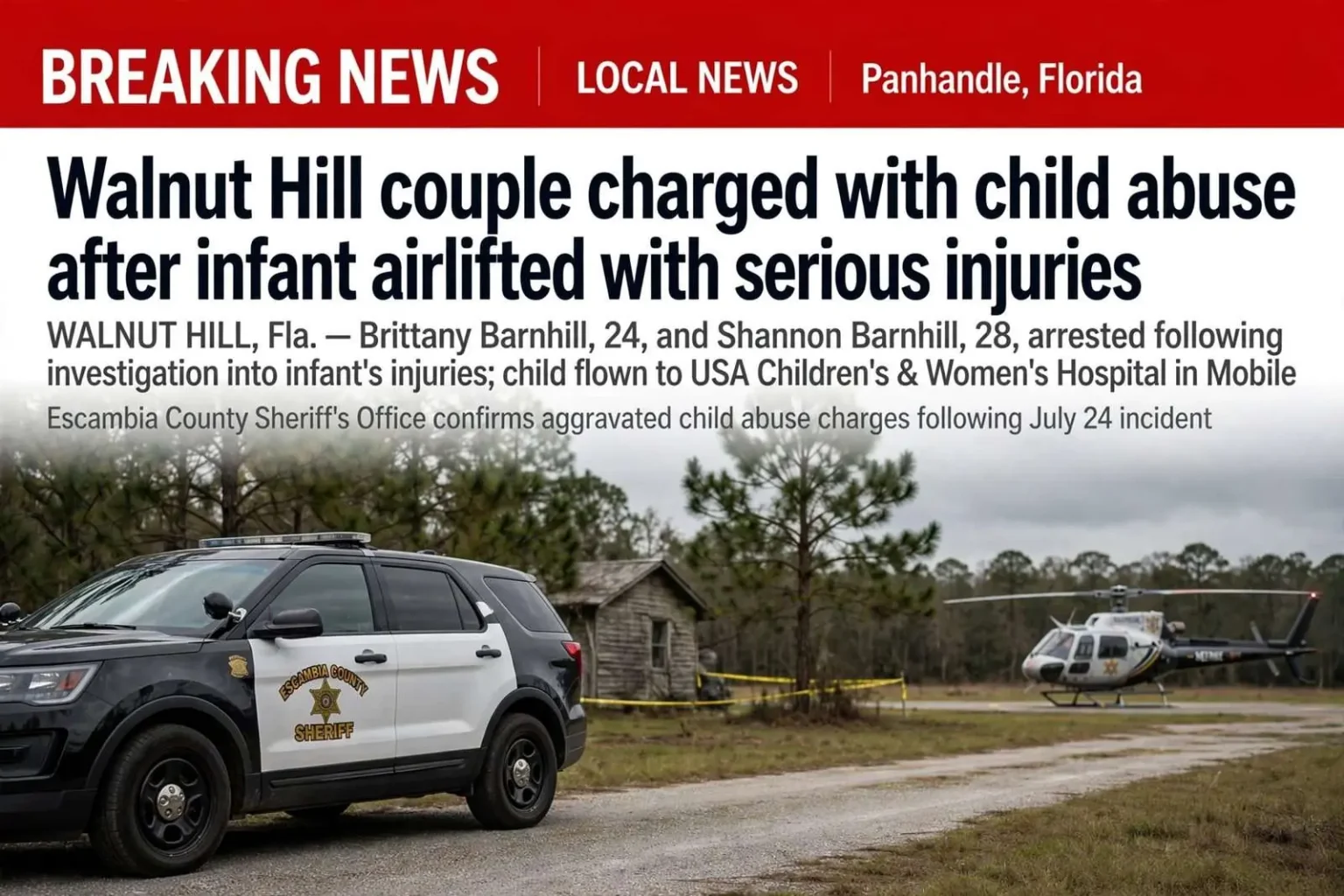
WALNUT HILL, Fla. — A Walnut Hill couple has been arrested on aggravated child abuse charges after their infant was airlifted to a hospital with multiple broken bones and head trauma, according to the Escambia County Sheriff’s Office.
Brittany Barnhill, 24, and Shannon Barnhill, 28, were taken into custody following an investigation that began when the infant was flown by helicopter to the University of South Alabama Children’s and Women’s Hospital in Mobile for emergency treatment. The charges, as with all criminal accusations, remain allegations until proven in court.
How the case came to light
The Florida Department of Children and Families opened an investigation on July 24 after an infant with head trauma was flown by helicopter to the University of South Alabama Children’s and Women’s Hospital. The hospital, which sits in Mobile just across the state line, is the major pediatric referral center for the central Gulf Coast, and its trauma capabilities make it the destination for critically injured children from rural Escambia County communities like Walnut Hill — a trip measured in minutes by air but far longer by road for an ambulance carrying a child in critical condition.
When medical staff at a trauma center identify injuries they assess as non-accidental, state child-protection agencies and local law enforcement are notified, and the investigation moves on two tracks: the criminal inquiry led by the sheriff’s office, and the child-welfare inquiry led by DCF, which determines custody and safety arrangements for the child and any siblings.
The injuries
The child was found to have a skull fracture, bleeding on the brain, a fractured collarbone and broken ribs, legs and arms, deputies said. The number and spread of the injuries — fractures at multiple sites in different stages combined with acute head trauma — formed the medical basis of the case, and investigators said the pattern was consistent with shaken baby syndrome.
Shaken baby syndrome, known in clinical settings as abusive head trauma, results from the violent shaking or impact of an infant, whose weak neck muscles and proportionally large, heavy head cannot protect the brain from the forces involved. The resulting injuries — retinal hemorrhages, subdural bleeding and the characteristic pattern of fractures — are the subject of extensive medical literature, and pediatric specialists at trauma centers like USA Children’s and Women’s are trained to recognize and document them.
The allegations against each parent
Investigators said the father, Shannon Barnhill, inflicted the injuries. Deputies said Brittany Barnhill gave explanations that did not account for the child’s current and prior injuries and failed to protect the infant from the abuse. Under Florida law, a caregiver who fails to protect a child from harm can face the same felony charge as the person who inflicted it, which is why both parents were taken into custody on aggravated child abuse charges.
The aggravated child abuse statute covers willful torture, malicious punishment, caging, or the willful and unlawful causing of great bodily harm, and it is one of the most serious charges in Florida’s criminal code short of homicide. Convictions can carry decades in prison, which is why cases of this kind are prosecuted by the state attorney’s office with the full medical record, investigator interviews and child-welfare findings assembled before trial.
The two investigations
Every serious child-abuse case runs in parallel through two systems. The criminal case, pursued by the sheriff’s office and the state attorney, seeks accountability through arrest and prosecution. The dependency case, pursued by the Department of Children and Families, seeks protection: determining immediately where the child will be safe, whether relatives can care for the child, and what services or court oversight are required. The two systems share information but reach separate decisions, and a family court dependency proceeding can move faster than the criminal case it accompanies.
In this case, the DCF investigation began the day the infant was flown to Mobile, and the sheriff’s investigation followed the medical findings. The weeks between the hospital notification and the arrests were spent assembling the record — medical imaging and physician assessments, interviews with family members and anyone with access to the child, and the DCF case history for the household.
The community and the response
Walnut Hill is a small rural community in the northern reaches of Escambia County, near the Alabama line and the communities of Century and Molino, where north-south roads connect the area to Pensacola to the south and Brewton and Atmore, Alabama, to the north. Cases of this kind land hard in small communities, where a family’s troubles are visible to neighbors and the questions — how the injuries went unnoticed, who saw what, when someone could have stepped in — linger after the arrests are made.
Child-protection agencies across the region use cases like this one to remind the public of the state’s mandatory and voluntary reporting channels. Florida’s abuse hotline takes calls around the clock, and medical professionals, teachers, caregivers and ordinary neighbors who suspect a child is being harmed can trigger the same investigative process that began this case on July 24.
Escambia County and the wider region
The case also illustrates the cross-border geography of Pensacola-area emergency medicine. Walnut Hill sits closer to the Alabama line than to downtown Pensacola, and for critically injured patients in the county’s northern reaches, the University of South Alabama Children’s and Women’s Hospital in Mobile can be the fastest appropriate destination. The helicopter transport that began this investigation is a routine feature of Gulf Coast trauma care, with flight services moving the most severely injured patients across county and state lines to the facility best equipped to treat them.
Escambia County’s courts handle the criminal side, while the dependency proceedings run through Florida’s family court system, and both will operate on their own schedules in the months ahead. For the record, the key dates established so far are the July 24 opening of the DCF investigation and the arrests that followed the completion of the investigative work.
The road ahead for the case
The Barnhills’ arrests mark the start, not the end, of the legal process. First-appearance hearings, arraignment, and the state attorney’s formal charging decisions come next, with bond determinations and, eventually, trial or plea proceedings. The aggravated child abuse charges each face are serious felonies, and the medical record — the skull fracture, the brain bleeding, the fractured collarbone and the broken ribs, legs and arms — will be the centerpiece of the prosecution’s evidence, presented through the pediatric specialists who documented it.
The infant, meanwhile, remains in the care of the child-welfare system, whose first responsibility is that no child returned to a dangerous household. The dependency court will decide custody arrangements as the criminal case moves forward.
Recognizing abusive head trauma
Medical experts note that abusive head trauma is the leading cause of serious injury and death in abused infants, and that the injuries often occur when a caregiver loses control under the pressure of inconsolable crying — one of the most common stressors in the first months of a baby’s life. Pediatric programs across the Gulf Coast, including the hospital that treated this child, run prevention education aimed at exactly that moment: teaching parents and caregivers that crying is normal, that placing a crying baby safely in a crib and stepping away is the correct response, and that shaking an infant even briefly can cause lifelong damage or death.
The fractured bones found on this infant are part of what makes such cases medically identifiable. Infants cannot fracture their own ribs, legs or arms, and radiologists can often estimate the age of healing fractures, which is how investigators distinguish current injuries from prior ones — the distinction that figured in the allegations against Brittany Barnhill, whose explanations, deputies said, did not account for either.
When the system works
For all the grim facts of the case, the sequence that produced the arrests shows the protection system operating as designed: hospital staff recognized the injuries as non-accidental, the state agency opened an investigation the same day, detectives assembled the medical and witness record, and charges followed against both the person accused of inflicting the abuse and the caregiver accused of failing to stop it. Every stage required someone to act on what they saw rather than look away.
Sheriff’s offices across the Florida Panhandle handle a persistent volume of child-abuse referrals, and the Escambia County Sheriff’s Office maintains dedicated investigators for crimes against children who work these cases jointly with DCF. The partnership between the medical, welfare and criminal systems is what converts a single hospital admission into an investigation, an arrest and, ultimately, a court case with the evidence to support it.
What the charges mean
The aggravated child abuse charges against Brittany Barnhill, 24, and Shannon Barnhill, 28, are formal accusations, and both are entitled to the presumption of innocence as their cases move through the Escambia County courts. The allegations themselves — an infant with a skull fracture, bleeding on the brain and multiple broken bones, injuries attributed by investigators to the father and unexplained by the mother — will now be tested in the forum built for that purpose.
The case stands as a hard local reminder of both the fragility of infants and the reach of the systems positioned to protect them. Anyone who suspects a child is being abused can contact Florida’s abuse hotline or local law enforcement; in this case, that first report from a hospital in Mobile is what set everything that followed in motion.