
Washington County Public Schools Closed Friday as Flu and Strep Drive Spike in Absences
Washington County Public Schools closed Friday due to a large number of flu and strep absences, with classes set to resume Wednesday after Mardi Gras break.
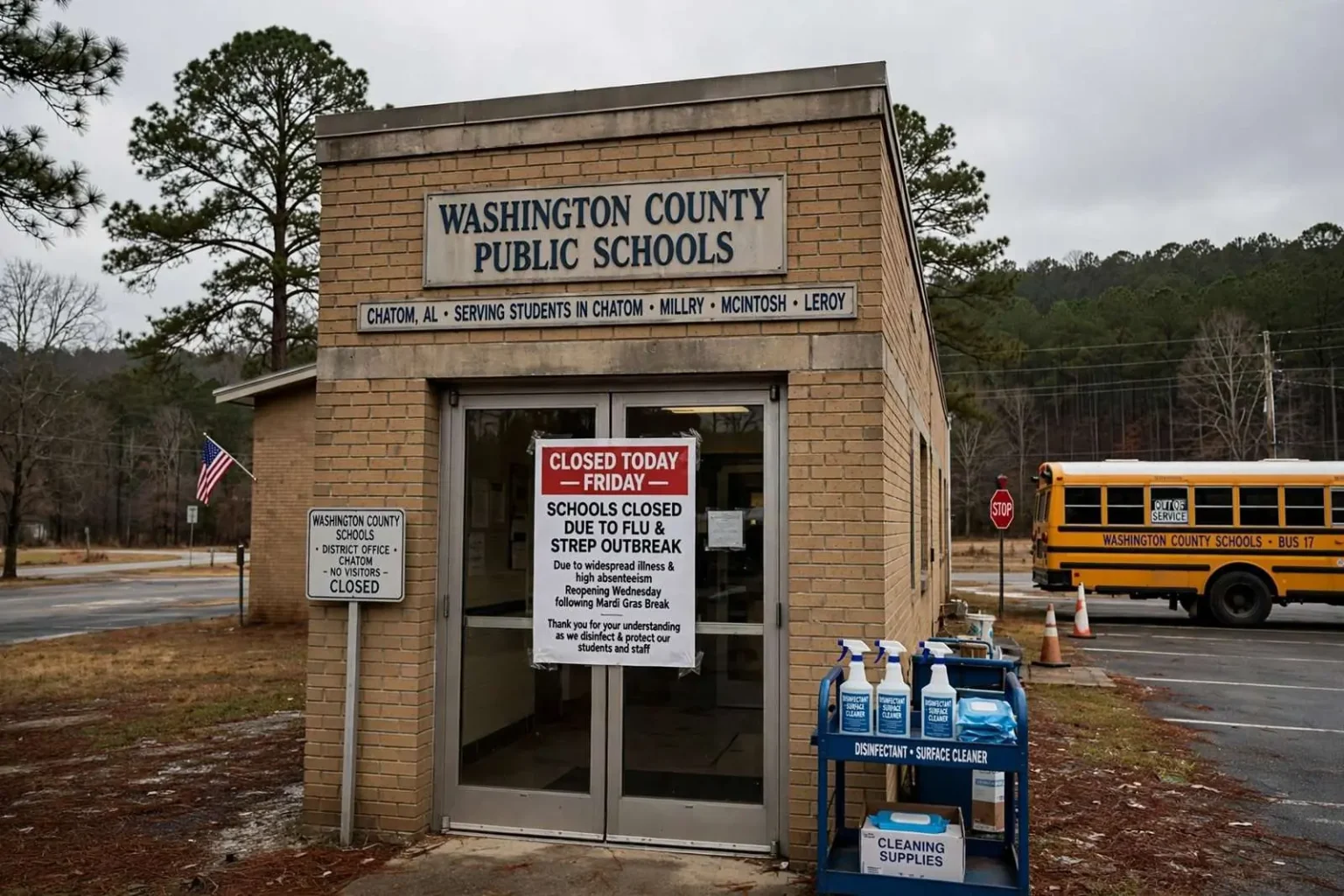
CHATOM, Ala. — Washington County Public Schools shut their doors Friday after a wave of flu and strep throat cases left classrooms across the rural county short on students and staff. District officials announced the closure that afternoon, citing an unusually large number of absences reported across the school system.
The decision to close an entire district is one school leaders rarely make, and it generally comes only when absenteeism reaches the point that instruction becomes impractical — when so many students and teachers are out that classes cannot function normally, and when bringing the healthy and sick together risks prolonging the outbreak. In announcing the Friday closure the same day it took effect, the district signaled both the speed of the outbreak and its reluctance to lose instructional time beyond what the illness itself demanded.
The district serves students in communities across Washington County, one of Alabama’s most sparsely populated counties, where the school system is headquartered in Chatom.
Geography shapes every operational decision in a district like this one. Washington County spreads across hundreds of square miles of rolling pine forest between Mobile and the Mississippi line, and its students depend on bus routes that can run long distances along rural highways to collect them each morning. Schools function as the social and civic anchors of small communities like Chatom, Millry, McIntosh and Leroy, and when campuses close, the effects reach beyond the classroom — into working parents’ schedules, school meal programs and the rhythm of small-town life.
In small, close-knit districts like Washington County’s, a contagious illness can spread quickly through grade levels and knock out both classroom attendance and bus routes at once.
The mathematics of a small district make outbreaks especially disruptive. A single elementary school may hold only a few hundred students, so a classroom of sick kindergartners or a flu-stricken wing of a high school represents a much larger share of the student body than the same outbreak would in a suburban system. Substitute teacher pools are thinner, meaning staff absences translate directly into merged classes or unfilled rooms, and when a bus driver is sick, an entire route of rural students may have no way to school at all.
Classes Resume After Mardi Gras Break
School leaders said they expect to reopen on schedule the following Wednesday, when the district’s Mardi Gras break ends.
The timing, while coincidental to the illness, worked in the district’s favor. Mobile-area school systems observe Mardi Gras as a school holiday, a tradition unique to the Gulf Coast where Carnival season is a genuine civic institution, and the scheduled break gave the district a ready-made buffer without extending the academic calendar.
The extended weekend gives custodial crews extra time to disinfect buildings and gives sick students and staff several additional days to recover before campuses fill up again.
Deep cleaning between school years is routine, but an outbreak-driven sanitizing pass is a different operation: cafeterias, gyms, libraries, computer labs and bus interiors all need attention, with particular focus on the high-touch surfaces — door handles, desks, railings, drinking fountains — where influenza and streptococcal bacteria pass most readily from one host to the next. influenza viruses can survive on hard surfaces for hours, and strep bacteria somewhat longer, so a multi-day gap between occupancy and return meaningfully breaks the chain of transmission within a building.
The extra days also serve the human side of the equation. Students with confirmed flu typically need five to seven days to fully recover, and strep infections, though quickly treatable with antibiotics, still send children home for a day or more after treatment begins. Staff follow the same timelines. A Friday closure bridging into a scheduled break meant most of the sick could convalesce without further lost instructional days on the back end.
Keeping Sick Children Home
Parents were notified of the closure through the district’s Facebook page.
The choice of channel reflects how rural districts now communicate. Social media reaches parents instantly and at no cost, and in communities where phone trees and notes in backpacks once carried every announcement, a district Facebook page functions as the modern equivalent — visible on phones, shareable between families, and archived for reference. For an unplanned closure announced the same day, it is often the fastest way to reach households before dismissal.
Health officials generally recommend that families treat feverish children at home until they have been fever-free for at least 24 hours, a practice that helps slow the spread of influenza and streptococcal infections through schools.
The 24-hour rule is the single most cited piece of advice in school outbreak control, and it exists because fever is the body’s clearest signal that an infection is still active. Children sent back too early — their symptoms masked by fever-reducing medication — remain contagious and can reseed an outbreak that a school has just cleared. Health providers add the same basics: frequent handwashing, covering coughs and sneezes, and not sharing water bottles or utensils, all of which matter more in a small building where students share everything from desks to gym equipment.
Flu Season’s Toll on Rural Districts
The mid-February closure landed at the peak of Alabama’s flu season, which typically stretches from late fall into early spring and hits school-age children hard. Statewide, schools routinely report attendance dips during peak flu weeks, and rural districts with limited substitute teacher pools often feel the strain more than larger city systems.
Alabama’s flu seasons vary in severity from year to year, but the pattern is dependable: activity builds through December, peaks in January and February, and lingers into March. School-age children are among the most efficient spreaders of influenza both because their immune systems are still building experience with circulating strains and because of the sheer closeness of classroom life — dozens of children sharing rooms, supplies and recess for hours at a day. When a aggressive strain circulates, schools are often the first place a community outbreak shows up, and attendance figures become a de facto public health dashboard.
Strep throat follows a similar seasonal rhythm and frequently rides alongside the flu in school outbreaks. The bacterial infection causes fever, sore throat and significant discomfort, and untreated cases can lead to more serious complications, which makes rapid diagnosis and treatment — and keeping diagnosed children home through their first day of antibiotics — part of the same containment playbook.
The Economics of a Rural Closure
For all its public health logic, closing a district carries real costs. Instructional time in Alabama is counted and prescribed, and days lost to illness must typically be made up or forgiven under state rules. Cafeteria staff prepare meals on projections that a closure upends. Federal and state funding formulas can hinge on average daily attendance, so a week of empty classrooms ripples into next year’s budgets. And for the working parents of rural counties — where commutes to jobs in Mobile, Jackson or across the state line can be long — a sudden extra day of childcare is a genuine hardship that district leaders weigh alongside the health risk.
That Washington County leaders judged the closure necessary anyway says something about the depth of the absences they were seeing. In a district where every percentage point of attendance is visible and staff coverage is tight, the calculus had evidently tipped: better to lose a planned Friday, disinfect during an already-scheduled break, and restart the following week with healthy students, staff and buses than to limp through days of half-empty classrooms while the outbreak found new hosts.
The episode is also a reminder of the region’s distinct school calendar. Gulf Coast districts that observe Mardi Gras break give their buildings an annual mid-winter airing that other Alabama systems do not get — and, as Washington County demonstrated this week, that scheduled pause can double as an outbreak firewall when the timing cooperates. Students across the county are expected back in class the following Wednesday, with their buildings cleaned, their classmates recovered, and the worst of the season’s wave hopefully behind them.
How Families Can Prepare for the Next Wave
Public health nurses and school officials across rural Alabama generally recommend that households keep a few fundamentals ready during peak season: a thermometer that works, a plan for who can stay home with a sick child, and a conversation with a family provider about whether flu antivirals are appropriate for high-risk members of the household. Annual flu vaccination remains the leading prevention measure health officials recommend, with the fall and early winter months identified as the ideal window so protection is in place before the January peak arrives.
Families can also watch for the warning signs that distinguish a routine case from one needing urgent care — difficulty breathing, persistent high fever, confusion, or a child who seems unusually listless — and schools typically ask parents to report diagnosed flu or strep cases to the front office, which helps administrators track the outbreak’s shape and make informed decisions about closures, cleanings and communications before absences mount beyond control.