Washington County students return to school with parents welcome back in classrooms
Washington County students returned to school with parents back in classrooms for the first time since 2019, a step toward normal after the pandemic.
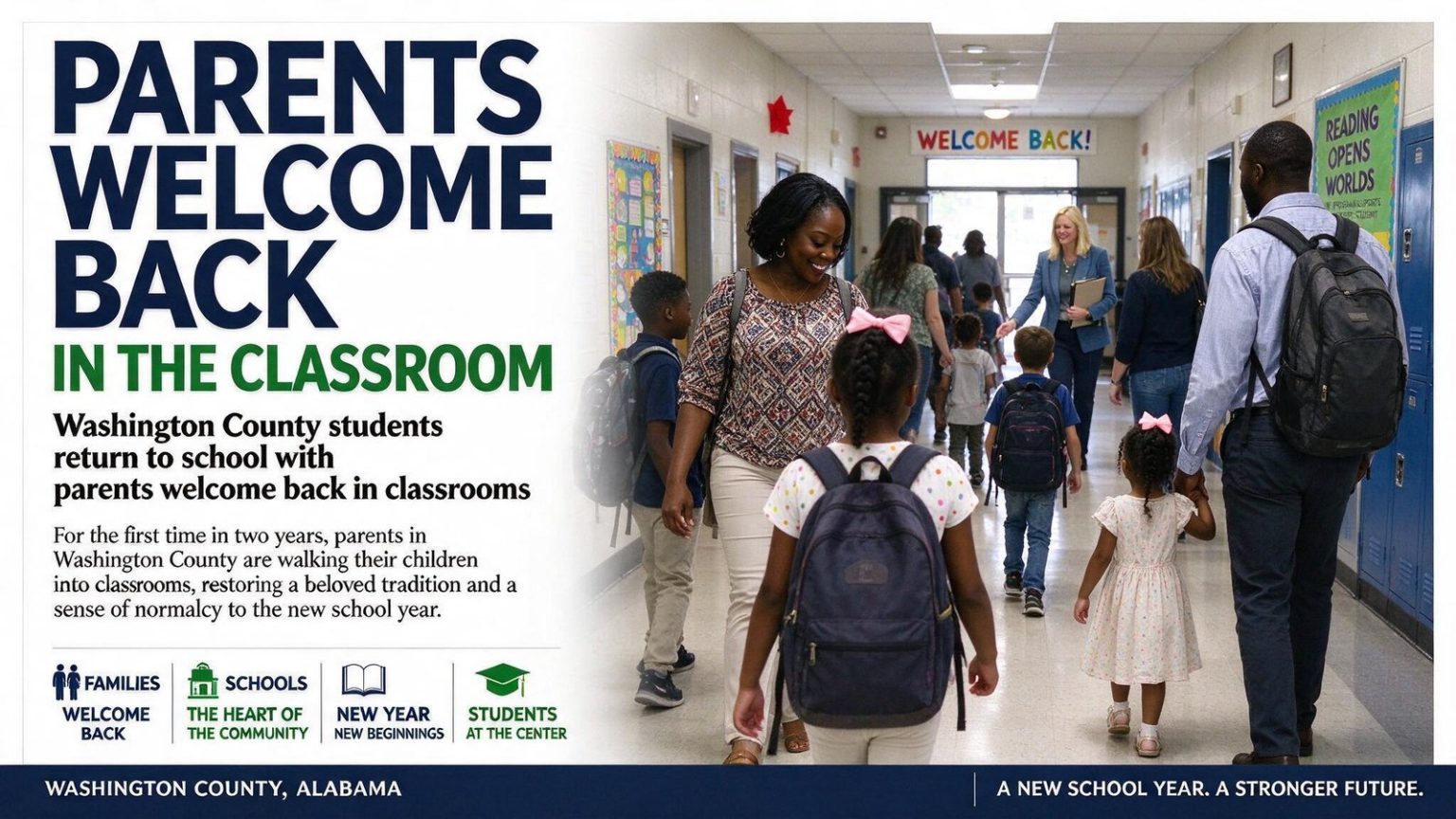
MCINTOSH, Ala. — For hundreds of children across Washington County, the first day of school this year felt almost like coming home. It is a school year closer to normal, with a tradition missing since the start of the 2019 school year back in place: parents were able to walk their kids into the classroom for the first time in two years. The sight of mothers and fathers escorting their children past the front office and down the hallways returned a rhythm to the first day that families across the rural county had gone without through the disruptions of the pandemic era.
“It’s very important for parents, they want to be here for the very first day and we want them here and haven’t had them here in two years and we welcome the parents being here today,” said Principal Edna Billingsley. Her welcome captured what school leaders across Washington County have emphasized about the return to normal operations: that the first day works differently, and better, when families are part of it.
Other highlights this year include a new reading program meant to help make up deficits brought on in part by virtual learning. School systems across Alabama and the nation have spent the years since 2020 measuring the academic slide that remote and hybrid instruction produced, particularly in early grades where reading foundations are built. Washington County’s answer is a concentrated push on literacy, the subject that research consistently identifies as the highest-leverage investment for elementary students.
The superintendent said the school system is 98% staffed as classes begin, a figure many systems across the state would envy. Rural districts have been hit especially hard by teacher shortages in recent years, with remote-tolerant jobs and higher-paying neighbors drawing certified educators away, so beginning a year nearly fully staffed gives Washington County a stability that translates directly into smaller class disruption and steadier instruction.
Schools as the Center of Rural Communities
Washington County is a wide, rural area, and the schools are often the central focus of their communities. In towns and crossroads communities across the county, from McIntosh to Chatom and Millry, the school is where Friday night football is played, where elections are decided, where churches and clubs meet, and where the county’s civic identity is formed generation after generation. When schools struggled through pandemic disruptions, the whole community felt it, and the return of first-day traditions is the kind of sign families have been waiting for.
Teachers were working Friday and some came in Sunday to get classrooms ready for Monday, the kind of off-contract effort that defines how rural faculties approach the opening of school. With small staffs and tight budgets, Washington County teachers have long worn many hats, and the weekend prep sessions before students arrived reflected both professional pride and the practical recognition that first impressions matter, for kindergartners seeing a classroom for the first time and for veterans returning to a more normal year.
The return of parents to the hallways is more than ceremony. Elementary principals across the country have described the first day as an emotional handoff, the moment when a family trusts a school with a child, and the walk-in tradition cements that trust in person. For the youngest students, having a parent beside them through the morning eases separation and sets a positive tone for the year. For parents, seeing the classroom, the teacher and the route their child will take builds the familiarity that turns into involvement, from PTO meetings to conferences, throughout the fall.
The two-year gap since the start of the 2019 school year meant that some families had never experienced a normal first day in the district at all. Children who started kindergarten remotely walked into a building this year as second graders, and parents who had only seen classrooms through a screen or a doorway during drop-off finally met teachers in person. Principals planned for those dynamics, and the emotional temperature of the first day reflected how much families had missed the ritual.
Reading Recovery After Virtual Learning
The new reading program arrives with urgency attached. Assessment data across Alabama showed the pandemic years widened gaps in early literacy, and the state’s Literacy Act framework has pushed districts to identify struggling readers early and intervene before third grade, when promotion decisions hinge on reading proficiency. A rural system like Washington County, with limited intervention staff spread across a wide geographic area, depends on structured programs that teachers can implement consistently in every school, which is what the new initiative is designed to provide.
Being 98% staffed changes what that reading push can look like. Intervention works best in small groups, and small groups require bodies in the building. A fully staffed roster lets principals schedule dedicated reading blocks without pulling teachers from other duties, keeps paraprofessionals assigned to the schools that need them, and reduces the churn of long-term substitutes that fragments instruction. Rural superintendents often spend the summer recruiting across county lines to reach that level of readiness, and the superintendent’s figure signaled that this year’s recruitment season succeeded.
Washington County’s geography shapes everything the district does. The county stretches across a broad swath of Alabama’s piney woods along the Mississippi line, with communities separated by miles of two-lane roads, and the school system operates as a network of small campuses rather than a few consolidated centers. Bus routes run long, and school events double as the social calendar for whole communities. That structure makes each school a local institution in its own right, with principals like Billingsley serving as civic leaders as much as administrators.
The county’s schools also anchor its economy in quiet ways, as among the largest employers in the area and the institutions most visible to families making decisions about whether to stay. A strong opening to the school year, with parents welcomed in, staffing nearly complete and a literacy plan in place, sends a message to those families that the district is moving forward. In a rural county, that message matters for enrollment, and enrollment drives funding.
The first day of school in McIntosh and across Washington County ended with the small logistics that mark a normal year returning: buses running their routes, cafeterias serving their first hot meals, playgrounds full at recess. Teachers who came in Sunday watched their preparation pay off, parents left with the reassurance of having seen where their children spend their days, and the year ahead, closer to normal than any since 2019, began the way Washington County’s school years traditionally have, with families and schools starting out together.
The Alabama Reading Initiative, the state framework under which districts have built their literacy efforts, emphasizes the science of reading: explicit, systematic instruction in phonics, phonemic awareness, vocabulary and comprehension, delivered by teachers trained in methods that decades of research support. Districts across the state have retrained faculties in these approaches, and Washington County’s new program aligns with that statewide push. For students whose early schooling was interrupted by virtual learning, the structured catch-up this year could determine whether they reach the third-grade reading benchmarks that Alabama’s law now requires.
The pandemic’s academic toll fell unevenly, and rural systems faced distinct challenges. Broadband gaps made virtual instruction spotty in stretches of the county where reliable internet remains scarce, meaning some students effectively lost far more instructional time than the calendar suggests. Teachers spent the past two years patching those gaps while managing normal classroom duties, and the new reading program formalizes the recovery effort, giving every school a common structure for identifying deficits and closing them.
First-day traditions like the parent walk-in also carry academic benefits that schools have come to appreciate. When families see the reading curriculum, the classroom libraries and the interventions in person, they are more likely to reinforce them at home, whether that means nightly reading time or simply asking the right questions about the school day. Rural schools often have strong family relationships to build on, since teachers and parents know each other from church, sports and community life, and the reopened doors of the first day reactivated those connections after two years of distance.
Principals across the county have described this year’s opening as a return to identity, a phrase that fits the place. Washington County’s schools have always functioned as the gathering points of their communities, and a first day that again welcomes parents restores not just a tradition but a partnership. The work ahead, closing reading gaps and sustaining near-full staffing through the year, will play out in classrooms across the county’s wide geography, but it began the way the county’s best school years have always begun, with teachers ready before the bell and families walking their children through the door.