
Washington Post Puts Fairhope’s ‘Utopia’ on the National Map
A Washington Post lifestyle feature dubbed Fairhope, Alabama utopia found on the coast, praising the Eastern Shore town and its famous alumni.
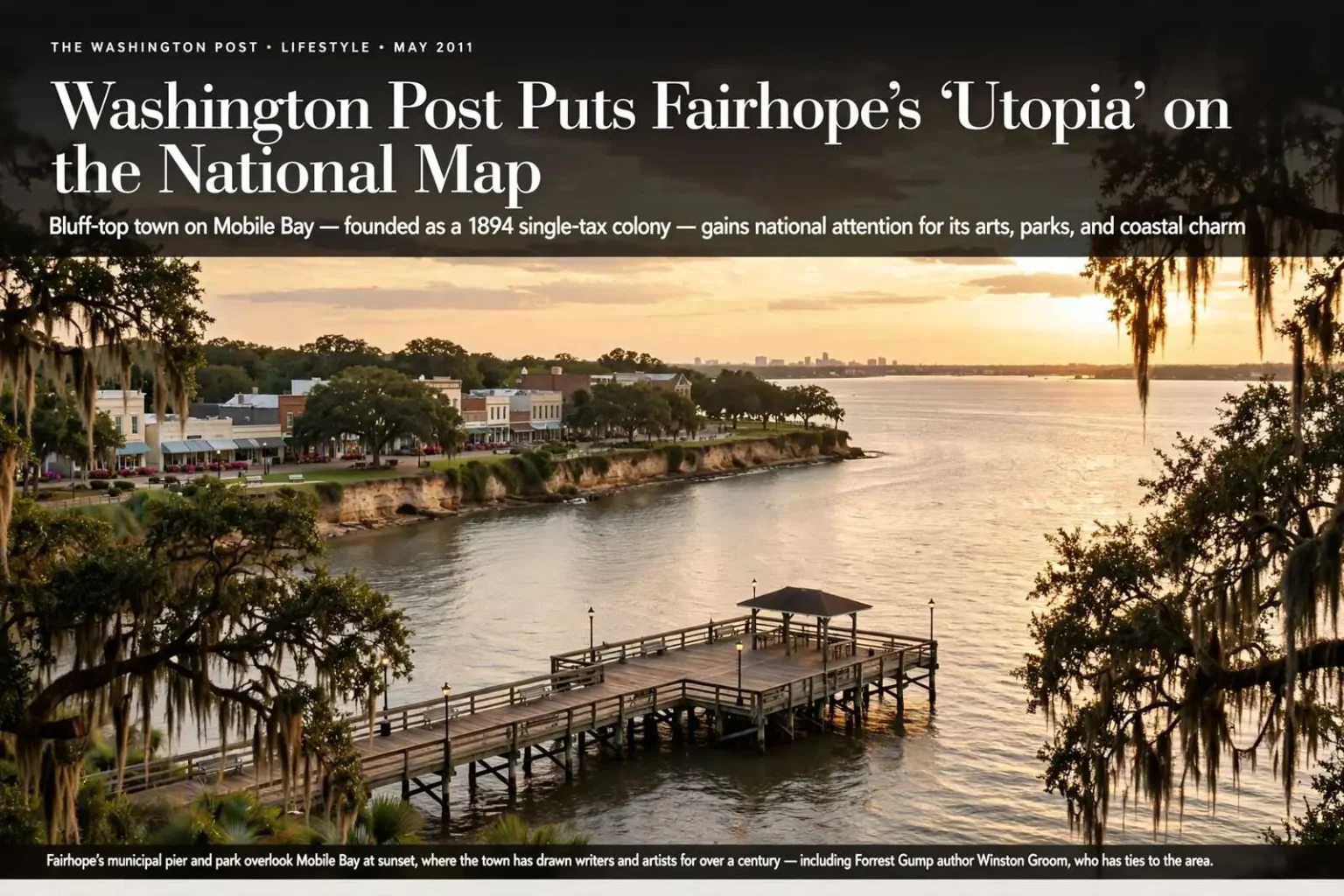
Fairhope has long been a point of pride on the Eastern Shore, and in May 2011 the town got a glossy national endorsement: a Washington Post lifestyle feature headlined “In Alabama, Utopia Found” that waxed poetic about the Baldwin County community. The piece described Fairhope as utopia lost and found on the coast of Alabama, painting a picture of a bluff-top town whose charm has drawn seekers for generations. For a town of a few thousand residents perched on the east bluff of Mobile Bay, the national attention was confirmation of a reputation built over more than a century.
The feature also name-checked some of Fairhope’s famous alumni, including author Winston Groom, adding literary weight to the town’s reputation. Groom, who grew up in Mobile and has deep ties to the Fairhope area, is best known as the author of “Forrest Gump,” the novel that became one of the most successful films in American history. A town that produces and attracts working writers has always worn that as a badge of honor, and the Post’s piece let the rest of the country in on what Gulf Coast readers already suspected.
Founded in 1894 as a single-tax colony, Fairhope has spent more than a century cultivating the mix of parks, storefronts and waterfront views that keeps landing it on national lists. For locals, the Post’s verdict merely confirmed what they already knew — it looks like utopia to them.
A town built on an idea
The single-tax colony that became Fairhope began with a group of settlers from the Midwest who were inspired by the economic writings of Henry George, the 19th-century reformer whose book “Progress and Poverty” argued that the value of land belongs to the community as a whole. The colonists purchased land on the high eastern bluff of Mobile Bay and established a corporation to hold it in trust, leasing plots to members while the land rent funded community improvements. They chose the name Fairhope because, as the story goes, they had a fair hope of success.
The experiment worked better than most utopian ventures of its era. While other intentional communities across the country rose and collapsed within a few years, the Fairhope Single Tax Corporation endured, and the town that grew around it became one of the most distinctive communities on the Gulf Coast. The colony’s early commitment to education, free thought, and public beautification left permanent marks: the town’s library, its parks, and its long tradition of attracting artists, writers, and free spirits all trace back to those founding ideals.
One of the most notable legacies is the School of Organic Education, founded in Fairhope in the early 1900s by educator Marietta Johnson. Her philosophy — that children learn best through experience and at their own pace, without the pressure of examinations — drew national attention and visitors from across the country, including the philosopher John Dewey. The school put Fairhope on the map decades before the Washington Post arrived, and it remains part of the town’s identity as a place that does things a little differently.
Geography as destiny
Fairhope’s setting does as much work as its history. The town sits on one of the highest bluffs along the eastern shore of Mobile Bay, high enough that its municipal park and pier look out over the entire sweep of the water, with the skyline of Mobile visible on the far horizon. That vantage point is the reason “bluff-top town” appears in nearly every description ever written about the place, including the Post’s. On a clear afternoon, the sunsets over the bay draw visitors to the pier and park long after the shops below have closed for the day.
The Eastern Shore itself — Fairhope, Daphne, and Spanish Fort strung along the bay’s eastern edge in Baldwin County — has been one of the fastest-growing regions of Alabama for years, drawing families and retirees who want coastal living with a small-town frame. Fairhope sits at the southern end of that corridor, and its downtown has managed a balancing act that few towns pull off: enough shops, restaurants, and galleries to justify a day trip, without losing the walkable, lived-in feel of a real community rather than a tourist strip.
Mobile Bay adds its own spectacle to the town’s appeal. The bay is famous for its jubilees — rare summer events when fish, crabs, and other sea life crowd into the shallow shoreline waters, and residents race to the beach with buckets and nets. The phenomenon, which tends to occur along the Eastern Shore, is one of the oddities of bay life that longtime residents recount for newcomers, and it reinforces the sense that Fairhope’s relationship with the water is closer than in most coastal towns.
Why the national spotlight keeps returning
The Washington Post was not the first national outlet to notice Fairhope, and it has not been the last. Towns of Fairhope’s size routinely appear in regional magazine rankings of best small towns, best places to retire, and best places to live on the water. The reasons are consistent across the lists: the parks, the pier, the flower-filled streets, the walkable downtown, and the arts community that has grown up around the town’s bohemian roots. What the 2011 feature added was the framing — utopia found — that connected the town’s present-day charm back to its founding ambition.
That framing resonates because Fairhope genuinely was founded as a utopian project. The colonists of 1894 did not set out to build a pretty tourist town; they set out to build a more just society, one land lease at a time. The beauty that visitors admire today — the parks, the public spaces, the waterfront access — flows directly from that founding structure, since the colony’s land rents were spent on community improvements from the beginning. The town’s good looks, in other words, are not an accident of geography but the visible result of a plan.
The literary thread the Post highlighted with Winston Groom runs deeper than a single name. Fairhope has housed and hosted a long line of writers over its history, a tradition that began when the colony’s founders deliberately courted artists and intellectuals. The town’s bookstores, its long-running writing community, and the quiet mornings on the bluff have made it a working environment for authors across generations. When a national feature needs evidence that a small Alabama town punches above its cultural weight, a single reference to Groom does a great deal of lifting.
What the coverage meant for the town
Features in major national newspapers carry real consequences for small communities. Visitors read them and plan trips; retirees read them and plan moves; real estate agents clip them. In Baldwin County, where growth pressures were already reshaping the Eastern Shore in the early 2010s, national praise for Fairhope added fuel to a town that was already one of the region’s most desirable addresses. Longtime residents have watched the town grow while debating how to hold onto the character that makes the lists in the first place — a debate as old as the colony itself.
The town’s response over the years has leaned on the tools its founders left behind. The Fairhope Single Tax Corporation still operates, still holds land, and still returns lease revenue to community purposes. The municipal park and pier remain publicly owned and free. Zoning and design review have aimed to keep downtown development in scale with the streets around it. None of that is glamorous, but it is the machinery by which a utopian experiment keeps its promises a century on.
For Eastern Shore readers, the pleasure of the Post’s piece was less in learning anything new than in seeing their town rendered faithfully for a national audience. The description of utopia lost and found on the Alabama coast captured the two halves of Fairhope that residents know well: a place born from a grand social idea, and a place that has settled comfortably into being simply a beautiful town on Mobile Bay. The founders would likely have recognized both.
National attention also lands on a town already well supplied with it by closer observers. Regional travel writers have long treated Fairhope as a staple subject, and Birmingham and Mobile outlets return to it each season for features on the arts festival circuit, the shops along Fairhope Avenue, and the descendants of colony families who still shape civic life. The 2011 Post feature joined that running catalog, distinguished mainly by its reach and by the confidence of its central metaphor — that a utopia imagined in 1894 had actually, in some usable sense, been built.
A century and a quarter after the first colonists climbed the bluff, Fairhope continues to collect endorsements the way its pier collects sunset photographers. The Washington Post’s 2011 verdict — utopia found — joined a long line of praise from visitors who arrived expecting an ordinary small town and left convinced they had found something rarer. Locals, as ever, were polite about it. They had a fair hope of that outcome all along.