Waterfront Rescue Mission Closed, Repairing Damage After Hurricane Sally
The Waterfront Rescue Mission in Pensacola remains closed as it repairs flood and mold damage from Hurricane Sally, leaving residents without shelter.
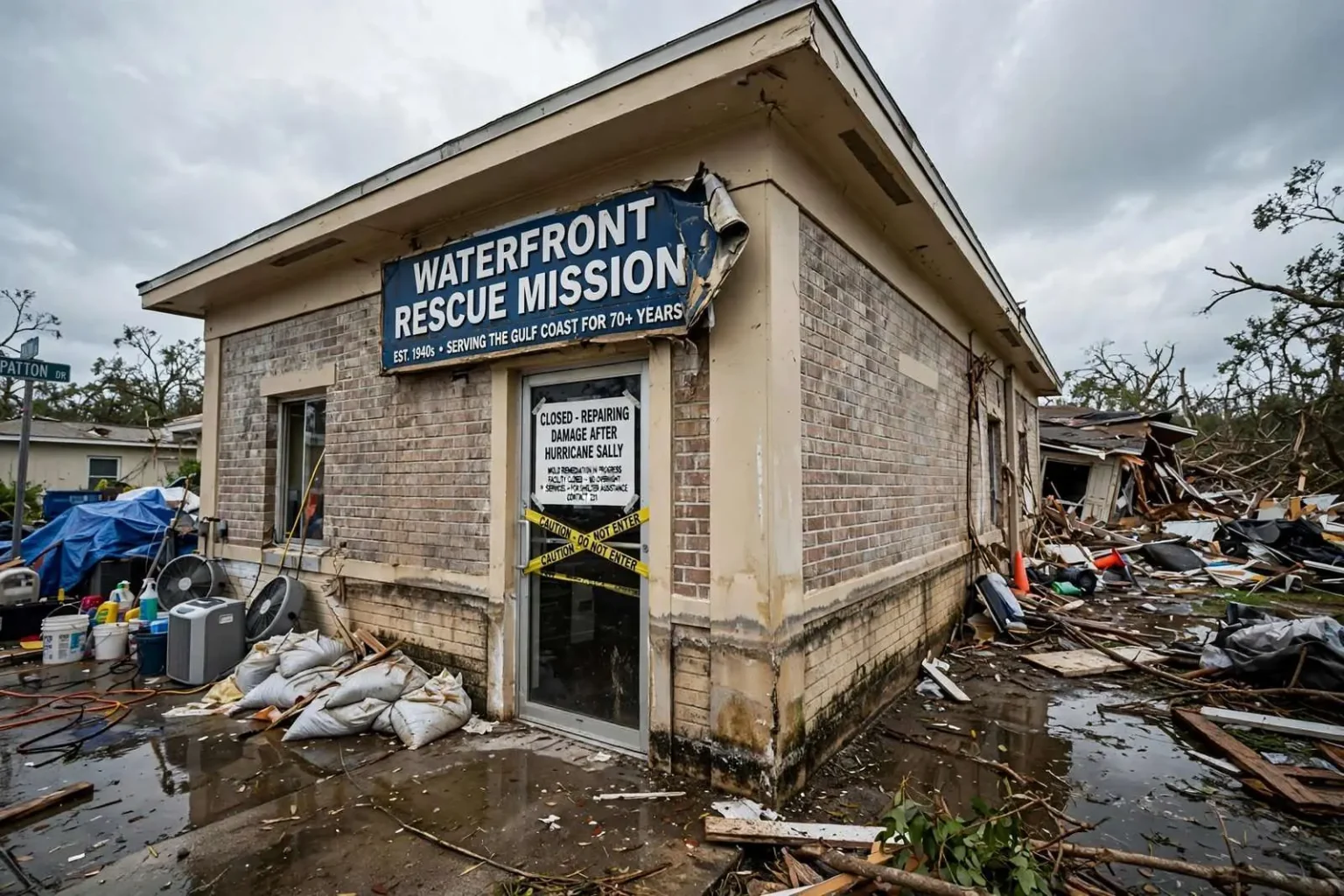
PENSACOLA, Fla. — More than two weeks after Hurricane Sally struck the Gulf Coast, cleanup continues at the Waterfront Rescue Mission on Patton Drive in Pensacola, leaving dozens of homeless people with nowhere to go. The shelter, a fixture of the city’s outreach to people living on the streets for more than seven decades, remains closed while crews work through flood-damaged buildings, and the closure has strained the network of agencies that serve the area’s most vulnerable residents.
Angie Ishee, senior vice president of public relations and development for the mission, walked through the buildings to show the damage left behind by the storm. What she found inside was a familiar post-hurricane scene playing out in slow motion: standing water that had long since receded, but the evidence of it still marked on the walls and beginning to turn into a larger problem.
“You can see where the water line was at about six inches in here, and you can see mold is starting to develop,” Ishee said. Six inches of floodwater may sound minor compared with the catastrophic surge that hit some coastal neighborhoods, but for an operation that depends on functioning buildings to deliver services every night, even that amount of intrusion was enough to force a complete shutdown of the affected facilities.
Three buildings at the Patton Drive campus were flooded in the storm, forcing everything inside them to be moved into the classroom building, which also sustained damage. The cascade effect is one that shelters across the hurricane-affected Gulf Coast have faced: when one structure fails, the contents and the people it served spill into others that were never designed to absorb the overflow. Staff have been operating out of compromised space while simultaneously managing the logistics of a disaster cleanup.
Outside, the wind left its own mark. The sign out front of the mission was damaged, and a backyard shed that covered the organization’s lawn equipment was destroyed, taking with it the tools staff and volunteers use for grounds maintenance. The losses are small compared with the flooding, but they compound the daily difficulty of keeping a large campus running while the main facilities are out of commission.
A Long History of Service on the Gulf Coast
For more than 70 years, the Waterfront Rescue Mission has provided overnight shelter for homeless men along with meals and other resources during the day for men, women and children. Founded in the 1940s, the organization has grown into one of the most established rescue missions on the Gulf Coast, serving Pensacola and communities across the region through a model that combines emergency shelter with longer-term support aimed at helping people rebuild their lives.
The mission’s daily work encompasses far more than a bed for the night. Guests receive meals, access to chaplaincy and counseling services, and help connecting with the documentation, employment opportunities and housing resources they need to move toward stability. For many of the men who stay there, the mission is the first step in a long road back — a place where immediate survival needs are met while the underlying causes of homelessness are addressed.
The closure has left many of those guests without a place to go. Dozens of people who relied on the mission for overnight shelter have been displaced into an uncertain landscape, and with other emergency resources across Pensacola County already stretched thin by the same storm, the loss of the mission’s beds has been felt throughout the community. Local outreach workers have had to scramble to find alternatives for people who would otherwise have had nowhere safe to sleep.
The timing could hardly be worse. In the weeks after a major hurricane, demand for shelter services typically rises rather than falls. Storm damage destroys housing stock at the low end of the rental market disproportionately, people who were already living paycheck to paycheck find themselves displaced, and the economic disruption pushes more families toward the edge. A community’s emergency shelter capacity is precisely the resource it cannot afford to lose in the weeks after landfall.
The Long Road to Reopening
Ishee said the team is working quickly but must first eliminate the mold before reopening, a constraint that reflects the reality of post-flood remediation. Mold begins to colonize wet building materials within 24 to 48 hours, and once it takes hold inside walls, flooring and HVAC systems, it cannot simply be painted over or wiped away. Professional remediation requires removing affected drywall and materials, drying the structure thoroughly, and treating surfaces before rebuilding can begin.
For a shelter serving a vulnerable population, the standards are even more demanding. Guests at a rescue mission include elderly individuals and people with chronic health conditions, respiratory illnesses and compromised immune systems — precisely the people most susceptible to the health effects of mold exposure. Rushing a reopening before the environment is truly clean would put that population at risk, so the mission is balancing urgency against the medical realities of its guest population.
“Whatever we can do as quickly as possible to get our homeless guests back in, that is our goal,” Ishee said. Her words capture the tension every disaster-affected service organization faces: the pressure to restore operations is enormous, but the work cannot be shortcut without undermining the mission itself. Every day of closure is a day of unmet need, yet reopening too early would mean exposing guests to unhealthy conditions.
The Waterfront Rescue Mission situation illustrates a broader pattern that emerges after every major Gulf Coast hurricane. Headlines focus on coastal condominiums, beach roads and tourist infrastructure, but the storm’s longest-lasting damage often falls on the community organizations that serve people with the fewest resources. A flooded shelter does not generate the same urgency as a closed bridge, yet for the people who depend on it, the impact is just as absolute.
Recovery in the wake of a storm like Sally is measured in months, not days, for organizations like the mission. Insurance claims, contractor availability and the sheer volume of construction demand across the hurricane-affected region all slow the pace of repair. In the meantime, the mission’s staff continue their work as best they can — distributing meals, coordinating with other agencies, and planning for the day the buildings can safely reopen their doors to the people who need them most.
Hurricane Sally’s Lasting Mark on the Gulf Coast
Hurricane Sally made landfall along the Gulf Coast in mid-September as a slow-moving Category 2 storm, and its leisurely pace turned out to be its defining characteristic. Rather than sweeping through quickly, Sally crawled inland at a speed that allowed historic rainfall totals to accumulate, dumping more than two feet of rain in some areas of the western Florida Panhandle and southern Alabama. The result was widespread inland flooding that caught many residents off guard even as they prepared for wind damage.
Pensacola was among the hardest-hit communities. The storm’s winds and floodwaters damaged thousands of structures across the city and surrounding Escambia County, knocked out power to hundreds of thousands of customers across the region, and left debris-choked streets that took weeks to clear. Bridges and coastal roads sustained serious damage, and neighborhoods far from the waterfront found themselves flooded by rainwater that had nowhere to drain.
The slow tempo of Sally’s destruction is central to understanding why organizations like the Waterfront Rescue Mission are still dealing with the aftermath more than two weeks later. Flooding damage reveals itself gradually: water that enters a building wicks up into drywall, soaks insulation, saturates flooring and settles into every cavity and crawl space. In the days after the water recedes, the visible mess is only the beginning, as moisture trapped in the structure gives rise to mold colonies that spread behind walls and under floors.
Across the Panhandle and south Alabama, churches, nonprofits and community organizations stepped into the gap left by the storm, organizing donation drives and coordinating with emergency management officials to house and feed people displaced by the hurricane. The weeks after landfall tested the region’s social infrastructure as thoroughly as the storm tested its physical infrastructure, and the continued closure of a major shelter illustrates how long that test lasts for the organizations on the front lines.
What the Closure Means for Homeless Services in Pensacola
The loss of the mission’s beds ripples through the entire local service network. When a large shelter goes offline, people who would have slept there turn to other options: car parks, encampments, the homes of acquaintances, or whatever other arrangements they can make. Outreach workers and other providers absorb as much as they can, but emergency capacity in any community is finite, and the margins are thinnest for the people with the greatest needs.
Escambia County’s homeless service providers have spent years building a coordinated system designed to move people from the streets into shelter and from shelter into permanent housing. That system depends on each organization doing its part, and when one of the largest pieces of it goes dark, the entire pipeline slows. People who might have entered the mission and begun working toward stability instead remain in crisis, and the longer the displacement lasts, the harder the eventual restart becomes.
The mission’s leadership has emphasized that the goal remains a full return to operations as quickly as safety allows. The mold remediation and repair work underway on Patton Drive represents the necessary path back, and every step of cleanup brings the reopening closer. Supporters of the organization have rallied around the need, recognizing that the mission’s restoration is not just a building project but the restoration of a lifeline for dozens of people.
For now, the people who depended on the Waterfront Rescue Mission wait — in the places they have found since the storm, in the care of other agencies, and in the hope that the buildings on Patton Drive will soon be dry, clean and open again. The storm took a great deal from the Gulf Coast, and the full accounting includes places like this one: quiet, essential institutions whose loss is measured not in dollars but in nights without shelter.
As cleanup continues and the mission works through the stages of assessment, remediation and repair, the organization has asked the community for patience and support. The path from a flooded shelter back to full operations is neither quick nor simple, but it is well understood, and the staff’s determination to reopen has not wavered. For the homeless men, women and children of Pensacola, that determination is the most important construction project in the city.