
Westbound Bayway Crash Blocks Lane, Backs Up Mobile Morning Commute
A westbound crash blocked a lane on the Bayway about two miles past Exit 35, backing up Mobile's morning commute by two miles.
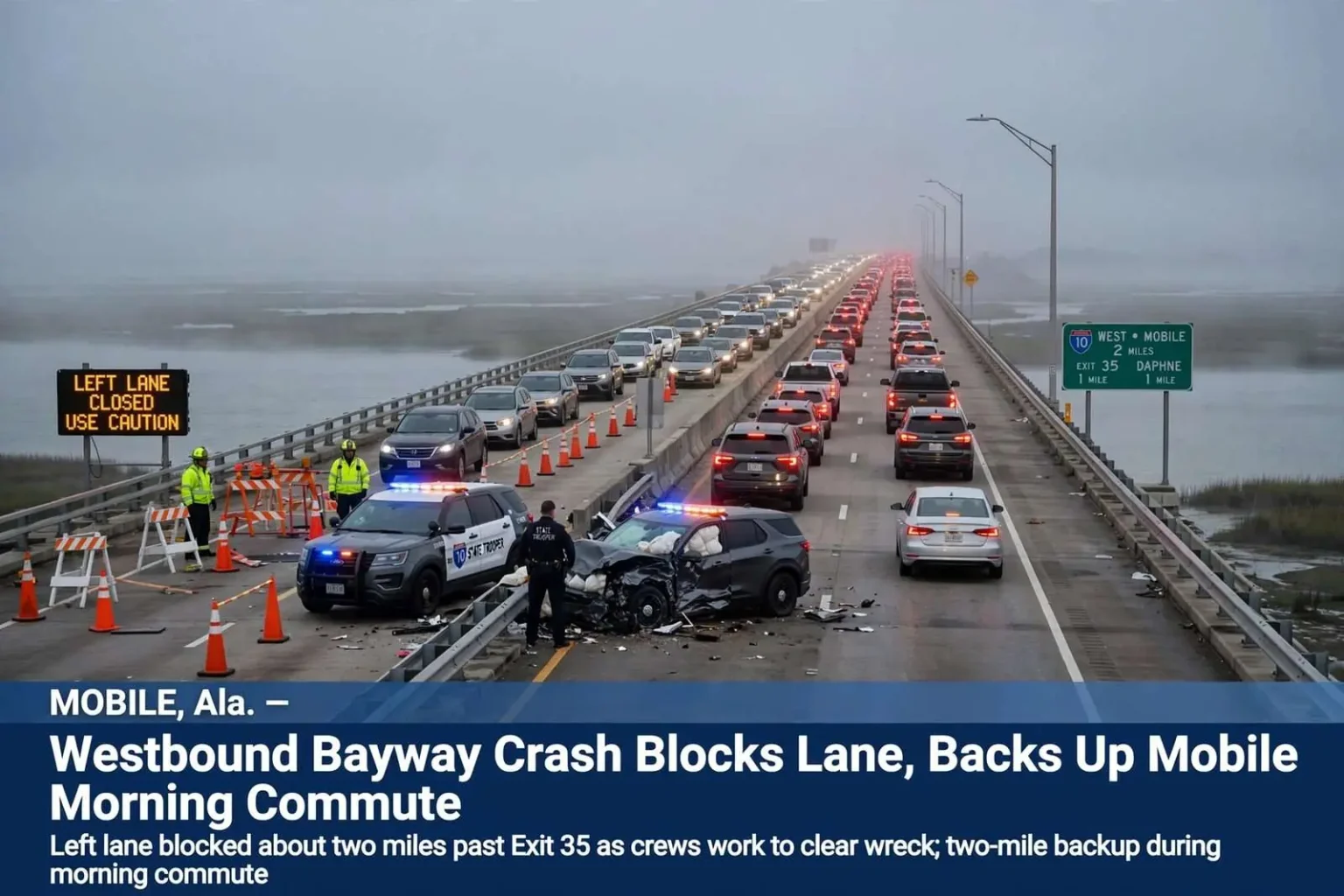
MOBILE, Ala. — Drivers heading into downtown Mobile ran into delays Thursday morning after a crash on the westbound Bayway. The accident left the left lane blocked about two miles past Exit 35, with traffic backing up for roughly two miles behind the scene during the height of the morning commute. Motorists were advised to use caution when passing through the area while crews worked to clear the roadway.
The Bayway — the long, low crossing of Mobile Bay that carries Interstate 10 between Baldwin and Mobile counties — is one of the most consequential stretches of highway on the Gulf Coast, and it is also one of the most fragile when something goes wrong. With only two travel lanes in each direction and shoulders that offer little room to maneuver, a crash that blocks even a single lane instantly halves the roadway’s capacity. Thursday’s incident, with the left lane shut about two miles past Exit 35, produced a backup of roughly two miles during the very hours when the bridge carries its heaviest load of commuters heading to work in Mobile.
Exit 35 serves the Daphne area on the Baldwin County side, and the location of the wreck placed it squarely on the eastbound approach to the bay crossing, where traffic coming from Daphne, Fairhope, Spanish Fort, and points east converges into the bridge’s tight footprint. Drivers behind the scene found themselves crawling across miles of open water with no exit available until they reached the Mobile County side, a frustration familiar to anyone who commutes the Bayway regularly.
Why a single blocked lane snarls an entire morning
Traffic engineers describe the mathematics bluntly: an interstate lane can move roughly 2,000 vehicles per hour under good conditions, and the Bayway’s westbound lanes routinely run near capacity during the morning peak. When a crash removes one of the two lanes, every vehicle that would have used it must merge into the remaining lane, and the merging itself slows traffic further as drivers brake, yield, and jockey for position. The result is a standing wave of congestion that builds far faster than it dissipates — hence a two-mile backup for what crews hoped would be a relatively quick clearance.
The physical setting makes it worse. The Bayway is a low-level bridge across open water, exposed to wind, fog, and rain, with no parallel routes for most of its length. Unlike a surface street network, where drivers can turn onto a parallel road to get around a wreck, Bayway traffic is committed: once a vehicle passes the last exit before the span, the only way out is across. That is why incidents on the bridge produce such outsized delays relative to their size, and why law enforcement and the Alabama Department of Transportation respond to them as emergencies even when injuries are minor.
Thursday’s timing compounded the disruption. The morning commute between Baldwin County and Mobile is a daily migration — thousands of workers, students, and freight vehicles cross the bay before 8 a.m. — and backups that form during that window tend to persist well past the moment the roadway is cleared, because the queue of waiting vehicles takes its own time to drain even at full capacity.
The Bayway and the geography of the Mobile commute
The crossing local residents call the Bayway is formally the Jubilee Parkway, a bridge-and-causeway structure completed in the late 1970s as part of the Interstate 10 crossing of Mobile Bay. It runs roughly eight miles across the northern lip of the bay, connecting the Baldwin County mainland to the Mobile County side, where I-10 continues through the George Wallace Tunnel under the Mobile River and into downtown. For commuters from Daphne, Spanish Fort, Fairhope, Loxley, and the fast-growing subdivisions beyond, the Bayway is the front door to Mobile’s job market.
That daily dependency explains why Thursday’s lane blockage mattered so broadly. Baldwin County has been one of the fastest-growing counties in Alabama for years, and much of its growth has been fueled by people who live on the eastern shore and work in Mobile. Every added household along the U.S. 98, Alabama 181, and State Highway 181 corridors translates into more vehicles crossing the Bayway each morning, on a bridge that has not gained a lane since it opened.
Alternatives exist but are distant. The Cochrane-Africatown USA Bridge on U.S. 90, north of I-10, and the Interstate 65 crossing far to the north can serve as workarounds in extremis, but both require long detours that erase any time savings except in a total closure. For most drivers Thursday, the practical choice was simply to wait, creep through the open lane, and lose the time.
Driving the Bayway safely
Safety officials offer advice specific to bridge driving that applies directly to mornings like Thursday’s. Slow down in wind and fog, which the open-water span concentrates. Leave generous following distance, since rear-end collisions are the most common crash type in stop-and-go bridge traffic. Stay off the phone, keep an eye on the road far ahead for brake lights, and use the left lane only for passing, since it is the lane where crashes most often block traffic entirely.
Drivers involved in a minor wreck on the bridge face a dilemma familiar to responders: staying in a travel lane to exchange information worsens the congestion and the danger, but leaving the scene raises legal complications. The practical guidance from troopers is to move vehicles to the shoulder or off the bridge entirely when the vehicles are drivable and no one is hurt, then exchange information and call police — a practice Alabama traffic law accommodates for minor collisions.
For those planning a Bayway crossing, real-time traffic tools have become an essential part of the routine. Navigation apps flag slowdowns and crashes quickly, and the Alabama Department of Transportation posts alerts for major incidents and closures on I-10. Drivers who saw the two-mile backup forming Thursday morning had the same options commuters have always had: wait it out, reroute at cost, or — for the flexible — shift their crossing earlier or later until the roadway was clear.
After the scene is cleared
Once crews removed the wreck and reopened the left lane, the Bayway’s westbound traffic gradually returned to its normal morning rhythm. The queues dissolved in the order they had formed, with the last delays clearing well after the crash scene itself was gone — a characteristic of bridge commuting that regulars on the route know to expect.
Thursday’s incident was, in the end, a routine event on a road that sees hundreds of thousands of crossings a week: a crash, a blocked lane, a slow crawl across the bay, and a reminder of how narrow the margin is on the Gulf Coast’s most important bridge. For the drivers who sat in it, the morning was lost; for the region, it was one more data point in the long-running conversation about I-10, the Bayway, and the growing traffic between Alabama’s two shores.
Motorists crossing the bay in the coming days can expect the usual pattern — heavy westbound flow through the morning and a heavy eastbound return in the evening — and the usual advice applies. Check conditions before you leave, slow down on the open water, move over for anyone stopped on the shoulder, and remember that on a bridge with no exits, the cheapest safety measure is simply a little more space between you and the car ahead.
Clearing a crash on the Bayway
Responding to a wreck on the bridge requires coordination among several agencies. State troopers and local police manage traffic and investigate the cause, fire and rescue units handle injuries and hazards such as fuel spills, and highway department crews deal with debris, damaged barriers, and lane closures. On a bridge with narrow shoulders, response vehicles often have to park in travel lanes themselves, further constricting the flow until the scene is cleared.
Crews Thursday worked to clear the roadway while traffic was advised to use caution through the area. The advisory to slow down is not mere formality: the approach to any crash scene is a danger zone for both the people involved and the responders working outside their vehicles. Secondary crashes — collisions caused when drivers do not slow or merge properly near an existing wreck — are a persistent hazard on interstates, and they are one of the leading causes of injuries to police, firefighters, and tow operators nationwide.
Alabama’s move-over law applies on scenes like Thursday’s, requiring drivers to change lanes away from stopped emergency and utility vehicles or, when they cannot, to slow well below the posted speed while passing. On a two-lane bridge with the left lane already blocked, that typically means a careful pass in the open lane at reduced speed, with full attention on the roadway rather than the wreckage.