When Grocery Shelves Go Empty, Mobile’s Pollman’s Bake Shop Keeps the Ovens Running
As Mobile grocery stores sell out of bread during the 2020 stockpiling rush, Pollman's Bake Shop bakes extra loaves daily for hospitals and churches.
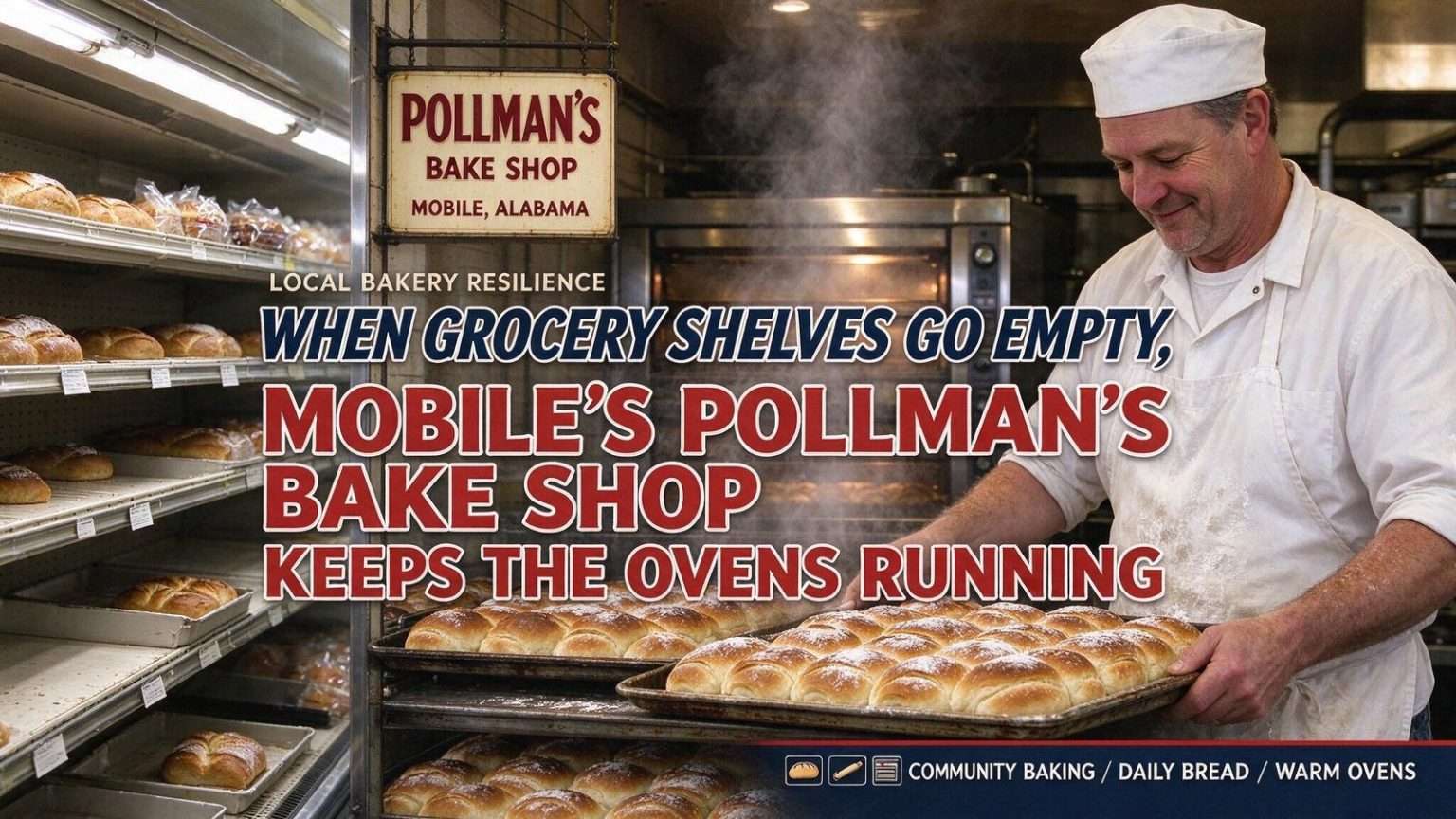
MOBILE, Ala. — When bread shelves across Mobile County grocery stores emptied out in late March 2020 amid the first wave of pandemic stockpiling, one of the most reliable places to find a fresh loaf turned out to be a local institution: Pollman’s Bake Shop.
The Mobile bakery has kept its ovens running at full tilt, baking loaves daily and ramping up production to meet demand from customers who struck out at the supermarket. While national distribution chains scrambled to refill warehouses and restock store shelves, a neighborhood bakery with ovens a short drive from its customers kept turning out bread the old-fashioned way — a batch at a time, every day.
Store manager Joanna Hernandez said the surge in orders has come from some unexpected places, including area hospitals. “Mobile Infirmary has been buying like 10 loaves every day,” Hernandez said.
Churches have also been placing larger orders for wheat bread so they can distribute loaves to members of their congregations who need it. For congregations that suspended in-person services and organized food distributions instead, a dependable source of bread became part of how they cared for members who were elderly, immunocompromised or suddenly out of work.
The Panic Buying That Emptied the Shelves
The shortages that sent Mobile County shoppers hunting for bread began within days of the first widespread pandemic closures. As offices, schools and restaurants shut down, households that once relied on cafeteria lunches and restaurant dinners suddenly cooked every meal at home, and grocery demand spiked across every aisle — but nowhere more visibly than the bread rack, where a day’s delivery could vanish by mid-morning.
The emptiness on the shelves was not truly a shortage of bread. It was a logistics mismatch: industrial bakeries produce and ship on schedules built for predictable demand, and no schedule had predicted this. Trucks kept rolling, but the system’s buffer — the extra pallets, the shelf stock, the warehouse inventory — drained faster than replenishment could arrive.
That gap is where a local bakery occupies different ground. Pollman’s bakes and sells within the same metropolitan area, a supply chain measured in miles rather than shipping lanes. There are no distant plants to wait on, no distribution centers rationing cases across three states. The flour arrives, the mixers run, the ovens fire, and the loaves go out the door the same day.
A Generation-Old Institution
For generations, Pollman’s has been part of Mobile’s food landscape. The bakery’s roots trace to a family baking tradition carried from German bakeries to the Gulf Coast, and its loaves, cakes and pastries have anchored birthdays, holidays and ordinary weeknight dinners across Mobile County for more than six decades.
Institutions like Pollman’s occupy a particular place in a city’s memory. Generations of Mobilians grew up on the same bread their parents bought, and the bakery’s counters have served everyone from families marking milestones to restaurants and churches that count on its ovens week after week. That accumulated loyalty matters in a crisis: when the shelves went bare, customers did not have to be told what a local bakery was — they already knew where the door was.
The bakery’s daily production rhythm, built around freshness rather than shelf life, turned out to be an asset precisely when the industrial system strained. Bread that travels long distances is baked to last; bread that travels a few miles is baked to be eaten, and the difference showed up on Mobile tables during a week when the supermarket option was an empty shelf.
Hospitals, Churches and the New Bread Run
The orders Hernandez described reveal how demand reshaped itself during the shutdown. Hospitals such as Mobile Infirmary, feeding staff working long shifts through a public health emergency, added a daily bread order — 10 loaves a day — that had not existed weeks earlier. Institutional kitchens that might once have drawn on broader supply arrangements found a dependable partner across town.
Churches became another unlikely distribution channel. With services suspended, congregations organized food pickups and deliveries to vulnerable members, and wheat bread — durable, familiar, versatile — became a staple of those boxes. A bakery that had sold to families at the counter was suddenly feeding outreach programs, one large order at a time.
The pattern repeated across the country during the pandemic’s early weeks: the customers who kept small bakeries, dairies and farms solvent were often institutions responding to the emergency, not just households cooking at home. For a business whose survival depends on volume, those daily hospital and church orders were the difference between ramping up and shutting down.
What Shopping Local Means in a Crisis
Beyond keeping bread on the table, shopping at a neighborhood bakery during the shortage has a second benefit: it channels support to a small local business at a time when many are struggling. Every dollar spent at a local bakery largely stays local — paying bakers and counter staff, buying supplies from regional distributors, supporting the utility and service businesses around it.
The pandemic’s early months delivered a brutal test to small food businesses everywhere. Restaurant closures wiped out wholesale accounts, foot traffic evaporated, and owners faced stark choices about staffing. A bakery whose product remained in demand was fortunate; one whose customers chose to seek it out during the shortage was fortunate twice over.
For generations, Pollman’s has been part of Mobile’s food landscape, and its ability to bake fresh daily means supply lines measured in miles rather than shipping lanes — an advantage when national distribution chains are strained. The bakery’s managers have framed the moment simply: as long as demand stays high, they will keep the loaves coming, one batch at a time.
Lessons From the Empty-Shelf Spring
The bread run of late March 2020 taught Mobile County something about its own economy that ordinary weeks never reveal. The region’s food supply, it turns out, has layers — the industrial network that fills supermarkets, and the local network of bakeries, dairies and producers that operates quietly underneath. The first layer cracked under the sudden strain. The second, smaller and closer, kept working.
Public officials and economic developers have long made the case for local food systems on the grounds of resilience, but abstract arguments rarely persuade the way an empty shelf does. When a household cannot find bread at any of three supermarkets, the bakery six blocks away stops being a nostalgia item and becomes infrastructure.
The episode also highlighted the adaptability of small food businesses. Ramping up production means more than baking more: it means adjusting ingredient orders, hours and staffing on short notice, all while protecting the workers who keep the ovens running through a public health emergency. That the bakery managed the surge while feeding hospitals and church outreach programs speaks to the operational muscle behind what looks, from the counter, like a simple neighborhood shop.
Keeping the Ovens Running
For the bakery’s staff, the days of the shortage ran long and hot — mixers running before dawn, racks of loaves moving from oven to cooling rack to customer, and a phone taking orders from accounts that had never called before. Customers who found the supermarket bare learned the bakery’s schedule and built their errands around it.
The broader lesson for the Gulf Coast may outlast the shortage itself. A community’s ability to weather a crisis — a pandemic, a hurricane, a supply chain breakdown — depends partly on the businesses that produce what people need close to home. Mobile’s port brings the world to its doorstep, but in the spring of 2020, the bread on many tables came from an oven across town.
As long as demand stays high, the bakery says it will keep the loaves coming, one batch at a time — a small promise that, on the empty-shelf days of a pandemic spring, meant a great deal to a county of households and the institutions caring for them.
Regular customers describe the shop’s role in Mobile life in generational terms — the birthday cakes ordered by mothers who once stood in line with their own mothers, the holiday pastries that appear on church tables and office break rooms each December, the loaves that make it home still warm. That kind of accumulated trust cannot be manufactured, and it is why the bakery became a destination the week the shelves went bare.
The surge also brought new faces through the door. Shoppers who had driven past for years without stopping became regulars during the shortage, and many of those first-time customers kept coming back after the supermarkets recovered — the kind of customer discovery that marketing budgets rarely buy and a crisis can deliver overnight.
For the Pollman’s family and staff, the spring of 2020 now sits in the shop’s long history alongside the other moments when the ovens mattered — the hurricane seasons when fresh bread became scarce along the Gulf Coast, the holidays when orders outgrew the racks. The bakery endured those stretches by doing what it does every day: baking, steadily, for the city that has kept it in business for generations.